In the realm of industrial automation, the reliability and precision of sensing components are paramount. The E2B-M18KN10, a cylindrical inductive proximity sensor from Omron's E2B series, stands as a quintessential example of engineering designed for demanding environments. This M18-threaded sensor is a non-contact switching device that detects the presence of metallic objects, primarily ferrous metals like iron and steel, through electromagnetic induction. Its robust construction and consistent performance make it a staple in machinery, conveyor systems, and automated assembly lines.
The core operational principle of the E2B-M18KN10 is based on a high-frequency oscillating circuit. The sensor face contains a coil that generates an alternating electromagnetic field. When a metallic target enters this detection field, eddy currents are induced on the target's surface. This causes a change in the oscillation amplitude within the sensor's circuit. An integrated evaluation circuit detects this damping effect and triggers a solid-state output switch. The "KN" in its model number typically denotes a normally open (NO) output configuration with a 3-wire DC configuration (brown: +V, blue: 0V, black: output). The standard sensing distance for this model is 10mm, a critical specification that ensures repeatability and prevents mechanical collision.
Key technical specifications define its application scope. It operates on a 10-30V DC supply, making it compatible with standard industrial control voltages. The output is typically an NPN transistor sink type, though PNP versions are available in the series. Its switching frequency is sufficiently high for most high-speed counting or positioning tasks. A notable feature is its embedded protection circuits against short-circuit, reverse polarity, and surge voltages, significantly enhancing its longevity in electrically noisy industrial settings. The housing, usually constructed from nickel-plated brass or stainless steel, offers an IP67 degree of protection. This rating signifies complete resistance to dust ingress and the ability to withstand temporary immersion in water, allowing deployment in washdown areas or outdoor installations.
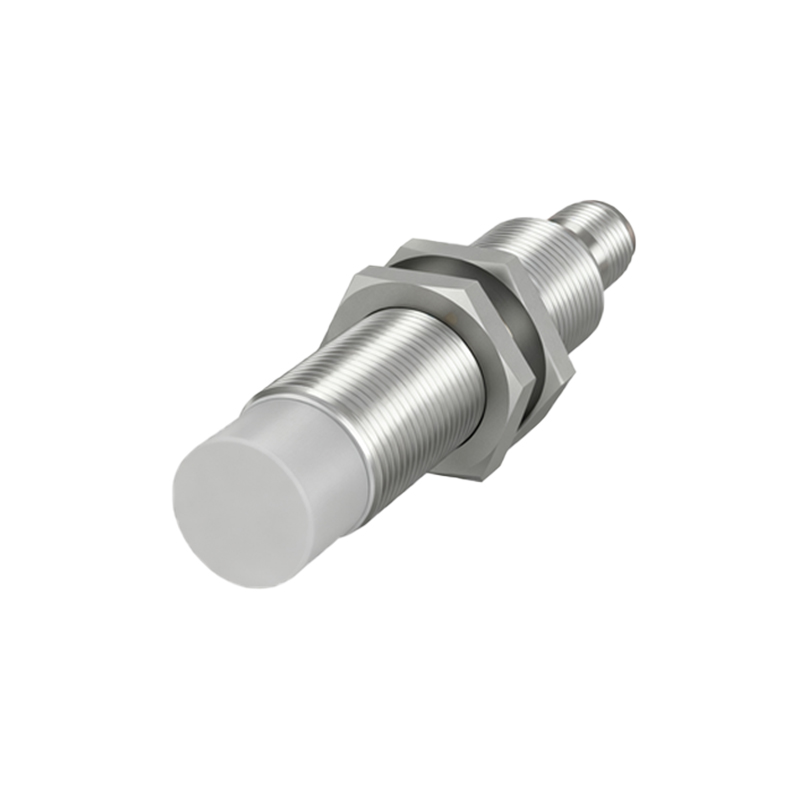
Installation and wiring are straightforward but require attention to detail for optimal performance. The M18 thread allows for easy mounting using standard locknuts. It is crucial to maintain the recommended lateral and axial spacing between multiple sensors to prevent mutual interference. The sensing face must be kept clear of any accumulations of metal dust or swarf, which could cause false triggering. For wiring, adhering to the color code is essential: connect the brown wire to the positive DC supply, the blue wire to the negative/common, and the black output wire to the PLC input or relay. Always refer to the official datasheet for the specific wiring diagram of your purchased variant.
The application versatility of the E2B-M18KN10 is extensive. Common uses include position detection of machine parts, such as confirming the presence of a cylinder in the retracted or extended position. It serves as an end-of-travel limit switch for moving platforms or slides without physical contact, eliminating mechanical wear. On conveyor lines, these sensors count metallic products, detect jams, or sort items. In robotic cells, they provide reliable feedback for arm positioning. Their ruggedness also makes them suitable for harsh environments like stamping presses or welding stations, where durability is non-negotiable.
When selecting a sensor for a task, comparing the E2B-M18KN10 with alternatives is prudent. Compared to capacitive or photoelectric sensors, its detection is exclusive to metals, which is an advantage in environments with non-metallic debris. Within the inductive proximity family, factors like sensing distance (5mm, 8mm, 10mm models), housing material (stainless steel for corrosive settings), and output type (NPN vs. PNP) guide the final choice. The E2B-M18KN10 offers a balanced profile of standard range, robust build, and proven reliability.
For maintenance, regular inspection is recommended. Check the housing for physical damage and ensure the sensing face is clean. Verify the electrical connections for corrosion or looseness. Performance can be validated by observing the sensor's indicator LED while introducing a standard target at the specified sensing distance. Should failure occur, common troubleshooting steps involve checking power supply voltage, load compatibility, and for the presence of surrounding metal that might be influencing the magnetic field.
In conclusion, the Omron E2B-M18KN10 inductive proximity sensor embodies a fusion of robust mechanical design, stable electrical performance, and application flexibility. Its widespread adoption across industries is a testament to its ability to provide accurate, maintenance-free detection in challenging conditions. By understanding its specifications, proper installation procedures, and typical applications, engineers and technicians can leverage this component to enhance the efficiency and reliability of their automated systems, ensuring seamless operation in the backbone of modern manufacturing.