Laser technology has become a cornerstone of modern science and industry. At the heart of any laser system lies a critical parameter: its wavelength. Precise knowledge and control of this wavelength are essential for countless applications, from manufacturing to telecommunications. This is where laser wavelength sensors, also known as wavelength meters, come into play. These sophisticated instruments are designed to measure the wavelength of laser light with exceptional accuracy and reliability.
The fundamental principle behind most high-precision laser wavelength sensors is interferometry. A common technique utilizes a Michelson or Fizeau interferometer. In such a device, the incoming laser beam is split into two paths. One beam travels a fixed reference distance, while the other reflects off a moving mirror. When the beams recombine, they create an interference pattern—a series of bright and dark fringes. By analyzing this pattern as the mirror moves, the sensor can calculate the wavelength with extreme precision, often down to parts per billion. Another widespread method, particularly for pulsed or rapidly tuning lasers, is based on diffraction gratings. The grating disperses different wavelengths at different angles, and a detector array, such as a CCD or CMOS sensor, captures this dispersed light. The position of the light spot on the array is directly correlated to the wavelength. Grating-based sensors often offer a favorable balance of speed, robustness, and accuracy for many industrial and research settings.
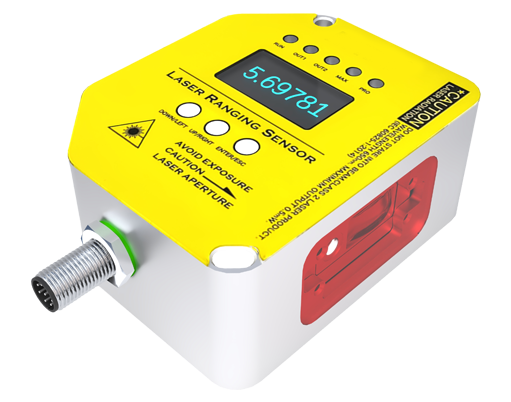
The applications for laser wavelength sensors are vast and varied. In telecommunications, they are indispensable for monitoring and stabilizing the wavelengths of lasers in dense wavelength-division multiplexing (DWDM) systems, ensuring that dozens of data channels do not interfere with each other. In semiconductor manufacturing, excimer lasers used for photolithography must maintain a specific wavelength to achieve the ever-shrinking feature sizes on microchips; wavelength sensors provide the necessary real-time feedback for control systems. In scientific research, particularly in spectroscopy and atomic physics, the exact wavelength of tunable lasers is critical for probing molecular structures or exciting specific atomic transitions. Furthermore, in the medical field, sensors help calibrate surgical and cosmetic lasers, ensuring they operate at the prescribed wavelength for safe and effective treatment of tissues.
Selecting the right laser wavelength sensor requires careful consideration of several key parameters. First and foremost is the required accuracy and resolution. Laboratory experiments in metrology may demand sub-picometer accuracy, while an industrial process monitor might only need ±0.01 nm. The wavelength range is equally crucial; a sensor must be compatible with the laser's output, whether it's in the ultraviolet, visible, or infrared spectrum. Measurement speed is another critical factor. A sensor for a rapidly scanning laser or for monitoring pulsed lasers needs a high acquisition rate, often provided by grating-based designs. For continuous-wave (CW) lasers where stability is the goal, a slower but more accurate interferometric sensor might be preferable. Other practical considerations include power handling capability, sensitivity (minimum detectable power), physical footprint, and ease of integration with existing control software.
Modern advancements continue to push the boundaries of laser wavelength sensor technology. Developments in integrated photonics are leading to miniaturized, chip-based sensors that could be embedded directly into laser packages. Enhanced algorithms and machine learning techniques are improving the speed and accuracy of data analysis from interferometric fringes or detector arrays, even in noisy environments. There is also a growing trend toward multi-channel sensors capable of monitoring several laser lines simultaneously, a feature highly valuable in complex experimental setups or multi-laser industrial stations.
In conclusion, laser wavelength sensors are not merely measurement tools; they are enabling technologies that ensure precision, stability, and repeatability across a broad spectrum of high-tech fields. By providing a definitive answer to the question "What is the wavelength?", they form a critical feedback loop that allows for the advanced control and innovation that modern laser applications demand. Whether ensuring the integrity of global data networks or enabling the next breakthrough in quantum computing, these sensors play a quiet yet vital role in the technological landscape.