In the realm of industrial automation and precision measurement, laser sensors stand as a cornerstone technology. Their ability to provide non-contact, high-speed, and highly accurate detection has revolutionized processes across manufacturing, logistics, and quality control. However, the true potential of a laser sensor is unlocked not just by its hardware, but by the intelligent selection and application of its operational modes. Understanding these modes is critical for engineers and system integrators to optimize performance for specific tasks. This guide delves into the primary laser sensor modes, their underlying principles, and their ideal use cases.
The most fundamental distinction lies between diffuse reflection mode and retro-reflective mode. In diffuse reflection mode, the sensor emits a laser beam towards the target. The target diffusely reflects a small portion of this light back to the sensor's receiver. This mode is highly versatile and common, suitable for detecting objects at varying distances without the need for a separate reflector. Its performance is heavily influenced by the target's color, surface texture, and material. Light-colored, matte surfaces provide a strong return signal, while dark or shiny surfaces can absorb or specularly reflect the beam away, potentially causing detection failures. Engineers must carefully consider these factors and often rely on background suppression techniques within this mode to ignore distant objects or the background.
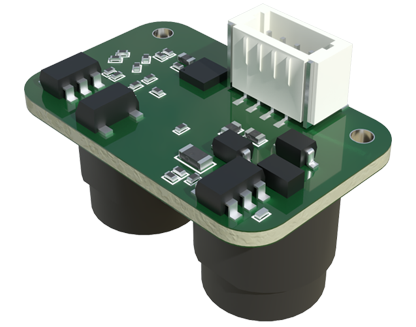
Retro-reflective mode, on the other hand, employs a separate retro-reflector (corner cube reflector) positioned opposite the sensor. The sensor's emitted beam travels to this reflector and is bounced directly back along the same path to the receiver. An object interrupting this beam path is detected. This mode offers a much longer sensing range compared to standard diffuse mode and provides a very stable, strong signal, making it largely immune to the target's surface properties. It is the preferred choice for long-range detection, presence sensing on conveyor lines, or safety light curtains. A key feature is the use of a polarizing filter; the sensor emits polarized light, and the receiver has a filter for the orthogonal polarization. The retro-reflector depolarizes the light, allowing it to pass the receiver's filter. This clever design prevents the sensor from being fooled by shiny, mirror-like objects that might reflect light without depolarizing it.
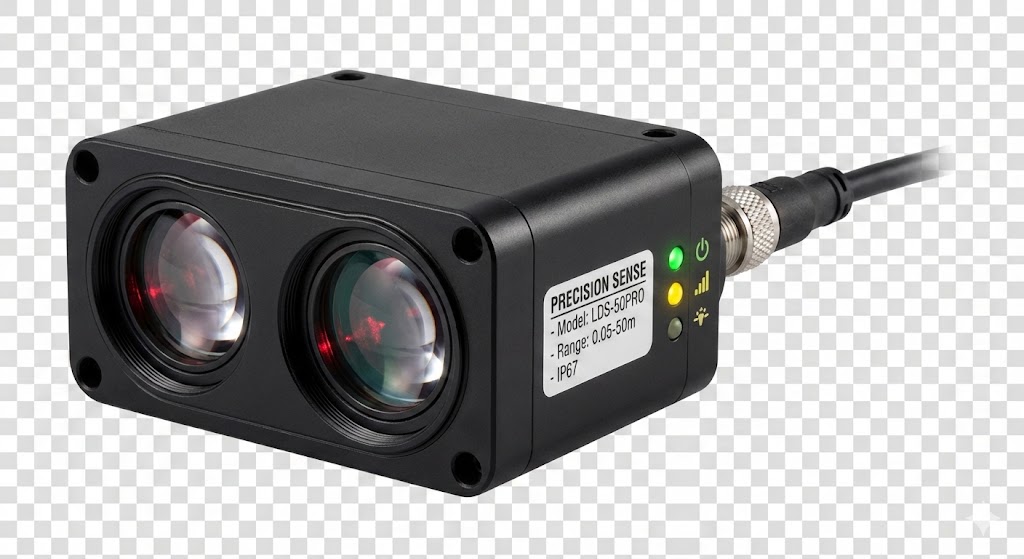
For the highest precision in distance or position measurement, thru-beam mode (also known as opposed mode) is the gold standard. This configuration uses two separate units: a laser emitter and a receiver placed in direct opposition. Detection occurs when an object breaks the beam between them. This mode achieves the longest possible range, the highest excess gain (signal strength), and the most reliable detection of very small or low-contrast objects. It is indispensable in applications like counting极小 parts, verifying component presence in assembly, or as a high-reliability trigger for inspection systems. While it requires careful alignment of two devices, its performance benefits are often unmatched.
Beyond these core detection modes, modern laser sensors integrate sophisticated measurement modes. Distance-measuring mode utilizes principles like triangulation or time-of-flight (ToF). Triangulation sensors project a laser spot onto the target, and the position of the reflected spot on a receiver array (like a CCD or PSD) changes with the target's distance. This allows for precise, continuous distance measurement, used in profiling, thickness gauging, and level detection. ToF sensors measure the round-trip time of a laser pulse, calculating distance based on the speed of light. They are excellent for longer ranges, such as in logistics for volume measurement or vehicle detection.
Background suppression (BGS) and foreground suppression (FGS) are intelligent sub-modes, typically within diffuse reflection sensors. BGS allows the sensor to ignore objects beyond a user-defined limit, detecting only objects within a specific window. This is perfect for detecting objects on a conveyor while ignoring the factory floor behind it. Conversely, FGS ignores very close objects, sensing only those beyond a set point. This can be used to detect when a tray has been emptied, ignoring the near side of the container.
Selecting the correct mode is a systematic process. Key decision parameters include: required sensing range, target characteristics (size, color, material, surface), environmental conditions (ambient light, dust, vibration), required precision (simple presence vs. exact distance), and installation constraints. For instance, a packaging line detecting glossy plastic bottles might opt for a retro-reflective sensor with polarizing filter, while a robotic bin-picking cell would require a distance-measuring triangulation sensor to locate parts in 3D space.
In conclusion, laser sensors are far from simple on/off devices. Their various operational modes—diffuse, retro-reflective, thru-beam, and specialized measurement and suppression modes—provide a toolkit for solving complex industrial challenges. Mastery of these modes enables engineers to design more robust, accurate, and efficient automated systems, pushing the boundaries of productivity and quality assurance in modern industry. Regular consultation with sensor datasheets and application engineers is recommended to match the perfect sensor and mode to the task at hand.