In the realm of industrial automation, laser sensors have become indispensable tools for precise object counting across various applications, from production lines to logistics sorting. Their ability to deliver high-speed, non-contact, and reliable detection makes them superior to traditional mechanical or photoelectric methods. But how exactly do these sophisticated devices perform counting tasks? The process fundamentally relies on the principles of laser triangulation, time-of-flight (ToF), or laser reflection modulation, depending on the sensor type and application requirements.
At its core, a counting operation using a laser sensor involves detecting the presence or absence of an object as it passes through a defined detection zone. The most common approach utilizes a through-beam or retro-reflective laser sensor setup. In a through-beam system, a laser emitter and a separate receiver are positioned opposite each other. The laser beam projects continuously from the emitter to the receiver. When an object passes through the beam, it interrupts the light path, causing the receiver to detect a loss of signal. This interruption is registered as a count pulse by the sensor's internal circuitry or an external counter/PLC (Programmable Logic Controller). Retro-reflective models work similarly but use a single unit that emits laser light toward a reflector; the object breaks the reflected beam to trigger the count.
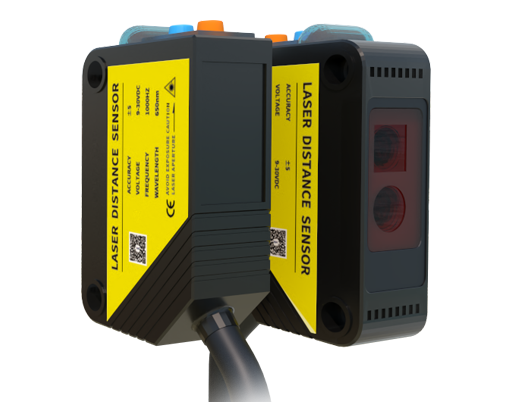
For more precise applications requiring distance information or profile detection, laser measurement sensors based on triangulation are employed. These sensors project a laser spot onto the target object. The reflected light is captured by a receiving element (like a CCD or PSD) at a specific angle. As the object's position changes, the position of the light spot on the receiver shifts. The sensor's processor calculates the distance or height based on this geometric triangulation. In counting scenarios on conveyor belts, this can distinguish between overlapping items or count objects based on height profiles, preventing double counts that simple beam-break methods might miss.
Time-of-Flight (ToF) laser sensors represent another advanced technology for counting, especially useful for larger detection ranges or bulk material applications. They measure the time it takes for a laser pulse to travel to the target and back. By setting specific distance thresholds, the sensor can detect when an object enters and exits a virtual "window" in space. Each entry-exit sequence is logged as a single count. This method is highly effective for counting boxes on a pallet or objects passing through a large gate without requiring precise beam alignment.
The integration of laser sensors with counting systems extends beyond simple interruption detection. Modern intelligent laser sensors come equipped with built-in functions for batch counting, rate calculation, and even data communication via IO-Link, Ethernet/IP, or Profinet. For instance, a sensor can be programmed to output a signal after a pre-set number of counts is reached, triggering a diverter arm or packaging machine. To ensure accuracy in high-speed environments, sensors feature adjustable response times and hysteresis settings to filter out vibrations or minor fluctuations.
Key factors influencing counting accuracy include the sensor's response speed, the object's size and surface properties, environmental conditions, and the spacing between objects. A fast-response laser sensor can distinguish between rapidly successive items, while a sensor with a small, focused beam spot is ideal for counting small components. Challenges like transparent objects (e.g., glass bottles) or highly reflective surfaces are addressed using specialized sensors with background suppression or polarized filters that ignore stray reflections.
In practice, setting up a laser sensor for counting involves careful positioning, alignment, and parameter configuration. The detection beam must be perpendicular to the object's path, and the sensing distance must be within the sensor's specified range. Sensitivity adjustments prevent false triggers from dust or ambient light. Regular maintenance, such as lens cleaning, ensures long-term reliability. As Industry 4.0 advances, laser sensors are increasingly part of networked systems, providing real-time count data to MES (Manufacturing Execution Systems) for production monitoring and analytics.
From bottling plants and electronic assembly to warehouse automation, the precision of laser sensor counting directly impacts efficiency, inventory accuracy, and quality control. Their versatility and evolving intelligence continue to push the boundaries of what automated systems can achieve, making them a cornerstone of modern industrial measurement and control.