Proximity ultrasonic sensors represent a cornerstone of modern industrial automation, offering non-contact detection capabilities with exceptional precision and reliability. These sensors operate by emitting high-frequency sound waves and analyzing the reflected signals to determine the presence, distance, or position of objects. Unlike optical or inductive sensors, ultrasonic variants are largely unaffected by target material, color, or transparency, making them versatile across diverse environments—from manufacturing lines to harsh outdoor settings.
One defining characteristic is their extended sensing range, which can span from a few millimeters up to several meters, accommodating both near-field and far-field applications. This flexibility allows a single sensor type to handle tasks as varied as liquid level monitoring in tanks and precise object positioning on conveyor belts. Moreover, ultrasonic sensors exhibit strong resistance to environmental interference such as dust, smoke, or ambient light, ensuring stable performance where other sensor technologies might falter. Their ability to detect virtually any solid or liquid material—regardless of surface texture or reflectivity—adds to their robustness in complex industrial scenarios.
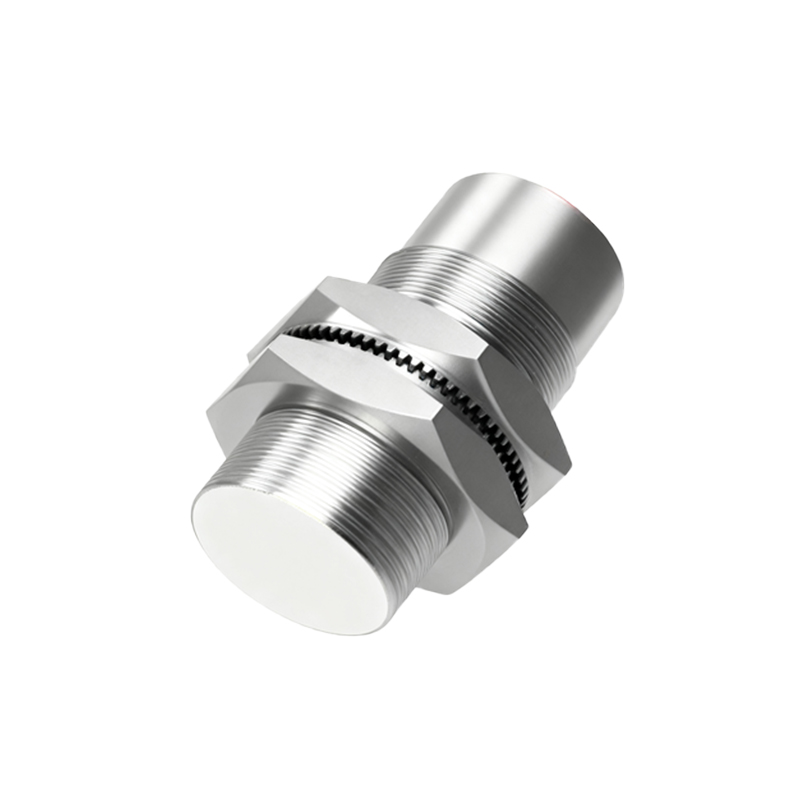
Another notable feature is the adjustable sensing window, which enables users to define specific detection zones. This programmability minimizes false triggers by ignoring objects outside the set range, enhancing system efficiency. Many models also incorporate temperature compensation circuits to counteract the effects of thermal variation on sound speed, maintaining accuracy across fluctuating operational conditions. The output options are equally adaptable, with configurations supporting analog voltage/current signals, discrete switching signals, or digital communication protocols like IO-Link for seamless integration into smart factory networks.
Durability is a key design focus. Industrial-grade ultrasonic sensors are typically housed in rugged, IP67-rated enclosures that withstand moisture, vibration, and chemical exposure. Their self-cleaning capability—where vibrations prevent debris accumulation on the transducer surface—reduces maintenance needs and prolongs service life. Additionally, advanced models feature diagnostic functions that alert operators to potential issues like signal degradation or misalignment, supporting proactive maintenance and minimizing downtime.
In practice, these sensors excel in applications requiring precise distance measurement or presence detection without physical contact. Examples include loop control in winding machines, height detection in robotic pick-and-place systems, and fill-level control for transparent or foamy liquids. As Industry 4.0 evolves, ultrasonic sensors are increasingly embedded with IoT connectivity, enabling real-time data analytics and predictive maintenance. Their combination of versatility, resilience, and precision solidifies their role as indispensable components in automated systems, driving efficiency and innovation across sectors from automotive to food processing.