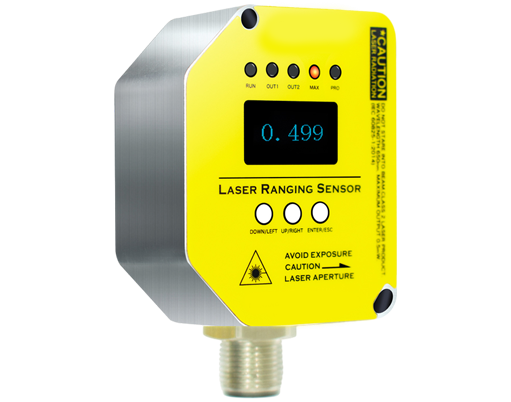
Serial communication serves as a fundamental interface for laser sensors in industrial automation, enabling precise data exchange between the sensor and control systems. This article delves into the technical aspects, common protocols, and best practices for implementing serial communication with laser sensors.
Laser sensors, widely used for distance measurement, object detection, and positioning, rely on serial communication to transmit measurement data, configuration parameters, and status information. The most prevalent serial interfaces in industrial laser sensors include RS-232, RS-422, and RS-485, each offering distinct advantages based on application requirements. RS-232 is suitable for short-distance, point-to-point connections, typically within 15 meters, with simple wiring but limited noise immunity. In contrast, RS-422 and RS-485 support longer distances (up to 1200 meters) and multi-drop networks, making them ideal for harsh industrial environments where electromagnetic interference is a concern. Many modern laser sensors also incorporate TTL-level serial or USB-to-serial adapters for compatibility with embedded systems and PCs.
The communication protocol defines the data format, baud rate, parity, and stop bits, ensuring reliable data transmission. Common protocols include ASCII-based commands, Modbus RTU, and proprietary formats from manufacturers like Keyence, SICK, or Banner. For instance, a typical laser sensor might use ASCII strings such as "MES" to trigger a measurement and return a value like "+0123.45mm" over serial. Modbus RTU, a binary protocol, is favored in PLC-integrated systems for its efficiency and standardization. Configuring the correct baud rate—from 9600 to 115200 bps or higher—is critical to match the sensor and host device, avoiding data corruption. Parity settings (none, even, or odd) and stop bits (1 or 2) add error-checking layers, though many industrial setups default to 8 data bits, no parity, and 1 stop bit (8N1) for simplicity.
Implementing serial communication requires attention to wiring, grounding, and software handling. For RS-485 networks, termination resistors at both ends prevent signal reflections, while shielded twisted-pair cables reduce noise. Engineers must ensure proper power supply isolation to avoid ground loops, which can cause communication failures. On the software side, host systems use serial libraries or dedicated drivers to send commands and parse responses. A common workflow involves initializing the sensor with setup commands (e.g., setting measurement units or output intervals), then periodically reading data streams. Timeout handling and checksum verification are essential for robustness, especially in real-time applications where sensor data drives automated decisions.
Challenges in serial communication with laser sensors include latency, data integrity, and compatibility. High-speed applications may require optimized baud rates and buffer management to prevent data loss. In noisy environments, protocols with error correction or redundant transmission can enhance reliability. Additionally, integrating sensors from different vendors may demand custom parsing logic due to protocol variations. Best practices involve thorough testing with tools like serial monitors or oscilloscopes to validate signal quality and response times. Documentation from sensor manufacturers often provides detailed command sets and example code, accelerating deployment.
As Industry 4.0 advances, serial communication remains relevant due to its simplicity and cost-effectiveness, though Ethernet-based options like EtherNet/IP or PROFINET are gaining traction for higher-speed networks. For many laser sensor applications—such as conveyor belt monitoring, robotic guidance, or quality inspection—serial interfaces offer a proven, low-latency solution. By understanding the technical nuances, engineers can leverage serial communication to maximize sensor performance, ensuring accurate and reliable data flow in industrial systems. In summary, mastering serial communication with laser sensors involves selecting the right interface, configuring protocols precisely, and adhering to industrial standards for seamless integration.