In the realm of industrial automation and control systems, the reliability and precision of sensing components are paramount. Among these, the three-wire proximity sensor stands as a cornerstone, and the PT12-T08N0 model exemplifies the engineering excellence required for demanding applications. This article delves into the technical specifications, operational principles, installation considerations, and typical use cases for this specific sensor, providing a detailed resource for electrical engineers and technicians.
The PT12-T08N0 is a cylindrical, inductive proximity switch with a threaded M12 housing and an 8mm sensing distance. Its three-wire configuration is standard for DC sensors, typically comprising connections for positive supply voltage (brown wire), negative/ground (blue wire), and the switched output signal (black wire). This model commonly features a normally open (NO) output, meaning the switch closes and allows current to flow when a metallic target enters its detection range. The output type is crucial; it is often a solid-state NPN or PNP transistor switch, providing fast, bounce-free operation ideal for high-speed counting or positioning tasks. Engineers must verify the specific datasheet for the output configuration (NPN sinking or PNP sourcing) to ensure proper integration with the programmable logic controller (PLC) or other control circuitry.
Operationally, the sensor functions on the principle of electromagnetic induction. An internal oscillator generates a high-frequency electromagnetic field emanating from the active face of the sensor. When a ferrous or non-ferrous metal target enters this field, eddy currents are induced in the target, causing a change in the oscillation amplitude. This change is detected by the sensor's circuitry, which subsequently triggers the state change of the output transistor. The "T08" in the part number directly indicates this nominal sensing range of 8mm. It is critical to note that this is the rated operating distance for a standard mild steel target. For other metals, such as aluminum or stainless steel, a reduction factor must be applied, effectively decreasing the reliable sensing distance.
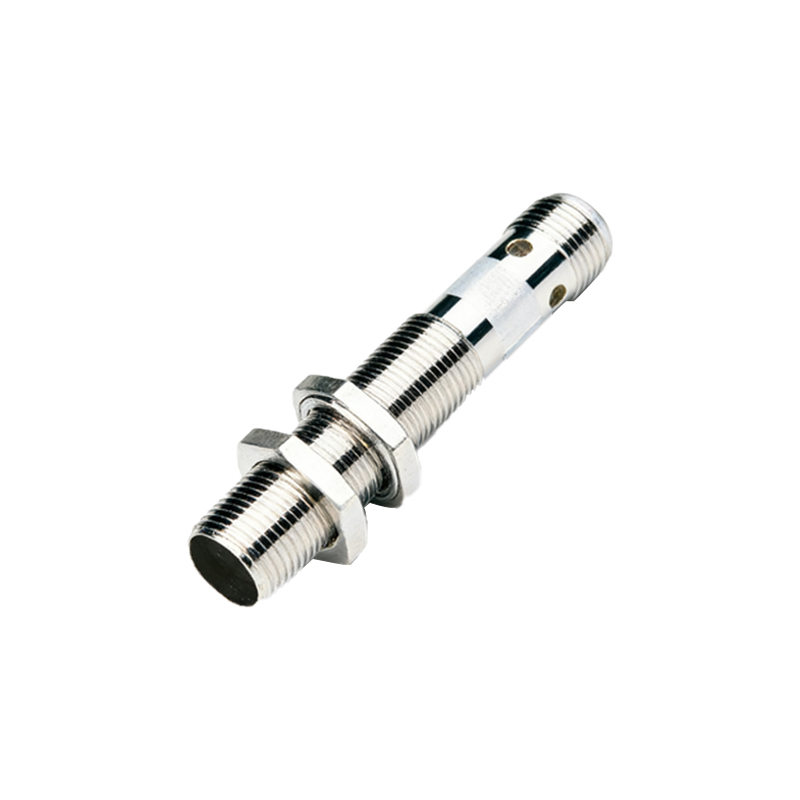
Installation of the PT12-T08N0 requires careful attention to several factors. First, the M12 thread allows for easy mounting in standard nuts or directly into a drilled and tapped hole. Proper flush or non-flush mounting conditions must be observed as per the manufacturer's guidelines. Non-flush models can sense targets from all directions but require more lateral clearance from metallic surroundings, while flush-mounted types can be embedded in metal without false triggering but have a slightly reduced range. Environmental protection is another key aspect; most models, including variants of the PT12-T08N0, boast an IP67 or higher ingress protection rating, making them resistant to dust and temporary immersion in water, suitable for harsh industrial environments. Wiring must be performed with the power disconnected. The supply voltage range, often 10-30V DC, should be strictly adhered to, and the load current of the output must not exceed the sensor's maximum rating, typically around 200mA. Overload protection or a flyback diode for inductive loads (like relays or solenoids) connected to the output may be necessary to prevent voltage spikes from damaging the internal transistor.
Typical applications for the PT12-T08N0 are widespread across manufacturing and processing industries. It is frequently employed for object detection on conveyor lines, such as verifying the presence of a metal part before a robotic arm engages. It serves as an end-of-travel limit switch in automated machinery, providing precise positional feedback. In packaging equipment, these sensors count metallic items or detect the position of a metal flag on a rotating shaft for speed monitoring. Its robust construction also makes it suitable for use in machine tools, material handling systems, and automotive assembly lines.
Troubleshooting is generally straightforward. Common issues include failure to detect, which can stem from an incorrect target material, the target being outside the effective sensing range, or accumulated debris on the sensor face. Constant activation might indicate a wiring error or a failed output transistor. Using a multimeter to check supply voltage and output state relative to the target's presence is the first diagnostic step. Always consult the official technical data sheet for the exact specifications, wiring diagrams, temperature ratings (usually -25 to 70°C), and response frequency.
In conclusion, the PT12-T08N0 three-wire proximity sensor represents a mature, reliable, and versatile solution for metallic object detection. Its standardized form factor, combined with robust performance characteristics, ensures its continued prevalence in industrial control panels and machinery. Understanding its electrical interface, sensing behavior, and installation constraints is essential for engineers to design robust and fault-tolerant automated systems. Proper selection and implementation of such sensors directly contribute to enhanced system uptime, safety, and operational efficiency.