Laser-based optical sensors represent a critical technology in modern industrial automation, offering unparalleled precision in measurement, detection, and control tasks. These sensors operate by emitting a focused beam of coherent light—typically from a laser diode—toward a target. The interaction between the laser light and the target, such as reflection, absorption, or scattering, is then detected and analyzed to derive information about the target's presence, distance, position, or surface characteristics.
The core principle hinges on the properties of laser light: coherence, monochromaticity, and directionality. Coherence ensures the light waves are in phase, enabling precise interference patterns used in techniques like laser interferometry for nanometer-scale measurements. Monochromaticity, or single-wavelength emission, allows sensors to filter out ambient light effectively, enhancing signal-to-noise ratios in varied environments. Directionality permits the beam to remain tightly focused over long distances, facilitating accurate long-range sensing.
Common operational modes include through-beam, retro-reflective, and diffuse-reflective configurations. In through-beam sensors, a separate emitter and receiver are aligned; an object interrupting the beam triggers detection. This method offers high reliability and long sensing ranges. Retro-reflective sensors use a reflector to bounce the beam back to a combined emitter-receiver unit, with detection occurring when the beam is blocked. Diffuse-reflective sensors rely on light reflecting directly off the target into the receiver, suitable for detecting objects without precise alignment.
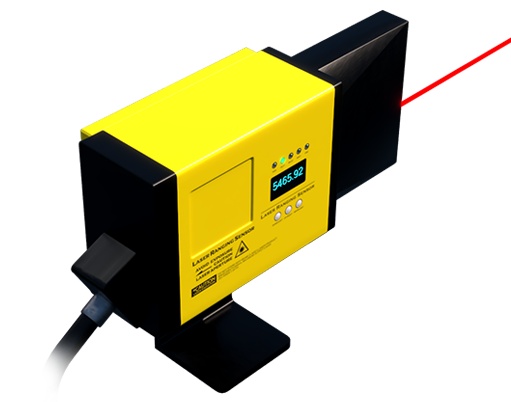
Advanced laser sensors incorporate time-of-flight (ToF) or triangulation principles for distance measurement. ToF sensors calculate distance by measuring the round-trip time of a laser pulse, ideal for applications like level monitoring or robotics. Triangulation sensors use a laser spot projected onto a target; the position of the reflected spot on a detector array shifts proportionally to distance, enabling high-resolution profiling in 3D scanning or thickness gauging.
Key components include the laser source (often Class 1 or 2 for safety), optics for beam shaping, photodetectors (e.g., photodiodes or CMOS arrays), and signal-processing electronics. Modern sensors integrate microprocessors for real-time data analysis, adaptive filtering, and communication via protocols like IO-Link or Ethernet/IP. Environmental factors such as dust, humidity, or target reflectivity can affect performance, necessitating features like background suppression or polarization filters.
Applications span diverse industries. In manufacturing, laser sensors enable non-contact inspection of part dimensions, defect detection on assembly lines, and precise positioning in CNC machinery. Logistics systems use them for barcode scanning, package sorting, and warehouse automation. Automotive sectors apply sensors for collision avoidance, adaptive lighting, and robotic welding guidance. Emerging trends include miniaturization, integration with AI for predictive maintenance, and enhanced safety standards like IEC 60825-1.
Despite advantages like speed and accuracy, challenges persist. Sensitive optics require protection from contamination, and highly reflective or absorptive surfaces may necessitate calibration. Cost considerations also influence adoption, though declining laser diode prices are expanding accessibility. Future developments may focus on multi-wavelength lasers for material discrimination and quantum-enhanced sensing for ultra-high precision.
In summary, laser-based optical sensors leverage the unique attributes of laser light to provide robust, high-performance solutions for industrial measurement and control. Their evolution continues to drive innovation in automation, contributing to smarter, more efficient industrial ecosystems.