Proximity switches, particularly those based on electromagnetic induction principles, are fundamental components in modern industrial automation and control systems. These non-contact sensors detect the presence or absence of metallic objects without any physical contact, offering high reliability, long operational life, and exceptional performance in harsh environments. The core technology behind inductive proximity sensors is electromagnetic induction, a phenomenon discovered by Michael Faraday. When an alternating current flows through a coil located within the sensor's oscillator circuit, it generates a high-frequency electromagnetic field at the active face of the sensor. In the absence of a metallic target, this field remains stable. However, when a conductive metal object enters this oscillating field, eddy currents are induced on the surface of the target. These eddy currents draw energy from the oscillator, resulting in a measurable reduction in the oscillation amplitude. This amplitude change is detected by a threshold circuit, which subsequently triggers a solid-state output switch—typically in the form of a PNP, NPN, or analog signal—to indicate the object's detection.
The design and application of inductive proximity sensors require careful consideration of several key parameters. Sensing distance, or nominal range, is specified for a standard target (usually mild steel). Factors like target material, size, shape, and mounting conditions can affect the actual sensing performance. Ferrous metals like iron and steel provide the longest sensing ranges, while non-ferrous metals such as aluminum, copper, or brass reduce the effective range due to differences in conductivity and permeability. Environmental robustness is another critical advantage. Encapsulated in robust housings made of materials like nickel-plated brass, stainless steel, or PBT plastic, these sensors are inherently immune to dust, dirt, oil, and moisture. They contain no moving mechanical parts, making them resistant to wear and tear from repeated operation. This makes them ideal for applications involving high-speed counting, position verification, end-of-travel detection on machinery, and presence sensing in automated assembly lines.
When selecting an inductive proximity sensor for a specific task, engineers must evaluate technical specifications beyond just the sensing range. The operating frequency, or switching frequency, defines how quickly the sensor can detect objects per second, which is vital for high-speed production lines. Hysteresis, the difference between the switch-on and switch-off points, provides stability to prevent output chattering when a target is at the edge of the detection zone. Furthermore, output configuration must match the control system's input requirements. DC sensors (10-30V DC) are most common, with 2-wire, 3-wire, and 4-wire designs offering different wiring and load compatibility. Advanced features include analog output versions for distance-proportional signals, weld-field immunity models for use near resistance welding equipment, and factors like temperature rating, short-circuit protection, and IP (Ingress Protection) ratings for specific environmental conditions.
Installation and integration are straightforward but demand attention to detail. Proper mounting, often in a threaded barrel style, requires maintaining the specified non-flush or flush mounting clearance to ensure the electromagnetic field is not influenced by surrounding metallic materials. Electrical noise from motors, drives, or power lines can sometimes interfere with sensor operation; thus, using shielded cables and proper grounding practices is recommended. In complex automated systems, these sensors interface directly with Programmable Logic Controllers (PLCs), providing critical binary input data for logic control sequences.
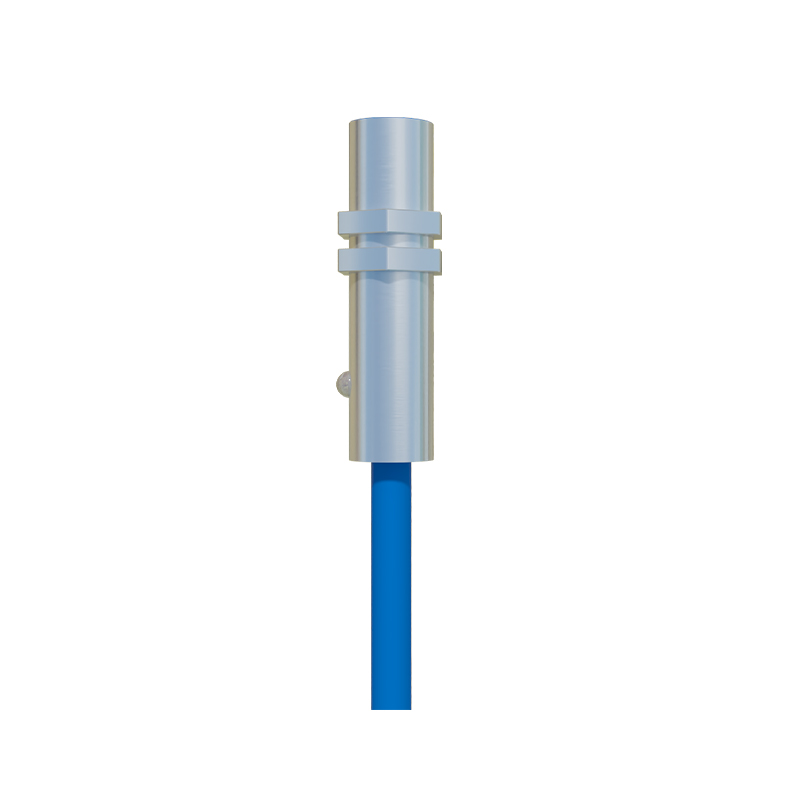
Looking ahead, the evolution of inductive proximity sensors continues. Miniaturization has led to sub-miniature sensors for space-constrained applications, while increased intelligence incorporates IO-Link communication capabilities, allowing for parameter setting, condition monitoring, and diagnostic data exchange within Industry 4.0 frameworks. Their fundamental principle remains unchanged, but enhancements in precision, connectivity, and durability solidify their indispensable role. From simple limit switching to complex robotic guidance, electromagnetic induction-based proximity switches provide a reliable, cost-effective, and maintenance-free solution for object detection, forming a silent yet crucial backbone of industrial automation efficiency and safety.