In modern industrial automation, precision measurement is a cornerstone of efficiency and quality control. Among the myriad of sensing technologies available, laser distance sensor arrays have emerged as a pivotal solution for high-accuracy, non-contact measurement across diverse applications. This article delves into the operational principles, key advantages, and practical implementations of these sophisticated systems, providing insights for engineers and system integrators seeking to optimize their automation processes.
At its core, a laser distance sensor operates on the principle of time-of-flight (ToF) or triangulation. In a ToF system, the sensor emits a laser pulse toward a target object. The time taken for the reflected pulse to return to the sensor is precisely measured. Since the speed of light is constant, the distance to the object can be calculated with remarkable accuracy. Triangulation-based sensors, on the other hand, use a laser emitter, a receiving lens, and a position-sensitive detector. The laser dot projected onto the target is imaged onto the detector at an angle; the position of the dot on the detector shifts proportionally with the target's distance, enabling precise distance calculation through geometric relationships.
A laser distance sensor array is essentially a coordinated assembly of multiple such sensors arranged in a linear or two-dimensional configuration. This arrangement allows for the simultaneous measurement of distances at multiple points, enabling the creation of detailed profiles or contours of objects. For instance, in automotive assembly lines, a linear array can scan the entire surface of a car door to ensure perfect flushness and gap consistency. In logistics, a 2D array mounted above a conveyor belt can rapidly capture the dimensions of packages for volume calculation and sorting.
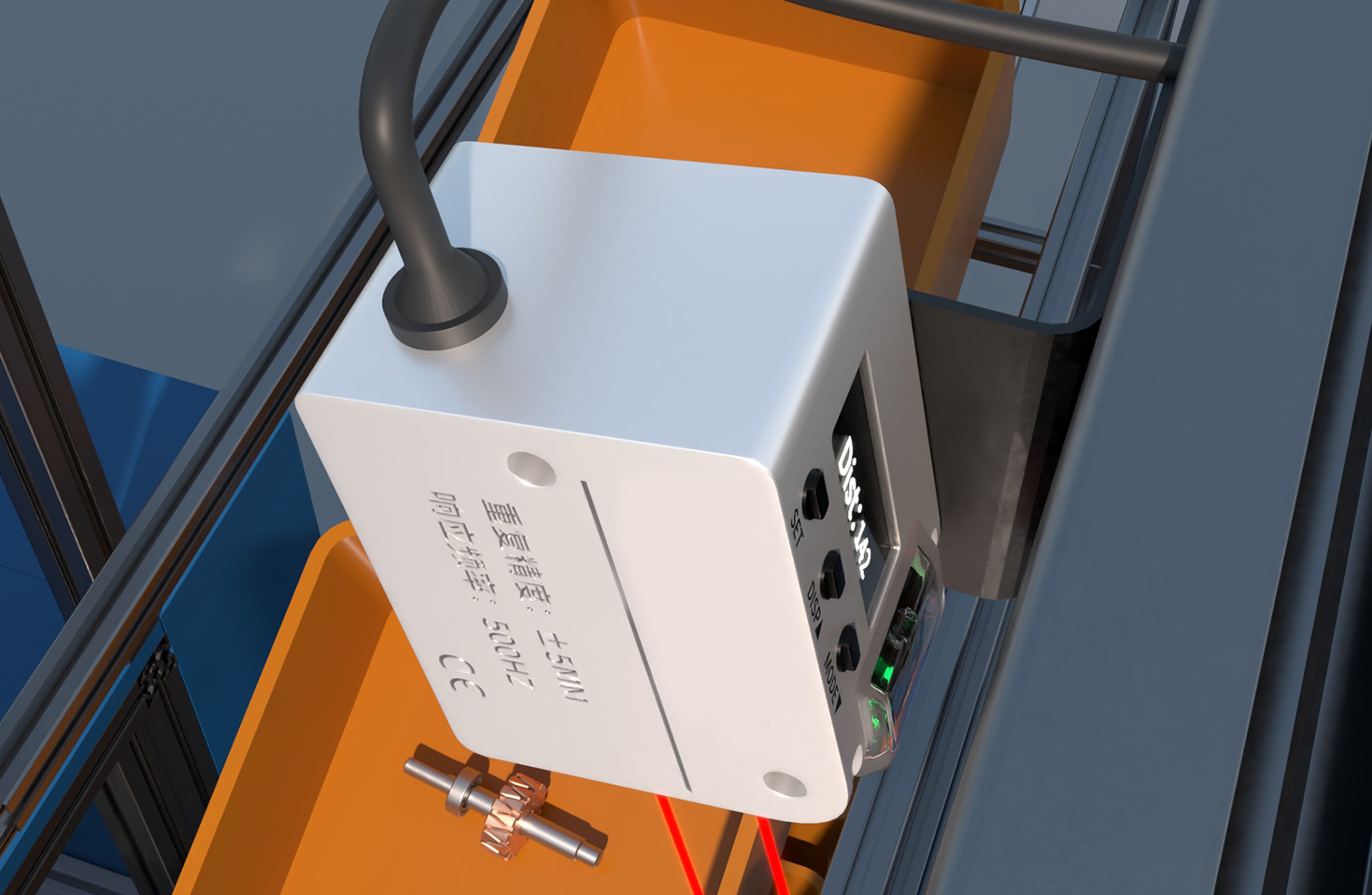
The advantages of deploying an array over a single sensor are substantial. Firstly, it dramatically increases measurement speed and throughput. Instead of mechanically scanning a single sensor across a target—which introduces moving parts, wear, and slower cycle times—an array captures a full dataset in a single shot. This is critical in high-speed production environments where every millisecond counts. Secondly, it enhances reliability. With no moving parts in the scanning mechanism, the system is less prone to mechanical failure, reducing maintenance downtime. Thirdly, it offers superior spatial resolution. By densely packing sensors, the array can detect minute variations in surface topography that a single scanning point might miss, such as subtle dents, warps, or thickness variations in manufactured parts.

Key technical specifications to consider when selecting a laser distance sensor array include measurement range, accuracy, resolution, and response time. Typical high-end arrays offer sub-millimeter accuracy over ranges from a few centimeters to several meters. The resolution, or the smallest detectable distance change, can be as fine as micrometers in specialized models. Response times are often in the microsecond range per measurement point, allowing for real-time process control. Additionally, environmental robustness is paramount. Industrial-grade arrays are housed in rugged enclosures with high Ingress Protection (IP) ratings, resisting dust, moisture, and vibrations. They are also designed to compensate for ambient light interference and varying surface reflectivities—common challenges in factory settings.
Integration of these arrays into an automation system involves careful planning. Communication protocols are a primary consideration. Most modern arrays support standard industrial interfaces such as Ethernet/IP, PROFINET, EtherCAT, or simple analog/digital I/O, enabling seamless connectivity with Programmable Logic Controllers (PLCs) and industrial PCs. Software plays an equally vital role. Manufacturers typically provide configuration software and Software Development Kits (SDKs) that allow engineers to set measurement parameters, define regions of interest, and implement logic for pass/fail judgments or data logging. The processed data can be used for closed-loop control, such as adjusting robot arm trajectories or activating reject mechanisms.
Practical applications are vast and growing. In robotics, arrays provide precise guidance for bin picking, assembly, and welding, allowing robots to adapt to the position and orientation of parts. In metal fabrication, they monitor the flatness of sheets and the dimensions of cut pieces. In the electronics industry, they ensure the precise placement of components on printed circuit boards. Furthermore, in emerging fields like autonomous mobile robots (AMRs) and smart warehouses, these arrays are integral for navigation, obstacle detection, and pallet profiling.
Looking ahead, the evolution of laser distance sensor arrays is closely tied to advancements in miniaturization, processing power, and smart sensor capabilities. The integration of edge computing allows arrays to perform preliminary data analysis on-device, reducing the load on central controllers and enabling faster decision-making. Additionally, the fusion of laser measurement data with other sensor types, such as vision cameras or inertial measurement units, is paving the way for more comprehensive and intelligent perception systems.
In conclusion, laser distance sensor arrays represent a mature yet continuously advancing technology that addresses the stringent demands of modern industrial automation. Their ability to deliver fast, accurate, and reliable multi-point measurements makes them indispensable for quality assurance, process optimization, and enabling flexible automation. For engineers, a deep understanding of their operation and integration is key to unlocking their full potential and driving the next wave of productivity gains in manufacturing and beyond.