Laser sensors have become indispensable components in modern industrial automation, playing a critical role in international trade for quality control, measurement, and safety applications. Understanding their operational principles is essential for engineers, procurement specialists, and technical managers engaged in global supply chains. This article provides a comprehensive technical overview of the core principles governing laser sensors commonly traded in the international market.
Fundamentally, a laser sensor is a non-contact measurement device that utilizes a focused beam of coherent light—laser light—to detect, measure, or profile an object. The core principle revolves around the interaction between the emitted laser beam and the target. The most common operating principles include triangulation, time-of-flight (ToF), and confocal measurement.
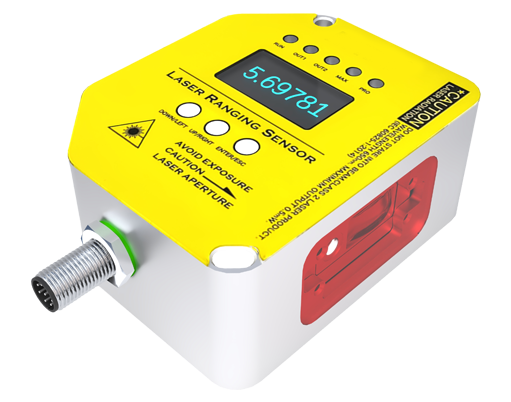
Triangulation is a prevalent method in high-precision displacement and distance sensors. The sensor emits a laser spot onto the target surface. The reflected light is then focused onto a position-sensitive detector (PSD) or a CMOS/CCD array at a specific angle relative to the emitter. When the target distance changes, the position of the reflected spot on the detector shifts. Using trigonometric calculations, the sensor's internal processor precisely determines the distance or displacement. This principle offers micron-level resolution and is widely used in dimensional gauging, vibration analysis, and thickness measurement in industries like automotive and electronics manufacturing.
Time-of-Flight (ToF) principles are employed for longer-range distance measurement. The sensor calculates distance by measuring the time interval between the emission of a laser pulse and the reception of its reflection. Given the constant speed of light, the distance is derived from the formula: Distance = (Speed of Light × Time of Flight) / 2. Modern ToF sensors use advanced pulsed or phase-shift measurement techniques to achieve high accuracy over distances ranging from a few centimeters to several hundred meters. These sensors are crucial in logistics (warehouse automation, AGV navigation), construction (leveling, surveying), and bulk material level monitoring.
Confocal chromatic measurement is a principle used for ultra-high-resolution applications, particularly for measuring transparent or multi-layered materials and highly reflective surfaces. Here, a white light source is focused through a multi-lens optical system. Only a specific wavelength (color) is precisely focused on the target surface; other wavelengths are defocused. The reflected light is analyzed by a spectrometer. The measured distance correlates directly to the wavelength of the light that was in perfect focus. This principle allows for nanometer resolution and is vital in semiconductor inspection, precision optics, and medical device manufacturing.
Beyond distance, laser sensors operate on principles for detecting presence, edge detection, and profile scanning. For simple presence detection, a through-beam sensor uses a separate transmitter and receiver; breaking the beam indicates an object's presence. A retro-reflective sensor uses a single unit and a reflector. Diffuse reflective sensors, common in trade, rely on the reflection of the laser light directly from the target object itself, with detection sensitivity often adjustable.
Key performance parameters in the international trade of laser sensors include measurement range, resolution, accuracy, repeatability, linearity, and response time. Environmental factors such as ambient light immunity, temperature stability, and resistance to dust or vapors are critical selection criteria, as industrial conditions vary globally. Communication interfaces like IO-Link, analog outputs (4-20mA, 0-10V), and digital protocols (EtherNet/IP, PROFINET) are standardized to ensure compatibility with international automation systems.
The choice of laser class (I, II, III, IV) is a paramount safety and regulatory consideration in global trade. Class 1 and 2 lasers are generally considered safe under normal operating conditions, while Class 3B and 4 require stringent safety measures. Compliance with international standards like IEC 60825-1 is mandatory for market access.
In conclusion, the international trade of laser sensors is driven by their underlying principles of operation—triangulation, time-of-flight, and confocal measurement—each catering to specific industrial needs. A deep technical understanding of these principles, coupled with knowledge of performance specifications and global safety standards, enables industry professionals to source, integrate, and apply these powerful tools effectively, enhancing productivity and quality in a competitive global marketplace.