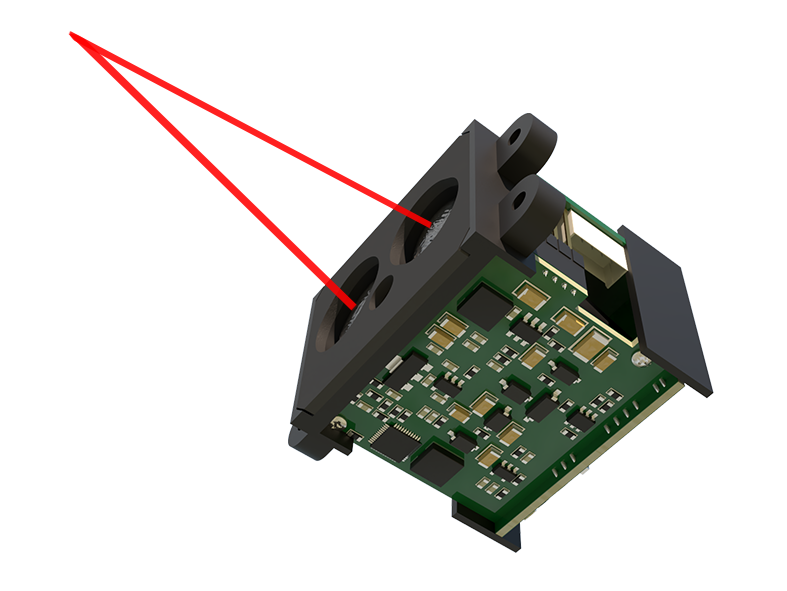
In the rapidly evolving landscape of industrial automation and precision measurement, the demand for reliable yet affordable sensing solutions has never been higher. Low-cost laser distance sensors have emerged as a pivotal technology, bridging the gap between basic ultrasonic sensors and high-end, precision laser interferometers. This article delves into the operational principles, key selection criteria, and practical application scenarios for these accessible devices, providing a clear roadmap for engineers and procurement specialists.
At their core, low-cost laser distance sensors operate on the time-of-flight (ToF) or phase-shift principle. A laser diode emits a focused pulse or modulated beam of light toward a target. The sensor's photodetector then captures the reflected light. By calculating the time delay or phase difference between the emitted and received signals, the sensor's internal processor accurately determines the distance. Modern versions often utilize Class 2 visible red lasers, making alignment straightforward and safe for operator use. While their precision, typically in the range of ±1mm to ±3mm, and measuring ranges (often 0.05m to 30m) may not match their premium counterparts, they offer a compelling balance for a vast array of tasks.
Selecting the right sensor requires careful consideration of several parameters beyond just price. First, define the required measuring range and the necessary accuracy for your specific application. Consider the target properties: dark, shiny, or transparent surfaces can challenge some sensors, so models with background suppression or specialized algorithms may be needed. The environmental conditions are critical; industrial settings may demand robust housing with high IP ratings (e.g., IP67) for dust and water resistance, and wide operating temperature ranges. Output interfaces are another key factor. Most low-cost sensors provide digital outputs (PNP/NPN) or analog outputs (0-10V, 4-20mA), while some offer serial communication (RS-232, RS-485) or even IO-Link for simplified integration into PLCs and control systems. Finally, evaluate the mechanical design for easy mounting and alignment, often facilitated by built-in alignment aids like LED indicators.

The application potential for these sensors is extensive. In material handling and logistics, they are deployed for palletizing, box dimensioning, and conveyor belt level monitoring. Within automated assembly lines, they perform precise parts positioning, robotic guidance, and presence detection. In the construction sector, they facilitate simple distance measurements and leveling tasks. Even in consumer electronics manufacturing, they are used for thickness gauging and component placement verification. Their affordability allows for deployment in multi-sensor networks, enabling complex monitoring systems without prohibitive costs.
However, it is crucial to acknowledge their limitations. Performance can degrade in direct sunlight or in environments with significant optical interference. Very high-speed measurements or sub-millimeter accuracy requirements typically necessitate more sophisticated and expensive technology. Therefore, a thorough evaluation of the operating environment against the sensor's datasheet specifications is non-negotiable.

Looking ahead, the trajectory for low-cost laser distance sensors is toward greater integration and intelligence. We are seeing trends like miniaturization, reduced power consumption, and the incorporation of smarter firmware with onboard diagnostics and data preprocessing. The integration with Industrial IoT platforms is becoming more common, allowing sensors to not only provide data but also communicate their health status, enabling predictive maintenance.
In conclusion, low-cost laser distance sensors represent a mature and highly viable tool for the modern engineer. By understanding their working principles, carefully matching specifications to application needs, and being aware of their operational boundaries, professionals can leverage these devices to achieve significant gains in efficiency, automation, and quality control across countless industrial scenarios. They are a testament to how advancing technology can deliver robust performance at an accessible price point, democratizing precision measurement for a wider audience.