In the realm of industrial automation, laser sensor switches have become indispensable components, offering unparalleled precision, speed, and reliability for detection and measurement tasks. Unlike traditional mechanical or photoelectric sensors, laser sensors utilize a focused beam of coherent light, enabling highly accurate and long-range sensing even in challenging environments. This article delves into the core types of laser sensor switches, their operational principles, and key application considerations for engineers and system integrators.
The fundamental principle behind a laser sensor switch involves the emission of a laser beam from a transmitter towards a target. The sensor then analyzes the reflected light. Depending on the specific type, it may measure the time-of-flight, triangulation angle, or intensity of the return signal to determine the presence, distance, or profile of an object. This non-contact method eliminates mechanical wear and allows for the detection of minute or sensitive objects without physical interaction.
Primarily, laser sensor switches can be categorized into several key types based on their sensing methodology:
1. Through-Beam Laser Sensors: This type consists of two separate units: a laser transmitter and a receiver placed opposite each other. An object is detected when it interrupts the laser beam traveling between them. Through-beam sensors offer the longest sensing ranges and highest reliability, as they are largely immune to the target's color, reflectivity, or surface angle. They are ideal for precise edge detection, counting, and safety curtains.
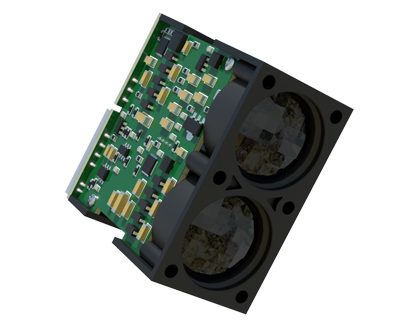
2. Diffuse-Reflective Laser Sensors: These are single-unit devices where the transmitter and receiver are housed together. The sensor detects an object by receiving the light diffused (reflected) back from the target's surface. Their setup is simpler, but sensing range and performance can be influenced by the target's color and texture. Advanced models with background suppression or true background suppression (TBS) use triangulation to only detect objects within a precise defined distance, ignoring more distant backgrounds.
3. Retro-Reflective Laser Sensors: Also a single-unit design, these sensors work with a reflector (like a prismatic tape) placed opposite the sensor. The sensor detects an object when it breaks the beam between itself and the reflector. They provide a longer range than diffuse types and are less affected by target properties than diffuse sensors, though they require installation of the reflector.
4. Laser Distance Sensors: These switches not only detect presence but also precisely measure the distance to a target. Common technologies include time-of-flight (ToF) and triangulation. ToF sensors calculate distance by measuring the time delay between the emitted and reflected pulse, suitable for longer ranges. Triangulation-based sensors use the angle of the reflected beam on a position-sensitive detector (PSD) for extremely high-resolution measurements at shorter ranges.

Selecting the appropriate laser sensor switch requires careful analysis of the application parameters. Key factors include:
- Sensing Range: Through-beam offers the maximum range, often exceeding 100 meters, while diffuse types are typically limited to shorter distances.
- Target Characteristics: Consider the size, color, material, and surface finish. Shiny or dark objects can pose challenges for diffuse sensors.
- Environmental Conditions: Factors like ambient light, dust, fog, or vibration can affect performance. Many industrial laser sensors feature robust housings (IP67/IP69K ratings) and modulated laser light to combat optical interference.
- Required Output: Standard outputs include digital (PNP/NPN) switches, analog (4-20mA, 0-10V), and serial communication (IO-Link) for integration into PLCs and control systems.
- Accuracy and Resolution: Critical for measurement tasks, where laser distance sensors with micrometer-level resolution are often specified.
In practice, laser sensor switches are deployed across diverse sectors. In automotive assembly, they ensure precise part positioning. In packaging machinery, they control fill levels and label registration. In electronics manufacturing, they verify component placement on PCBs. Their high-speed response makes them perfect for object counting on high-velocity conveyor lines.
In conclusion, the evolution of laser diode and receiver technology has made laser sensor switches more compact, affordable, and robust. Understanding the distinctions between through-beam, diffuse-reflective, retro-reflective, and distance-measuring types is crucial for optimal system design. By matching the sensor's capabilities to the specific demands of the detection task—considering range, target, environment, and output needs—engineers can leverage these powerful tools to enhance automation efficiency, quality control, and operational safety. As Industry 4.0 advances, the integration of smart laser sensors with IoT platforms will further expand their diagnostic and predictive maintenance capabilities.