In the realm of industrial automation, proximity sensors are indispensable components for detecting the presence or absence of objects without physical contact. Among the various types, non-shielded (or unshielded) proximity sensors represent a specific category with distinct operational characteristics and application scenarios. Unlike their shielded counterparts, which have a metal ring surrounding the sensing face to concentrate the electromagnetic field and provide protection from lateral metal interference, non-shielded sensors lack this feature. This fundamental design difference dictates their performance and suitability in diverse industrial settings.
The primary advantage of a non-shielded inductive proximity sensor lies in its extended sensing range. By not constricting the electromagnetic field, these sensors can detect metallic targets at a greater distance compared to a shielded sensor of the same physical size and nominal specifications. This makes them highly effective in applications where longer range detection is a critical requirement, and where the sensor can be installed in a manner that minimizes the risk of interference from adjacent metallic structures or machinery. For instance, in material handling systems where large metallic objects need to be detected as they approach a workstation, a non-shielded sensor provides the necessary reach.
However, the very trait that grants a longer sensing range also introduces a key consideration: reduced immunity to lateral metal interference. The unconstrained magnetic field of a non-shielded sensor is more susceptible to influence from metallic objects approaching from the sides. If a metal bracket, machine frame, or even a fast-moving conveyor component comes too close to the side of the sensor, it may cause false triggering or a reduction in the effective sensing distance to the intended target. Therefore, meticulous attention must be paid to the sensor's mounting environment. Engineers must ensure adequate clearance—often specified as a "free zone" in the sensor's datasheet—around the sides of the sensor body to guarantee reliable operation.
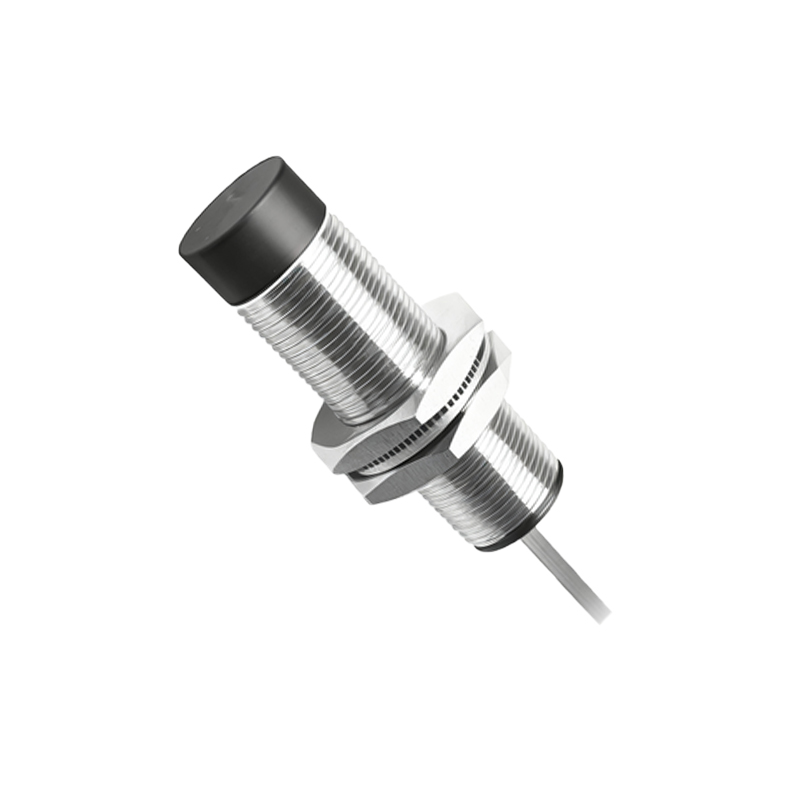
Typical applications for non-shielded proximity sensors are plentiful. They are frequently deployed in packaging machinery for detecting the position of metal components on indexing tables, where sensors can be spaced apart sufficiently. In automotive assembly lines, they are used for presence verification of metal pallets or fixtures at a distance. Another common use is in crane and hoist systems for end-of-travel detection, where the sensor needs to detect a large metal plate or flag from a safe distance. In all these cases, the installation is planned so that the sensor's sides are not exposed to extraneous metal within its active field.
Selection criteria between shielded and non-shielded types hinge on a thorough assessment of the application's mechanical constraints and detection needs. When space is limited and the sensor must be flush-mounted in a metal bracket or panel, a shielded sensor is mandatory to prevent the mounting metal from affecting the sensor. Conversely, if there is ample space for a "free zone" around the sensor and the primary goal is to maximize the sensing distance, the non-shielded variant becomes the preferred choice. It often represents a more cost-effective solution for achieving longer ranges without needing a physically larger sensor.
Installation and commissioning of non-shielded sensors demand precision. Following the manufacturer's guidelines for the required lateral and frontal clearance is non-negotiable. During commissioning, it is good practice to test the sensor with the target object while simulating worst-case scenarios, such as bringing other potential metal interferents near the designated free zone to verify stability. Regular maintenance should include checking for any accumulation of metallic dust or debris on the sensing face, which can attenuate performance, and ensuring that mounting hardware has not loosened, potentially altering the critical clearance distances.
In conclusion, non-shielded proximity sensors are powerful tools in an engineer's arsenal, offering extended range for metal detection where the installation environment permits. Their successful deployment is a testament to careful planning, understanding of electromagnetic field behavior, and adherence to mechanical mounting guidelines. By correctly applying these sensors, industries can achieve robust, reliable, and cost-effective object detection, enhancing the efficiency and safety of automated processes. The choice is not about which sensor is universally better, but which is optimally suited to the specific spatial and functional demands of the task at hand.