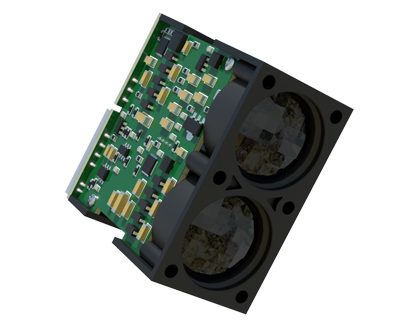
In the rapidly evolving landscape of modern defense systems, combat laser radar (LADAR) sensors have emerged as a pivotal technology, redefining the paradigms of target acquisition, threat assessment, and battlefield situational awareness. Unlike conventional radar systems that rely on radio waves, LADAR utilizes focused laser beams to generate high-resolution, three-dimensional maps of the operational environment. This capability provides an unprecedented level of detail, enabling the precise identification and tracking of objects, even in cluttered or obscured conditions. The core principle involves emitting short pulses of laser light and measuring the time it takes for the reflected signal to return. This time-of-flight data, combined with advanced signal processing algorithms, allows for the creation of real-time, dynamic models of the battlefield.
The operational advantages of combat LADAR are manifold. Its exceptional angular resolution permits the discrimination between closely spaced targets, such as distinguishing a missile from its decoy. Furthermore, the narrow beam divergence of laser systems makes them inherently resistant to jamming and interception, a critical feature in electronic warfare scenarios. Modern LADAR sensors are integrated into a variety of platforms, including unmanned aerial vehicles (UAVs), ground vehicles, and missile guidance systems. For instance, in precision-guided munitions, LADAR seekers can autonomously identify and lock onto specific target features, ensuring high strike accuracy while minimizing collateral damage. The sensor's ability to penetrate light foliage and atmospheric obscurants like smoke or dust provides a significant tactical edge in complex terrains.
Technological advancements continue to push the boundaries of LADAR performance. The development of eyesafe laser wavelengths, high-efficiency detectors, and sophisticated data fusion techniques has enhanced both the safety and functionality of these systems. Contemporary research focuses on increasing the detection range, improving resistance to countermeasures, and reducing the size, weight, and power (SWaP) requirements for broader deployment. The integration of artificial intelligence and machine learning is another frontier, enabling autonomous target recognition and predictive tracking based on the rich point-cloud data generated by LADAR. This synergy promises to create fully autonomous combat systems capable of rapid, informed decision-making.
However, the deployment of combat LADAR is not without challenges. Atmospheric attenuation, particularly due to fog, rain, or heavy dust, can significantly degrade laser signal integrity. System designers must also contend with the high cost of components and the need for rigorous calibration and maintenance to ensure operational reliability. Despite these hurdles, the strategic value offered by LADAR's precision and stealth ensures its central role in next-generation defense architectures. As nations invest in modernizing their military capabilities, combat laser radar sensors stand as a testament to the relentless pursuit of technological superiority, shaping the future of warfare with every pulse of light.