In the realm of industrial automation and control systems, proximity sensors stand as fundamental components for non-contact detection. Among the various types, the five-wire proximity sensor represents a sophisticated and versatile solution, particularly valued for its enhanced diagnostic capabilities and reliable performance in complex applications. This article delves into the operational principles, wiring configurations, key advantages, and typical use cases of five-wire proximity sensors, providing a detailed technical overview for electrical engineers and industry professionals.
At its core, a proximity sensor detects the presence or absence of an object within its sensing range without physical contact. It achieves this through electromagnetic fields, light, or sound. The five-wire sensor specifically refers to a DC-powered device with a specific output configuration. Unlike simpler two-wire or three-wire sensors, the five-wire variant incorporates additional circuitry for diagnostic feedback, making it a "complementary" or "push-pull" output type.
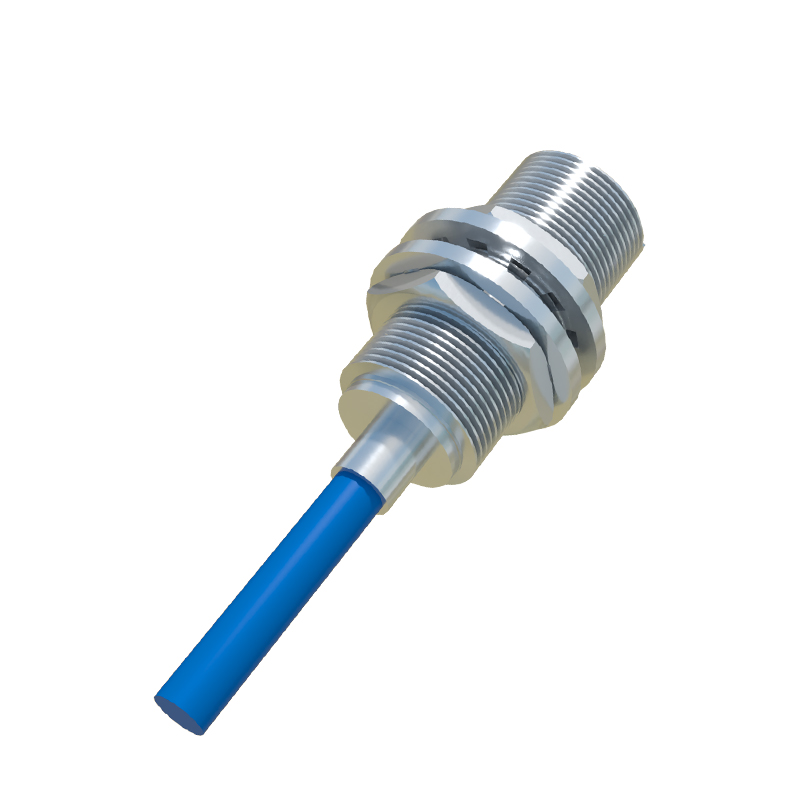
The defining characteristic of a five-wire sensor is its output stage. It contains two separate switching elements, typically transistors. One connects the load to the positive supply voltage (often labeled as the PNP or sourcing output), and the other connects the load to the negative supply or ground (often labeled as the NPN or sinking output). These two outputs work in a complementary manner; when one is active (ON), the other is inactive (OFF). This configuration provides two distinct signal wires for control, in addition to the standard power supply wires (V+ and V-) and a common wire.
The standard wiring for a five-wire DC proximity sensor is as follows:
1. Brown Wire: Connected to the positive DC supply voltage (typically +10 to +30 VDC).
2. Blue Wire: Connected to the negative DC supply voltage or 0V (ground).
3. Black Wire: This is the first output signal wire. In a standard configuration, it acts as the normally open (NO) PNP (sourcing) output. When a target is detected, this wire switches to supply the positive voltage to the connected load.
4. White Wire: This is the second output signal wire. It typically acts as the normally closed (NC) PNP output or, in complementary setups, the complementary signal to the black wire. Its function can vary by model.
5. Black (or sometimes Gray) Wire: This is the NPN (sinking) output wire. It provides a path to ground for the load when active. The specific function of the white and second black wire depends heavily on the manufacturer's design—one may be NO and the other NC, or they may be complementary outputs of the same state.
It is absolutely critical to consult the specific sensor's datasheet, as wire color coding and function can differ between manufacturers. The key takeaway is the presence of two independently controllable output paths from a single sensing element.
The primary advantage of a five-wire sensor lies in its flexibility and diagnostic potential. The dual complementary outputs allow a single sensor to control two different loads or provide status information to two separate points in a control system, such as a PLC input and a pilot light. More importantly, this configuration enables advanced diagnostic monitoring. A control system can monitor both output states. If both outputs are simultaneously ON or OFF—a logical impossibility in a correctly functioning complementary circuit—it indicates a fault within the sensor (e.g., a shorted output transistor). This built-in diagnostic capability is invaluable for predictive maintenance and reducing machine downtime in critical processes.
Furthermore, five-wire sensors offer high switching capacity and excellent resistance to electrical interference (noise), making them suitable for demanding industrial environments found in automotive manufacturing, packaging machinery, and material handling systems. They provide a reliable interface with Programmable Logic Controllers (PLCs) and other control devices.
When selecting and applying a five-wire proximity sensor, engineers must consider several factors:
Sensing Range: The nominal range at which the sensor can reliably detect a standard target.
Output Configuration: Confirming the exact function of each wire (NO/NC, PNP/NPN) as per the datasheet.
Supply Voltage: Ensuring compatibility with the available DC power source.
Load Current: The output must be capable of handling the current requirement of the connected load (e.g., a relay coil, PLC input, or indicator lamp).
Environmental Conditions: Factors such as temperature, humidity, and the presence of chemicals or metallic dust can influence housing material (often nickel-plated brass or stainless steel) and ingress protection (IP) rating selection.
In summary, the five-wire proximity sensor is a powerful tool in an engineer's arsenal, offering more than simple detection. Its complementary output structure provides operational flexibility and crucial diagnostic insights, enhancing system reliability and simplifying troubleshooting. While its