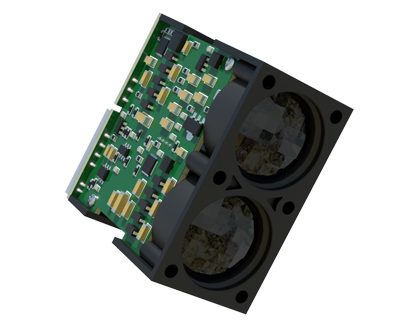
Laser sensors are pivotal components in modern industrial automation, offering high precision, reliability, and versatility. These devices operate by emitting a focused beam of light—typically from a laser diode—toward a target object. The sensor then detects changes in the light beam, such as reflection, interruption, or modulation, to determine the presence, position, distance, or characteristics of the object. The fundamental principle relies on the properties of laser light: coherence, monochromaticity, and directionality, which enable accurate measurements even in challenging environments with dust, vibration, or varying ambient light.
There are several types of laser sensors commonly used in industrial settings. Through-beam sensors consist of separate transmitter and receiver units; when an object breaks the laser beam between them, the sensor triggers a response. These are ideal for long-range detection and precise object counting. Retro-reflective sensors use a single unit that emits light toward a reflector, detecting objects when the reflected beam is interrupted. Diffuse reflective sensors, on the other hand, rely on light bouncing directly off the target, making them suitable for shorter distances and varied surface types. More advanced versions include time-of-flight sensors, which calculate distance by measuring the time taken for a laser pulse to return, and triangulation sensors, which use geometric principles for high-resolution displacement or thickness measurements.
The applications of laser sensors span numerous industries. In manufacturing, they facilitate precise positioning of components on assembly lines, monitor fill levels in containers, and inspect product dimensions for quality control. Automotive sectors utilize them for robotic guidance, weld seam tracking, and part identification. Logistics and packaging benefit from laser sensors in barcode scanning, parcel sorting, and inventory management. Additionally, in safety systems, laser scanners create protective fields around machinery to prevent accidents by detecting human intrusion. The adaptability of laser sensors is enhanced by their integration with programmable logic controllers (PLCs) and industrial networks, enabling real-time data processing and automation.
Selecting the right laser sensor involves considering factors like sensing range, response time, environmental conditions, and output type (e.g., digital or analog). Regular maintenance, such as lens cleaning and alignment checks, ensures longevity and accuracy. As technology advances, trends like miniaturization, increased connectivity via IoT, and enhanced AI-driven analysis are expanding the capabilities of laser sensors, paving the way for smarter, more efficient industrial operations. In summary, laser sensors are indispensable tools that drive precision and automation, contributing to productivity and safety across global industries.