In the realm of precision measurement and industrial automation, laser displacement sensors stand as critical tools for non-contact, high-accuracy distance and position sensing. At the heart of many advanced laser triangulation sensors lies a key optical component: the grating. This article delves into the function, types, and application considerations of gratings within laser displacement sensors, providing a technical overview for engineers and industry professionals.
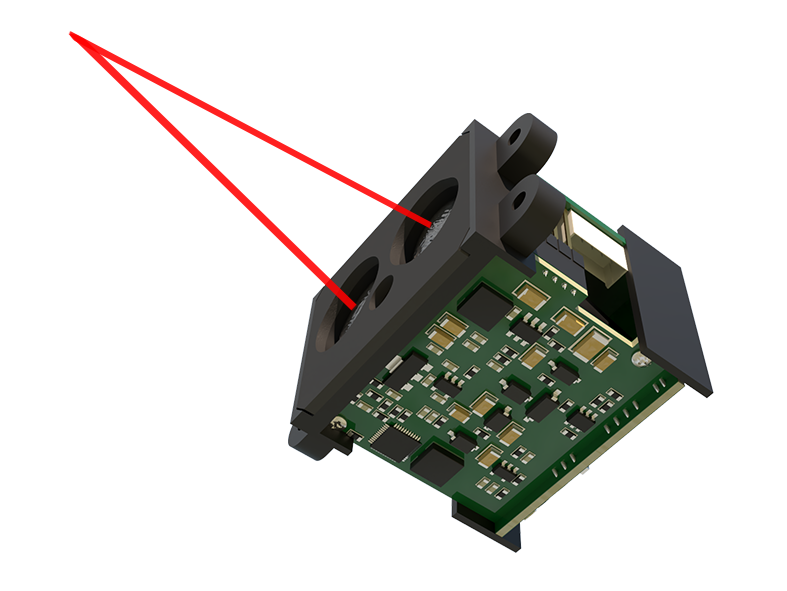
Fundamentally, a grating in this context is an optical element with a periodic structure that diffracts light. In a standard laser triangulation sensor, a laser diode projects a focused spot onto a target surface. The diffusely reflected light from this spot is collected by a receiving lens and focused onto a position-sensitive detector, typically a CMOS or CCD linear array. The core principle is triangulation: the position of the light spot on the detector shifts linearly with changes in the target's distance. The role of the grating is often integrated into the light projection or reception path to enhance performance, enable specific measurement modes, or mitigate environmental challenges.
One primary application of gratings is in the projection system. Instead of projecting a single spot, a diffraction grating can be used to split the incident laser beam into a structured light pattern, such as a line or multiple dots. This creates a laser line sensor or multi-spot sensor. The significant advantage here is the ability to capture profile or contour data in a single snapshot, dramatically increasing measurement speed for inspecting object shapes, thickness, or warpage. Each point along the generated line follows the triangulation principle independently, allowing for high-speed 2D profile acquisition.
Another critical use is in the receiver optics. Here, gratings can serve as optical filters. In harsh industrial environments, ambient light—especially from welding arcs, furnaces, or bright factory lighting—can saturate the detector and drown out the measurement signal. A specialized grating, such as a narrow-bandpass filter grating, can be employed to transmit only the specific wavelength of the sensor's laser while rejecting a broad spectrum of ambient light. This drastically improves the signal-to-noise ratio and measurement stability in challenging conditions.

Gratings are characterized by several key parameters that influence sensor design:
* Pitch/Period: The distance between repeating grating elements. This determines the diffraction angles for different orders of light.

* Duty Cycle: The ratio of the line width to the period in a line grating, affecting diffraction efficiency.
* Blaze Angle: In blazed gratings, the angle of the groove facets is optimized to direct maximum light intensity into a specific diffraction order, enhancing efficiency for a given wavelength.
* Type: Common types include amplitude gratings (alternating transparent and opaque zones) and phase gratings (modulating the phase of transmitted or reflected light, often more efficient).
The choice of grating type and specifications is a careful balance in sensor engineering. For line projection, a phase grating designed for the laser's wavelength is typically used to maximize the brightness and uniformity of the projected line. The grating's period is calculated to produce the desired line length and divergence angle for the sensor's working range. For filtering applications, a holographic or ruled grating with very high wavelength selectivity is integrated, often in combination with other optical coatings.
In practical industrial applications, sensors utilizing these grating technologies are ubiquitous. In automotive manufacturing, laser line sensors with grating-based projectors perform rapid 100% inspection of weld seam profiles, body panel gaps, and dimensional checks. In electronics assembly, they measure coplanarity of BGA solder balls or component height. In metal processing, sensors equipped with robust optical filtering gratings reliably measure the position of red-hot steel billets or during robotic welding processes, where intense parasitic light would otherwise render measurement impossible.
When selecting a laser displacement sensor for an application, understanding the role of its internal optics, including gratings, is valuable. For high-speed profile measurement, a sensor with a line projection grating is essential. For measurements in the presence of strong ambient light, specifying a sensor with enhanced optical filtering, often involving gratings, is critical. Furthermore, the wavelength of the laser source (common are 650nm red, 850nm infrared, or 405nm blue/violet) is chosen in conjunction with the grating's characteristics; blue lasers, for example, scatter more from rough surfaces and can be paired with gratings for finer line projection or tighter filtering.
Maintenance and environmental factors also play a role. While gratings are solid-state components, contamination on the sensor's front window can affect the performance of both projection and reception gratings. Ensuring clean optics according to the manufacturer's guidelines is necessary for sustained accuracy. The sensors are designed to be robust, but understanding that the grating is a precision optical element underscores the need to avoid mechanical shock or exposure to corrosive atmospheres that could degrade optical surfaces.
In conclusion, the grating is a sophisticated enabler within modern laser displacement sensors. It transforms a simple spot measurement into high-speed profile scanning or fortifies the system against optical noise. From projecting precise lines of light to acting as a spectral gatekeeper, gratings extend the functionality, reliability, and application scope of these indispensable measurement tools. As demands for speed and precision grow across manufacturing and R&D, the continued evolution of grating and laser diode technology will further push the boundaries of what non-contact optical sensing can achieve.