In the world of industrial automation, proximity sensors are indispensable workhorses, reliably detecting the presence or absence of objects without physical contact. Among the various types, inductive proximity sensors are particularly valued for their robustness, long service life, and immunity to environmental factors like dust or oil. However, a well-known and significant limitation exists: standard inductive proximity sensors are notoriously ineffective at detecting non-ferrous metals, most notably aluminum. This article delves into the technical reasons behind this limitation and explores practical solutions for applications requiring aluminum detection.
The fundamental operating principle of an inductive proximity sensor is based on electromagnetic induction. The sensor's core contains an oscillator circuit that generates a high-frequency alternating electromagnetic field at its active face. When a metallic object enters this field, eddy currents are induced on the surface of the object. These eddy currents draw energy from the sensor's oscillator, causing a change in its amplitude. The sensor's evaluation circuit detects this amplitude drop and triggers a switching signal.
The effectiveness of this process is heavily dependent on the electrical and magnetic properties of the target material. Two key material properties come into play: magnetic permeability and electrical conductivity.
Magnetic Permeability: This is a measure of a material's ability to support the formation of a magnetic field within itself. Ferrous metals like iron, steel, and nickel have very high magnetic permeability. When such a material enters the electromagnetic field, it concentrates the magnetic flux lines, significantly increasing the inductive coupling and causing a strong, easily detectable drop in the oscillator's amplitude.
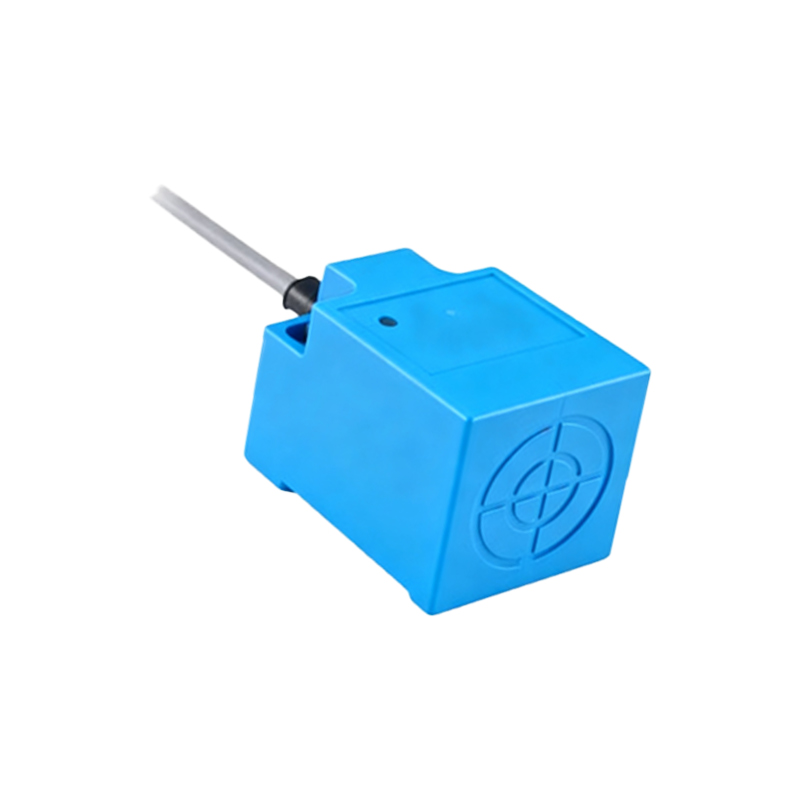
Electrical Conductivity: This determines how easily eddy currents can flow. Aluminum, copper, and brass are excellent conductors but have very low magnetic permeability (approximately equal to 1, similar to air).
Aluminum, being a non-ferrous metal, has extremely low magnetic permeability. Therefore, it does not concentrate the magnetic flux. Its detection relies almost solely on the energy loss caused by eddy currents generated due to its high electrical conductivity. While these eddy currents do occur, the energy loss they cause is substantially lower compared to the combined effect of high permeability and conductivity in ferrous metals. For a standard inductive sensor tuned for steel, the sensing distance for aluminum can be reduced by as much as 60-70%. In many cases, the signal shift is too weak and unstable for the sensor's standard switching threshold to recognize reliably, resulting in failed or intermittent detection.
This poses a major challenge in industries like automotive manufacturing, aerospace, and packaging, where aluminum components are prevalent. A sensor failing to detect an aluminum piston, a machined part, or a can on a conveyor line can lead to production stoppages, quality issues, or machine damage.
Fortunately, several proven solutions address this challenge:
1. Factor-1 Sensors: These are specialized inductive sensors specifically designed for detecting non-ferrous metals. They are calibrated with aluminum as the reference material (hence "Factor-1," where the rated sensing distance is defined for aluminum). Their circuitry is optimized to be more sensitive to the eddy current losses typical of good conductors with low permeability. They will still detect steel, but at a much greater distance than their rated sensing range.
2. Capacitive Proximity Sensors: These sensors detect objects based on their dielectric constant rather than metallic properties. They can detect aluminum, other metals, plastics, liquids, and powders. They work by generating an electrostatic field. Any object that enters the field alters its capacitance, triggering a switch. They are an excellent universal choice but can be more sensitive to environmental factors like moisture or contaminants on the sensor face.
3. Ultrasonic Sensors: Operating on the principle of sound wave reflection, ultrasonic sensors are completely material-agnostic. They can reliably detect aluminum, regardless of its alloy, surface finish, or color, at relatively long distances. They are ideal for applications involving varying target materials or requiring precise distance measurement.
4. Photoelectric Sensors: While not a proximity sensor in the inductive sense, photoelectric sensors (through-beam, retro-reflective, or diffuse) are highly effective for detecting aluminum objects, especially based on their reflective properties. Polished aluminum can be highly reflective, which can be leveraged or compensated for with specialized sensors.
When designing a system involving aluminum detection, the choice of sensor depends on the specific application requirements: required sensing distance, environmental conditions, target size, alloy type, surface condition, and cost. For pure, reliable detection of aluminum in an industrial setting, specifying a Factor-1 inductive sensor is often the most robust and straightforward solution, providing performance comparable to standard sensors on steel.
Understanding the electromagnetic principles behind sensor operation is crucial for correct selection. The inability of standard inductive sensors to detect aluminum is not a flaw but a consequence of physics. By acknowledging this limitation and leveraging the appropriate alternative technologies, engineers can build reliable, efficient, and