Laser displacement sensors are pivotal components in modern industrial automation and precision measurement systems. Operating on the principle of triangulation or time-of-flight, these devices emit a focused laser beam onto a target surface and analyze the reflected light to calculate distance with exceptional accuracy. The core mechanism involves a laser diode, a receiving lens, and a position-sensitive detector. When the laser spot hits the target, its reflection is captured by the receiver. Any change in the target's position alters the angle of the reflected beam, causing the light spot to shift on the detector. This shift is precisely measured and converted into a distance value via sophisticated internal algorithms.
The advantages of laser displacement sensors are manifold. They offer non-contact measurement, eliminating mechanical wear and allowing inspection of delicate or moving objects. High-speed response capabilities enable real-time monitoring in dynamic processes, while sub-micron resolution ensures data integrity for the most demanding tasks. Furthermore, their compact design and robustness make them suitable for harsh industrial environments involving vibration, dust, or temperature variations.
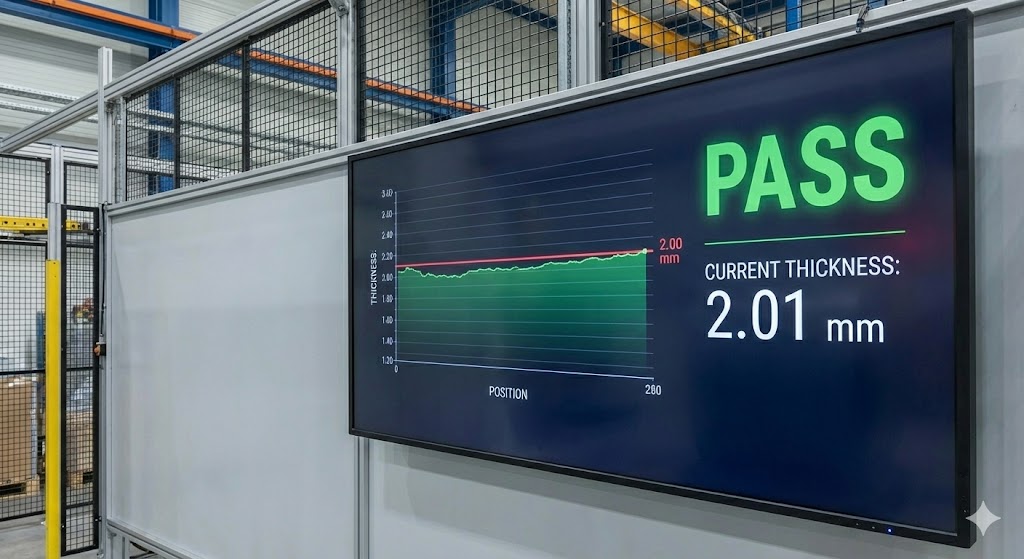
In practical applications, these sensors are indispensable across diverse sectors. In automotive manufacturing, they verify component dimensions, inspect weld seams, and control robot positioning. The electronics industry relies on them for chip placement verification, PCB flatness inspection, and connector pin height measurement. Within aerospace, they contribute to turbine blade profiling and airframe gap inspection. Beyond manufacturing, they are used in structural health monitoring of bridges and buildings, as well as in medical devices for precise alignment.
Selecting the appropriate laser displacement sensor requires careful consideration of several parameters. Measurement range defines the minimum and maximum distances the sensor can handle. Spot size influences resolution and suitability for small features or textured surfaces. Sampling speed must match the process dynamics. Environmental factors like ambient light, temperature extremes, and target material properties (color, reflectivity, transparency) significantly impact performance. Modern sensors often integrate advanced features such as analog/digital outputs, programmable logic, and software suites for data analysis and system integration.
Installation and calibration are critical for optimal performance. Proper alignment relative to the target surface is essential to avoid cosine error. Mounting must be stable to prevent vibration-induced noise. Regular calibration against known standards maintains long-term accuracy. Users should also implement protective measures, such as air purge units for dirty environments or protective housings for mechanical risks.

The future of laser displacement sensing is geared towards enhanced intelligence and integration. Developments include multi-point and profile measurement capabilities, embedded IoT connectivity for predictive maintenance, and improved algorithms to handle challenging surfaces like transparent glass or shiny metals. As Industry 4.0 advances, these sensors will become even more central to creating adaptive, data-driven production systems.
In conclusion, laser displacement sensors are versatile, high-precision tools that form the backbone of modern quality control and automation. Understanding their operating principles, key specifications, and application best practices is crucial for engineers and technicians to leverage their full potential, driving efficiency and innovation in countless industrial fields.