Laser distance sensors, also known as laser rangefinders or LiDAR (Light Detection and Ranging) sensors in some contexts, are pivotal components in automation, robotics, and precision measurement. These devices operate on the fundamental principle of emitting laser light toward a target and analyzing the reflected signal to calculate distance with high accuracy. The core working mechanisms primarily fall into three categories: time-of-flight (ToF), phase-shift measurement, and triangulation.
Time-of-flight is one of the most straightforward methods. The sensor emits a short pulse of laser light, which travels to the target object and reflects back to a detector within the sensor. An internal high-speed clock measures the elapsed time between emission and reception. Since the speed of light is constant (approximately 3×10^8 meters per second), the distance can be calculated using the formula: Distance = (Speed of Light × Time of Flight) / 2. This method is effective for long-range measurements, often used in surveying, automotive safety systems, and aerial mapping. However, it requires extremely precise timing circuits for accuracy at shorter distances.
Phase-shift measurement, often employed for medium to high-precision applications, uses a continuous-wave laser beam modulated at a specific frequency. The sensor compares the phase difference between the emitted light and the reflected light. This phase shift is directly proportional to the distance traveled. By analyzing the shift, the sensor computes the distance with resolutions that can reach sub-millimeter levels. This technique is common in industrial automation for tasks like positioning, thickness monitoring, and fill-level detection in containers. Its advantage lies in excellent accuracy over moderate distances, though it can be influenced by the target's surface properties.
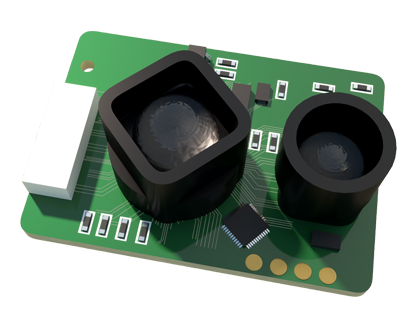
Triangulation is a geometric method ideal for short-range, high-accuracy measurements. The sensor projects a laser spot onto the target. A receiver lens, positioned at a known angle from the emitter, captures the spot's image. As the target distance changes, the position of the laser spot on the receiver's sensor (like a CCD or CMOS array) shifts. Using trigonometric calculations, the precise distance is determined. This method offers very high resolution and is widely used in quality control, 3D scanning, and assembly line inspections. However, it requires a clear line of sight and can be sensitive to ambient light interference.
Key components of a laser distance sensor include the laser diode (typically using visible red or infrared light), optics for beam shaping and focusing, a photodetector, and sophisticated signal processing electronics. The choice of laser wavelength depends on the application; for instance, infrared lasers are less affected by ambient light, while visible lasers aid in alignment. Advanced sensors incorporate features like background suppression, which filters out irrelevant reflections, and multiple echo evaluation to handle complex surfaces.
In industrial settings, these sensors enable non-contact measurement, which is crucial for fragile, hot, or moving objects. Applications span from robot guidance and warehouse logistics (e.g., pallet sizing) to construction (monitoring structural deformations) and agriculture (crop height mapping). Their integration with IoT and Industry 4.0 systems allows for real-time data collection and predictive maintenance, enhancing operational efficiency.
Despite their advantages, challenges persist. Factors like target material, color, and surface finish can affect reflectivity and measurement accuracy. Highly reflective or transparent surfaces may require special coatings or sensor settings. Environmental conditions such as dust, fog, or extreme temperatures also pose limitations, often necessitating protective housings or complementary sensor technologies.
Future trends point toward miniaturization, reduced power consumption, and enhanced smart capabilities. The development of solid-state LiDAR and integration with artificial intelligence for adaptive sensing are expanding possibilities in autonomous vehicles, smart manufacturing, and beyond. Understanding the underlying laser principles empowers engineers to select the appropriate sensor type, ensuring reliable performance in diverse operational landscapes.