In the high-stakes world of financial security, the battle against counterfeit currency is relentless. Traditional methods of verification, relying on human inspection of watermarks, security threads, and color-shifting inks, are increasingly vulnerable to sophisticated forgeries. Enter laser displacement sensors, a non-contact measurement technology that is transforming currency authentication from an art into a precise, data-driven science. By leveraging the principles of triangulation and laser reflection, these sensors provide an unforgeable fingerprint of a banknote's unique physical structure.
At its core, a laser displacement sensor projects a focused beam of light onto the surface of a banknote. The reflected light is captured by a receiving element, typically a CMOS or PSD (Position Sensitive Device). By calculating the angle of the reflected beam, the sensor determines the exact distance to the measurement point with micron-level accuracy. When this point is scanned across a banknote, it generates a detailed topographical map of the surface. This map reveals the subtle, intentional textures and elevations that are integral to modern currency design—features far more difficult to replicate than printed patterns.
The true power of this technology lies in its ability to quantify the third dimension: height. Consider the intaglio printing process used by mints worldwide. This technique deposits thick layers of ink, creating a distinctive, tactile raised feel on elements like portraits, numerals, and lettering. A counterfeit operation might simulate the visual appearance of intaglio, but replicating the exact height profile—the precise micro-millimeter peaks and valleys—is a monumental engineering challenge. A laser displacement sensor scans these critical areas, measuring the exact height and cross-sectional shape of the raised ink. The sensor's controller compares this live data against a stored, certified reference profile. Any deviation outside a strict tolerance window triggers an immediate rejection.
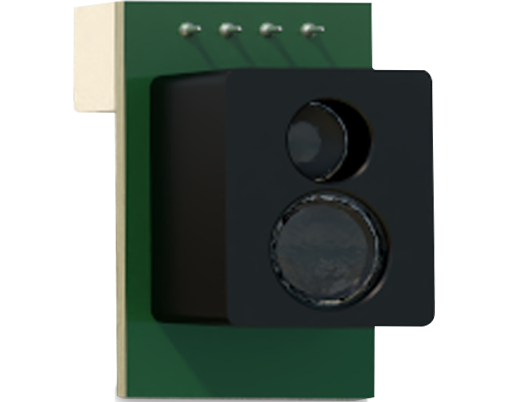
Furthermore, the technology excels at verifying security features invisible to the naked eye. Micro-perforations, for instance, are tiny holes often forming a pattern or value. A laser sensor can detect not just their presence by measuring the sudden drop in surface level at the hole's edge, but also their precise diameter and depth. Similarly, the complex embossing on holographic strips or the specific texture of specialized substrate paper can be mapped and authenticated. The sensor operates at high speed, capable of making thousands of measurements per second, making it ideal for integration into high-throughput sorting machines at central banks, casinos, and retail cash processing centers.
The advantages over traditional optical sensors are profound. Optical sensors primarily analyze color and 2D patterns, which can be deceived by high-quality color copying. Laser displacement sensors, however, are largely immune to color variations. They measure physical geometry, a property independent of ink color. This makes them exceptionally robust against washed, faded, or soiled notes that might fool other systems. They provide an objective, numerical assessment, eliminating human subjectivity and fatigue from the verification process.

Implementation requires careful calibration. A reference library of authentic height profiles for each denomination and series must be established. Advanced algorithms then analyze the scan data, looking not just at single points but at the spatial relationship between features—the distance between intaglio lines, the slope of an embossed edge, the pattern of a background guilloche. Modern systems often combine laser displacement sensing with multispectral imaging, creating a multi-layered defense that examines both physical structure and material composition.

As counterfeiters adopt more advanced technologies like precision printing and chemical bleaching, the financial industry's defense must stay ahead. Laser displacement sensors offer a future-proof solution. They move authentication beyond superficial inspection to a fundamental analysis of a banknote's manufactured identity. This technology is not just detecting fakes; it is positively confirming authenticity based on immutable physical characteristics, ensuring the integrity of cash transactions and bolstering public trust in the currency system. From banknote printing presses to automated teller machines and vending systems, laser triangulation is setting a new, nearly impassable standard for security.