In the realm of industrial automation, proximity sensors play a pivotal role in enabling non-contact detection of objects, ensuring efficiency, safety, and precision. Among the various types available, E2B proximity sensors have established themselves as a reliable and widely adopted solution. This article delves into the fundamentals, working principles, types, and key applications of E2B proximity sensors, providing a thorough understanding for engineers and technicians in the electrical and automation fields.
E2B proximity sensors are inductive sensors designed to detect metallic objects without physical contact. The "E2B" designation typically refers to a specific series or model family from manufacturers like Omron, a leading name in industrial components. These sensors operate on the principle of electromagnetic induction. Inside the sensor, an oscillator generates a high-frequency electromagnetic field that emanates from the sensing face. When a metallic object enters this field, eddy currents are induced on the surface of the object. This causes a change in the oscillation amplitude or frequency within the sensor's circuit. The sensor's detection circuit monitors this change and triggers an output signal—either a switching signal (ON/OFF) or an analog signal proportional to the distance.
One of the primary advantages of E2B inductive proximity sensors is their robustness. They are typically housed in rugged metal or high-grade plastic casings, making them resistant to environmental factors such as dust, oil, coolant, and mechanical vibrations commonly found in industrial settings like machining centers, assembly lines, and material handling systems. Their non-contact nature eliminates mechanical wear, leading to a long operational life and minimal maintenance requirements.
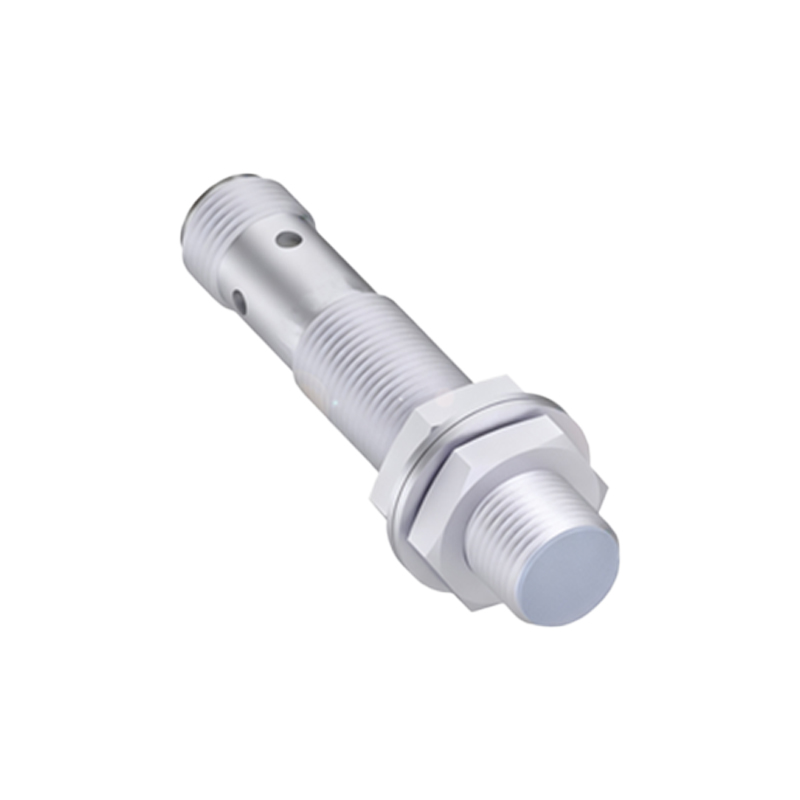
E2B sensors come in various form factors and sensing ranges to suit diverse applications. Common types include cylindrical (threaded barrel) models, rectangular or block-style models, and ring-shaped models for specific detection tasks like checking for the presence of nuts or washers. Sensing distances can vary from a few millimeters to several tens of millimeters, with factors like the target material (steel, aluminum, brass), target size, and installation conditions influencing the effective range. It is crucial to consult the datasheet for the specific E2B model to understand its nominal sensing distance (Sn) and ensure proper installation with adequate derating for reliable operation.
Output configurations are another critical consideration. E2B sensors are available with different output types:

- DC 2-wire: Simple to wire but may have a residual current when off.
- DC 3-wire (NPN or PNP): The most common type, offering clear switching signals. NPN outputs sink current to common negative, while PNP outputs source current from common positive.
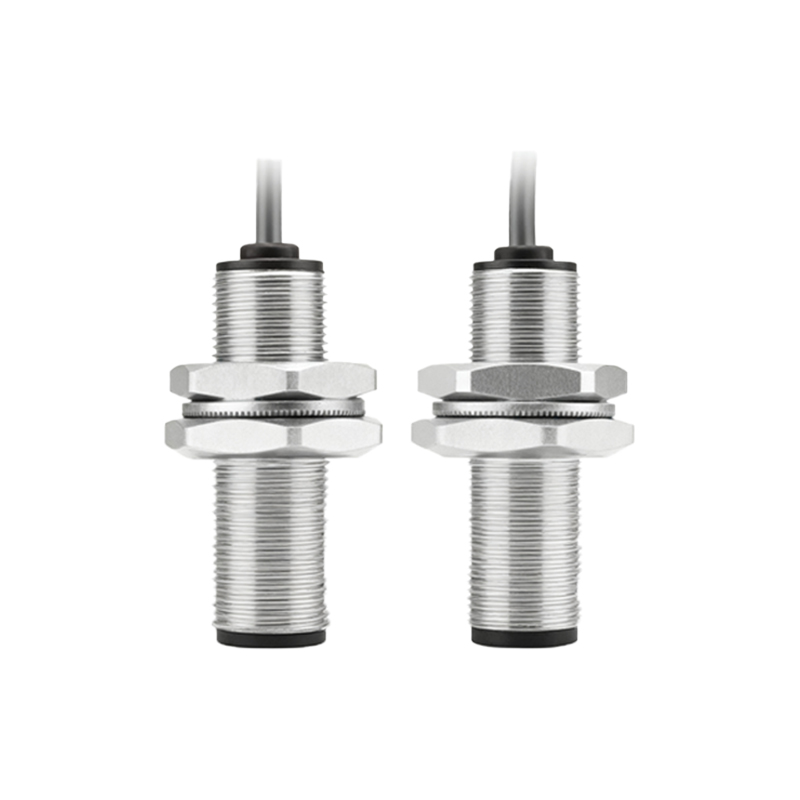
- DC 4-wire: Often combines both an NPN and a PNP output in one device.
- Analog Output (e.g., 4-20mA, 0-10V): Provides a continuous signal proportional to the distance to the target, useful for positioning or monitoring applications.
Selecting the right E2B sensor involves evaluating several parameters:
1. Target Material: Standard inductive sensors best detect ferrous metals (like mild steel). For non-ferrous metals (aluminum, copper), sensors with a reduced sensing range or specialized "all-metal" detection models are required.
2. Sensing Distance: Choose a sensor with a nominal sensing distance greater than the required installation gap to account for tolerances and ensure consistent detection.
3. Environmental Conditions: Consider the IP (Ingress Protection) rating for dust and water resistance, temperature range, and resistance to chemicals or welding spatter.
4. Electrical Requirements: Match the supply voltage (commonly 10-30V DC) and output type with the control system (e.g., PLC input module).
5. Mounting: Ensure the sensor body and sensing face can be properly installed in the available space, considering flush or non-flush mounting styles. Flush-mounted sensors can be embedded in metal without affecting their sensing range, whereas non-flush models offer longer ranges but require clearance around the sensing face.
In practice, E2B proximity sensors are ubiquitous in manufacturing. They are used for tasks such as part presence verification on conveyor belts, end-of-travel detection on linear actuators, counting metallic objects, monitoring rotational speed by detecting gear teeth, and ensuring correct positioning in robotic pick-and-place systems. Their reliability makes them indispensable for safety interlocks on machine guards and doors.
Installation and wiring best practices are straightforward but essential. Maintain the specified mounting distances between multiple sensors to prevent mutual interference. Use shielded cables in electrically noisy environments and ensure proper grounding. Always power down the circuit during installation or maintenance. For optimal performance, periodically clean the sensing face of any accumulated debris or metal chips that could cause false triggering.
In conclusion, E2B proximity sensors represent