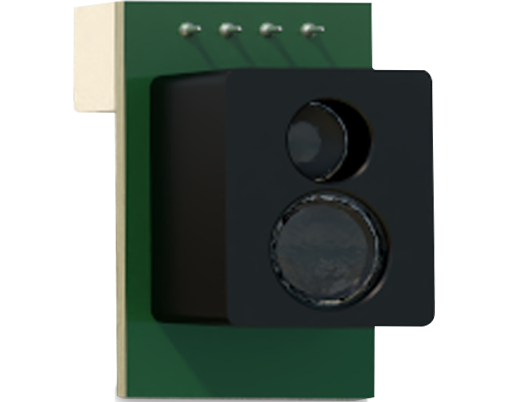
In the realm of industrial automation and precision measurement, laser sensors have become indispensable tools. Their ability to provide non-contact, high-accuracy detection and measurement has revolutionized processes across manufacturing, robotics, and quality control. However, with their widespread use comes a critical safety consideration: the interaction between laser emissions and eyewear. This article delves into the technical aspects of laser sensor operation, the potential risks associated with exposure to various types of eyewear, and the essential safety protocols and application considerations for engineers and technicians.
Laser sensors operate by emitting a focused beam of light—coherent, monochromatic, and often highly collimated. Common types include through-beam, retro-reflective, and diffuse reflective sensors, each utilizing the laser beam differently for object detection, distance measurement, or profile scanning. The laser classes, defined by international standards such as IEC 60825-1, are paramount. Class 1 and Class 2 lasers are generally considered safe under normal operating conditions, with Class 2 requiring caution against staring directly into the beam. Class 3R, 3B, and particularly Class 4 lasers pose significant eye hazard risks, where even diffuse reflections or momentary exposure can cause severe retinal injury.
The core of the safety issue lies in the interaction with eyewear. Standard prescription glasses, safety glasses (without laser-specific filtering), and even some sunglasses can pose a risk. They are not designed to attenuate specific laser wavelengths. In some scenarios, they might inadvertently focus the laser beam, concentrating its energy onto a smaller area of the retina and potentially exacerbating injury. The lens material, coatings, and curvature can alter the beam's path in unpredictable ways. For instance, anti-reflective coatings on prescription lenses are optimized for visible light, not necessarily for the near-infrared wavelengths commonly used in industrial laser sensors.

Therefore, the use of Laser Protective Eyewear (LPE) is non-negotiable in environments with Class 3B and Class 4 lasers. This specialized eyewear is characterized by its Optical Density (OD) rating at specific wavelengths. An OD rating indicates the logarithmic scale of attenuation. For example, eyewear with an OD of 5 at 905nm reduces the laser irradiance by a factor of 100,000. Selecting the correct LPE requires precise knowledge of the laser sensor's wavelength, power output, and pulse characteristics. Using eyewear with an insufficient OD rating provides a false sense of security, while over-specified eyewear may unnecessarily darken the visible field of view, creating other workplace hazards.
Beyond safety, the interaction between lasers and eyewear has practical implications for sensor performance. In applications involving barcode scanning or object recognition on moving personnel (e.g., in warehouses with smart glasses), the laser beam might intermittently strike the wearer's glasses. This can cause temporary signal saturation, reflection noise, or complete signal loss, leading to read errors. Sensor engineers must account for these potential interferences during system design, possibly by adjusting scanning angles, using specific polarization filters, or implementing software algorithms to distinguish between a genuine object and a spurious reflection from eyewear.

For system integrators and maintenance personnel, rigorous protocols are essential. These include conducting a thorough laser hazard risk assessment for each installation, clearly marking laser hazard zones with appropriate signage, and enforcing strict personal protective equipment (PPE) policies. Training must emphasize that laser safety eyewear is wavelength-specific; glasses that protect against a 650nm red laser will not necessarily protect against an 850nm infrared laser. Regular inspection of LPE for scratches or damage is also crucial, as imperfections can compromise their protective capabilities.
In conclusion, the relationship between laser sensors and eyewear is multifaceted, intertwining critical safety engineering with practical application challenges. The invisible threat posed by certain laser wavelengths makes proactive risk management imperative. By understanding laser classifications, mandating the use of correctly specified laser protective eyewear, and designing systems with these interactions in mind, electrical engineers and industry professionals can harness the full power of laser sensor technology while safeguarding one of our most vital assets: human vision. The principle is clear: in the precise world of laser sensing, there is no room for optical compromise when it comes to eye safety.