In the realm of industrial automation and machine design, proximity sensors are indispensable components for non-contact object detection. A critical decision facing engineers and system integrators is the choice between embedded (flush-mounted or埋入) and non-embedded (non-flush-mounted or非埋入) installation. This choice significantly impacts sensor performance, application suitability, installation complexity, and overall system reliability. Understanding the fundamental differences, advantages, and limitations of each mounting style is paramount for optimal design.
Fundamental Operating Principle and the Mounting Impact
Most inductive proximity sensors operate on the principle of generating an electromagnetic field. When a metallic target enters this field, it induces eddy currents, causing a change in the sensor's oscillation amplitude, which is then detected. The key distinction between embedded and non-embedded mounting lies in how this field is shaped and directed.
Non-Embedded (Non-Flush) Sensors: Maximizing Range
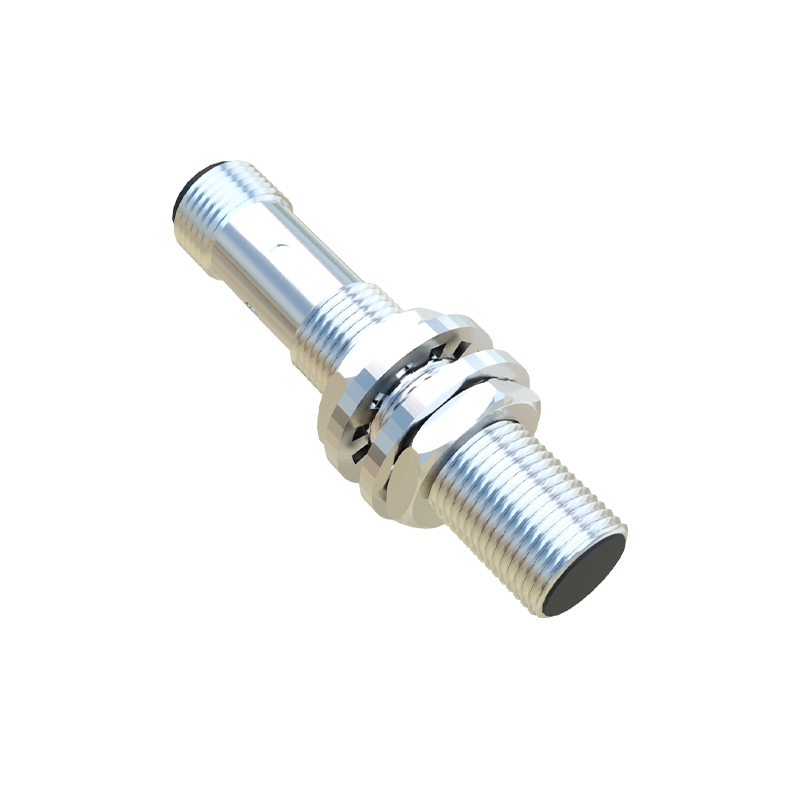
Non-embedded sensors are designed to be installed with their sensing face protruding from the mounting surface. This configuration allows the electromagnetic field to propagate freely in all directions—frontally and radially. The primary advantage is a significantly longer sensing range, often 2 to 3 times greater than that of an embedded sensor of the same size. For instance, an 18mm diameter non-embedded sensor might offer a nominal sensing distance (Sn) of 8mm, compared to 5mm for its embedded counterpart.
This extended range provides greater flexibility in mechanical design, allowing for more tolerance in target positioning. They are ideal for applications where the target may not pass directly in front of the sensor or where a generous detection margin is required. However, this omnidirectional field is also their Achilles' heel. Non-embedded sensors are susceptible to false triggers from metallic objects approaching from the sides, such as machine frames, bolts, or moving parts adjacent to the intended sensing path. They require careful consideration of the surrounding environment to ensure only the correct target is detected.
Embedded (Flush) Sensors: Precision and Environmental Immunity
Embedded sensors are installed flush with (or recessed into) a metal mounting bracket or machine surface. Their design incorporates a shielding (usually a ferrite core or metal ring) around the coil. This shielding focuses the electromagnetic field strictly forward, dramatically reducing its radial spread. Consequently, the sensing range is shorter, but the sensor gains a high degree of immunity to lateral interference.
This makes embedded sensors exceptionally robust in congested mechanical environments. They can be installed side-by-side or in close proximity to metal structures without mutual interference or false actuation. They are the default choice for applications like end-position detection of cylinders (where the sensor is mounted directly in the aluminum profile), material presence detection in metal chutes, or any scenario where the sensor must be surrounded by metal. The flush mounting also offers superior physical protection for the sensing face against impacts or abrasion.
Key Comparison and Selection Criteria
1. Sensing Distance: Non-embedded wins for longer range. Embedded is preferred for short-range, precise detection.
2. Environmental Interference: Embedded excels in metallic, congested environments. Non-embedded requires clear lateral space.
3. Installation: Embedded mounting often requires precise machining of a mounting hole and may need a specific bracket. Non-embedded installation can be simpler but may necessitate stand-off spacers to achieve the required protrusion.
4. Target Material: Both detect ferrous metals (steel, iron) best. For non-ferrous metals like aluminum, copper, or brass, the sensing range reduces, and the difference between embedded and non-embedded ranges becomes even more pronounced. Sensor datasheets typically provide reduction factors.
5. Target Size: The target must be at least equal to the sensor's sensing face diameter for standard sensing distance. For small targets, a factor must be applied, affecting both types.
6. Application Examples:
Choose Non-Embedded: Conveyor line counting with varying object heights, rotary cam detection where target path is not perfectly aligned, overstroke detection on cylinders with plastic brackets.
Choose Embedded: Hydraulic cylinder piston detection, metal part ejection confirmation in a press, level detection in a metal tank, any mounting within a metal machine frame.
Advanced Considerations: Factor 1 and All-Metal Sensing
A crucial specification is the "installation factor." For embedded sensors, this is often defined as the reduction in sensing distance when mounted in different materials (e.g., steel vs. aluminum). Engineers must consult the datasheet to derate the sensing range accordingly.
Furthermore, the rise of "all-metal" or "factor 1" sensors has blurred the traditional lines. These advanced inductive sensors use specialized algorithms and coil designs to detect all metals (ferrous and non-fer