In the realm of industrial automation, precision measurement and reliable object detection are paramount. Among the myriad of sensing technologies available, laser distance proximity sensors have emerged as a sophisticated and highly accurate solution. These devices utilize laser light to determine the presence, absence, or precise distance of an object without physical contact, offering significant advantages in various demanding applications.
The fundamental operating principle of a laser distance proximity sensor is based on the time-of-flight (ToF) or triangulation method. In the ToF approach, the sensor emits a short pulse of laser light towards a target. A photodetector within the sensor then captures the light reflected back. By precisely measuring the time interval between the emission and reception of the laser pulse, and knowing the constant speed of light, the sensor's internal processor calculates the distance to the object with remarkable accuracy. The triangulation method, often used for shorter ranges and higher precision, involves projecting a laser spot onto the target. The reflected light is focused onto a position-sensitive detector (like a CCD or PSD). The position of the light spot on this detector changes with the target's distance, allowing for precise distance calculation through geometric principles.
Key components of a typical laser sensor include the laser diode (usually in the visible red or infrared spectrum), the transmitting optics, the receiving optics, the photodetector, and a signal processing unit. Modern sensors integrate advanced microprocessors that filter noise, compensate for environmental variables, and provide stable, repeatable measurements.
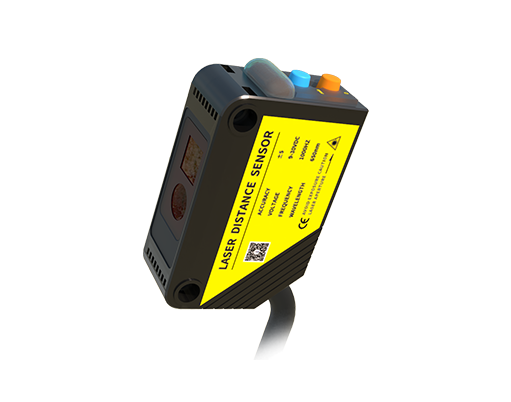
The advantages of laser distance proximity sensors are compelling. They offer exceptionally high measurement accuracy, often down to sub-millimeter levels, and excellent resolution. Their measurement range can vary significantly, from a few centimeters to several hundred meters, depending on the model and technology. The laser's focused beam allows for precise detection of small objects or edges, minimizing interference from background objects. Furthermore, they are largely unaffected by the color, material (within reason, as highly absorbent surfaces can reduce signal strength), or surface texture of the target, although glossy surfaces may cause specular reflection issues. Their non-contact nature eliminates wear and tear, ensuring long-term reliability.
These sensors find extensive applications across numerous industries. In factory automation, they are used for precise positioning of robotic arms, controlling roll diameters in winding machines, and measuring part dimensions for quality control. In logistics and warehousing, they monitor fill levels in silos and bins, and guide automated guided vehicles (AGVs). The automotive industry employs them for assembly line verification and gap measurement. They are also crucial in construction for leveling and alignment, and in agriculture for monitoring crop height and guiding machinery.

When selecting a laser distance proximity sensor for a specific application, several critical parameters must be considered. The *measuring range* defines the minimum and maximum distances the sensor can handle. The *accuracy* and *repeatability* specifications determine the precision of the measurements. The *response time* or sampling rate is vital for high-speed applications. The *laser class* (typically Class 2 or Class 2M for industrial sensors) indicates safety levels, requiring appropriate caution to avoid direct eye exposure. Environmental factors such as *ambient light immunity*, *operating temperature*, and *ingress protection (IP) rating* for dust and moisture resistance are crucial for reliable operation in harsh conditions. Finally, the *output interface* (analog 4-20mA/0-10V, digital IO-Link, RS-232, Ethernet/IP, Profinet) must be compatible with the existing control system.
Installation and commissioning require attention to detail. The sensor must be securely mounted to minimize vibration. The laser beam should be aligned perpendicular to the target surface for optimal reflection, especially for diffuse surfaces. For challenging targets like transparent materials or highly reflective surfaces, special models with background suppression or advanced filtering algorithms may be necessary. Regular maintenance primarily involves keeping the lens clean from dust, oil, or debris to ensure consistent performance.
In conclusion, laser distance proximity sensors represent a pinnacle of non-contact measurement technology. Their blend of high precision, versatility, and robustness makes them an indispensable tool in modern industrial systems. By understanding their operating principles, key features, and selection criteria, engineers and technicians can effectively harness their capabilities to enhance automation, improve quality, and boost operational efficiency across a wide spectrum of applications. As technology advances, we can expect these sensors to become even more compact, intelligent, and integrated into the Industrial Internet of Things (IIoT) ecosystem.