Proximity sensors are indispensable components in modern industrial automation, robotics, and safety systems. They detect the presence or absence of objects without physical contact, offering reliability, longevity, and high-speed operation. Classification by operating principle is fundamental for selecting the right sensor for a specific application. This article delves into the primary types of proximity sensors based on their core working mechanisms.
The most prevalent type is the Inductive Proximity Sensor. It operates on the principle of electromagnetic induction. The sensor generates an oscillating electromagnetic field from its coil. When a metallic object (ferrous or non-ferrous) enters this field, eddy currents are induced in the target, causing a change in the oscillation amplitude or frequency. This change is detected by the sensor's circuitry, triggering an output signal. Inductive sensors are robust, resistant to environmental factors like dust and oil, and are ideal for detecting metals in machine automation, position sensing, and part counting.
Capacitive Proximity Sensors function by detecting changes in capacitance. The sensor's active face and the target act as two plates of a capacitor. The sensor generates an electrostatic field. When any material (metal, plastic, wood, liquid, or granules) enters this field, it alters the dielectric constant and thus the capacitance. This change is measured, and the output switches state. Capacitive sensors can detect non-metallic objects and are widely used in level detection of liquids or powders, material handling, and presence detection of various substances.
Magnetic Proximity Sensors, often called reed switches or Hall-effect sensors, detect magnetic fields. Reed switches consist of two ferromagnetic reeds sealed in a glass tube. When a permanent magnet approaches, the reeds magnetize and attract each other, closing the electrical contact. Hall-effect sensors produce a voltage (Hall voltage) when a magnetic field is applied perpendicular to current flow in a conductor. These sensors are used for position sensing of cylinders (with magnetic pistons), door/window security systems, and speed detection in rotating equipment.
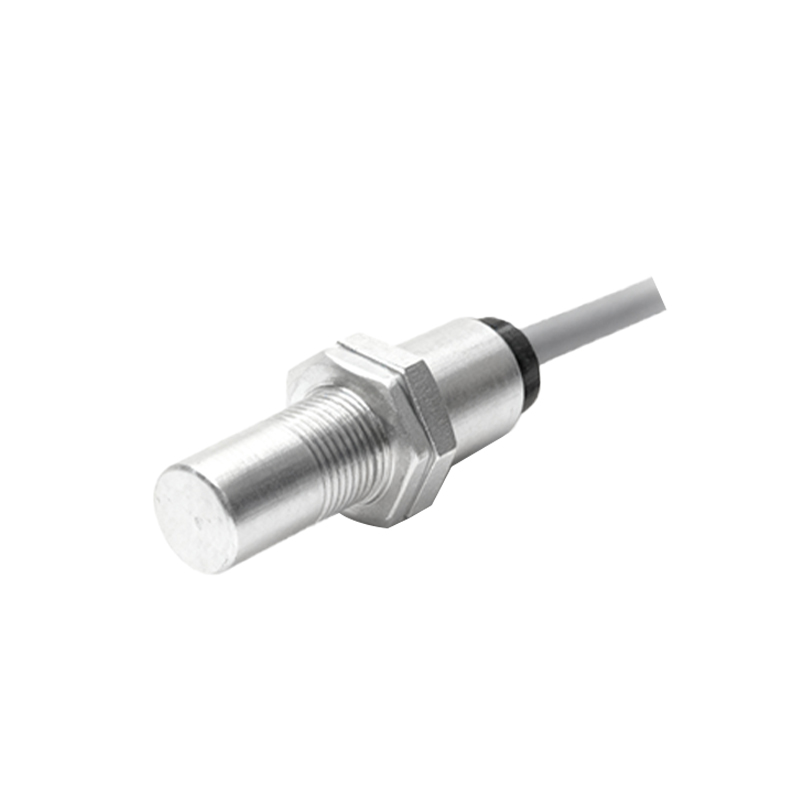
Ultrasonic Proximity Sensors utilize sound waves beyond human hearing. They emit high-frequency ultrasonic pulses and measure the time taken for the echo to return after reflecting off a target. The time-of-flight principle allows them to calculate distance. They can detect almost any material, regardless of color or transparency, and are effective in challenging environments with dust, smoke, or light interference. Common applications include distance measurement, object detection on conveyors, and liquid level control in tanks.
Photoelectric Sensors, while sometimes categorized separately, are a crucial non-contact proximity technology. They consist of a light emitter (usually LED) and a receiver. In the proximity-sensing context, the diffuse reflective mode is common. The sensor emits light, which reflects off the target back to the receiver. Detection occurs when the reflected light intensity exceeds a threshold. They excel at detecting small objects, offer long sensing ranges, and can sense various materials, but their performance can be affected by color, surface finish, and ambient light.
Each principle offers distinct advantages. Inductive sensors are precise for metals. Capacitive sensors offer material versatility. Magnetic sensors are simple and reliable for harsh environments. Ultrasonic sensors provide excellent range and material independence. Photoelectric sensors offer flexibility and long range. The choice depends on factors like target material, required sensing distance, environmental conditions (temperature, contaminants), response speed, and electrical output needs. Understanding these core operating principles is the first critical step toward implementing an efficient, reliable, and cost-effective sensing solution in any automated system.