Laser displacement sensors are non-contact measurement devices that have become indispensable in modern industrial automation and quality control. Operating on the principle of triangulation or time-of-flight, these sensors project a focused laser beam onto a target surface. The reflected light is captured by a receiving element, such as a CCD or PSD. By calculating the angle or time difference between the emitted and reflected light, the sensor's internal processor determines the precise distance to the target with high accuracy and speed. This fundamental principle enables reliable measurement regardless of material color, texture, or ambient light conditions in most applications, making them superior to traditional contact probes or ultrasonic sensors in many scenarios.
The core advantages of laser displacement sensors drive their widespread adoption. They offer exceptional resolution, often down to the sub-micron level, and high sampling rates, allowing for real-time monitoring of fast-moving production lines. Their non-contact nature eliminates mechanical wear, ensures no damage to delicate surfaces, and allows measurement of hot, soft, or vibrating objects. Key performance specifications include measuring range, spot size, linearity, repeatability, and response frequency. For instance, a sensor with a 50mm range might achieve ±0.05% linearity and a 0.1µm resolution, while a long-range model for 500mm might offer ±0.2% linearity. The choice between a red laser and a blue laser is critical; blue lasers, with their shorter wavelength, provide a smaller, more precise spot size and are less susceptible to penetration or scattering on transparent or glossy surfaces like glass or polished metal.
In practical industrial applications, these sensors solve numerous measurement and inspection challenges. On assembly lines, they perform critical tasks such as measuring component thickness, checking coplanarity of semiconductor leads, monitoring vibration amplitude of motors, and profiling object contours for dimensional verification. In robotics, they provide essential feedback for precise guidance and positioning, enabling tasks like bin picking or seam tracking in welding. The electronics industry relies on them for solder paste inspection, wafer warpage measurement, and connector pin height verification. Furthermore, they are pivotal in roll gap control in steel mills, tire tread profiling in automotive plants, and thickness monitoring of extruded plastics or coated materials.
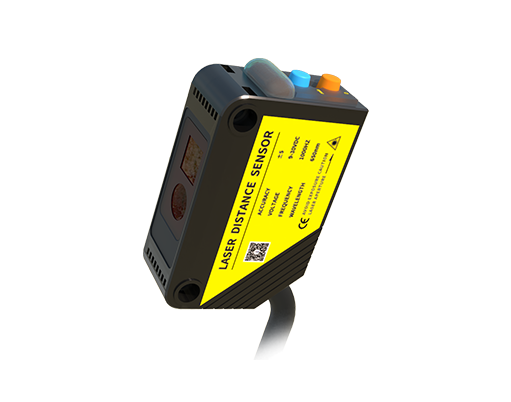
Selecting the appropriate laser displacement sensor requires a detailed analysis of the application requirements. Engineers must first define the measurement target: its material, surface finish, color, and possible movement or vibration. A dark, matte surface absorbs more light, potentially requiring a sensor with higher laser output, while a shiny surface may need a model with specialized glare suppression algorithms. The required accuracy, repeatability, and measurement speed dictate the necessary specifications. Environmental factors are equally crucial; industrial settings may involve oil mist, dust, coolant, or significant temperature fluctuations, necessitating sensors with robust IP67 or IP69K enclosures and stable temperature compensation. Integration considerations include the physical mounting constraints, required output interfaces (analog voltage/current, digital Ethernet, PROFINET, etc.), and compatibility with existing PLC or data acquisition systems. For complex profiles, 2D scanning sensors that use a sweeping laser line are often preferred over single-point models.

Recent technological advancements continue to expand the capabilities of laser displacement sensors. The integration of CMOS technology has improved light reception efficiency and enabled smarter sensors with built-in judgment functions. High-speed models now achieve sampling rates exceeding 200 kHz, capturing ultra-fast processes. The development of confocal chromatic sensors offers another high-precision alternative for multi-layer and transparent material measurement. Furthermore, the convergence with AI and machine vision is a significant trend. Modern sensors can stream dense point cloud data to vision systems, where AI algorithms perform advanced classification, defect detection, and predictive analytics, moving beyond simple distance measurement to comprehensive process intelligence.
In conclusion, laser displacement sensors are a cornerstone technology for precision in Industry 4.0. Their ability to deliver fast, accurate, and reliable non-contact measurements makes them vital for enhancing quality, optimizing processes, and enabling automation across diverse sectors. A successful implementation hinges on a thorough understanding of both sensor technology and the specific application's demands, ensuring the selected sensor delivers optimal performance and a strong return on investment in the demanding industrial landscape.