In modern industrial automation and precision measurement, laser displacement sensors have become indispensable tools. Their ability to provide non-contact, high-accuracy, and high-speed measurements makes them ideal for applications ranging from quality control and robotics to vibration analysis and thickness gauging. However, the true potential of these sophisticated sensors is unlocked only through their interfaces—the critical communication bridges that connect the sensor to the wider control system. This article delves into the common interface types, their selection criteria, and practical integration considerations for engineers.
The primary function of any sensor interface is to transmit the measured data reliably and efficiently. For laser displacement sensors, the choice of interface is dictated by factors such as required sampling speed, communication distance, system compatibility, and environmental robustness. The most prevalent interfaces can be broadly categorized into digital and analog types.
Digital interfaces are favored for their noise immunity, multi-device networking capability, and ability to transmit rich data packets beyond just the displacement value. Common protocols include:

1. RS-232/RS-422/RS-485 (Serial Communication): These are foundational industrial standards. RS-232 is simple for point-to-point connections over short distances. RS-422 and RS-485 support multi-drop configurations, allowing several sensors to communicate on a single bus line over longer distances, making them cost-effective for distributed systems.
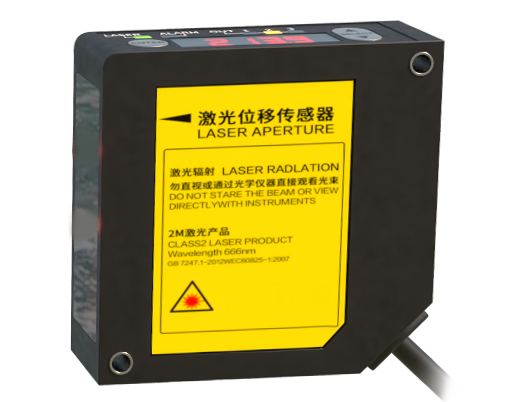
2. Ethernet (TCP/IP, EtherNet/IP, PROFINET): Ethernet interfaces are becoming the de facto standard for factory floor connectivity. They offer high-speed data transfer, long-distance capability, and seamless integration into plant-wide networks. Protocols like EtherNet/IP or PROFINET provide deterministic real-time communication essential for synchronized multi-axis measurements.
3. USB: Universal Serial Bus interfaces are extremely common for benchtop setups, prototyping, and direct connection to PCs for configuration and data logging. They offer plug-and-play convenience and high bandwidth but are generally not suited for harsh industrial environments over long distances.
4. Fieldbus Protocols (PROFIBUS, DeviceNet, CC-Link): These are traditional, robust networks deeply embedded in specific automation architectures. Sensor selection often aligns with the existing fieldbus infrastructure of a factory.

Analog interfaces, on the other hand, provide a continuous voltage or current signal proportional to the measured displacement. The most common standards are:
* Analog Voltage (0-5V, 0-10V, ±5V, ±10V): Provides a straightforward, easily interpreted signal. However, voltage signals can be susceptible to electrical noise over long cable runs.
* Analog Current (4-20mA): Renowned for its high noise immunity and ability to power the sensor over the same two wires (loop power). The 4mA "live zero" allows the system to distinguish between a true zero reading and a sensor fault or broken wire.
Beyond these, many sensors offer discrete I/O (Input/Output) for simplified control. These include digital outputs for triggering measurements, marking parts, or signaling when a measurement falls outside preset tolerance limits (Hi/Go/Lo outputs). High-speed synchronous triggers are crucial for capturing data at precise moments, such as on a moving conveyor belt.
Selecting the appropriate interface requires a systematic analysis of the application:
* Speed Requirement: High-speed inspection lines demand interfaces with minimal latency and high sampling rates, such as Ethernet with real-time protocols or dedicated high-speed digital I/O.
* Integration Environment: The choice is often constrained by the host controller (PLC, IPC, CNC). Matching the sensor's interface to the controller's available ports is paramount.
* Noise and Distance: For electrically noisy environments or long cable runs (beyond 15-20 meters), current loop (4-20mA) or differential digital signals (RS-422/485, Ethernet) are superior to single-ended voltage signals.
* Data Complexity: If you need to read not just displacement but also sensor status, internal temperature, or configure parameters remotely, a digital bidirectional interface is necessary.
* Multi-Sensor Synchronization: Applications involving multiple sensors measuring the same object require interfaces that support precise clock synchronization, often provided by Ethernet-based protocols.
Successful integration involves more than just plugging in a cable. Engineers must consider cable specifications, shielding, proper grounding to avoid ground loops, and sometimes external signal conditioners or gateways. Configuration software provided by the sensor manufacturer is typically used to set parameters like measurement mode, filtering, and output scaling, which must be aligned with the interface's data format.
In conclusion, the laser displacement sensor interface is not an afterthought but a core component of the measurement system. A careful evaluation of digital versus analog options, specific protocol capabilities, and the application's practical demands ensures reliable data acquisition, system stability, and ultimately, the success of the automation or inspection task. As Industry 4.0 drives greater connectivity, interfaces that support IT/OT convergence, like OPC UA over Ethernet, are setting the standard for the next generation of intelligent sensing systems.