Time-of-Flight (ToF) laser displacement sensors represent a significant advancement in non-contact measurement technology, offering high precision and versatility across numerous industrial applications. Unlike traditional triangulation-based laser sensors, ToF sensors measure distance by calculating the time it takes for a laser pulse to travel to a target and back to the detector. This fundamental principle, akin to radar or lidar but on a smaller scale, enables robust performance even in challenging environments with varying surface colors, textures, or ambient light conditions. The core component is a high-speed timing circuit that measures the nanosecond-level flight time of the laser pulse. By using the constant speed of light, the sensor accurately computes the distance to the target. Modern ToF sensors often employ advanced modulation techniques, such as phase-shift measurement, where a continuous-wave laser beam is modulated, and the phase difference between the emitted and reflected signals is analyzed to determine distance with sub-millimeter accuracy. This method enhances resolution and stability compared to simple pulse timing.
The advantages of ToF laser displacement sensors are substantial. They typically feature long measurement ranges, from a few centimeters up to several meters, without a significant sacrifice in accuracy. Their optical design is generally simpler than triangulation sensors, as the emitter and receiver are often coaxial, meaning they share the same optical axis. This coaxial design eliminates the "shadow effect" or blind spots common in triangulation sensors, allowing for reliable measurement on steps, holes, or complex geometries. Furthermore, ToF sensors are largely insensitive to target surface characteristics. Whether measuring a shiny metal surface, a dark matte object, or a transparent material like glass, a ToF sensor can provide stable readings with minimal configuration changes. This makes them exceptionally suitable for automated production lines where product variety is high.
In industrial settings, ToF laser displacement sensors are deployed for a wide array of tasks. A primary application is object detection and positioning in logistics and material handling. They can reliably detect the presence, absence, or precise position of packages, pallets, or robotic end-effectors over long distances. In automotive assembly, they are used for gap and flush measurement between body panels, ensuring quality and fit. The technology is also crucial in warehouse automation for bin picking, volume measurement, and AGV (Automated Guided Vehicle) navigation. Beyond positioning, they are employed for profiling and contouring of large objects, such as wind turbine blades or aircraft fuselages, where long stand-off distances are required. Their speed and accuracy also facilitate applications in level monitoring in silos or tanks.
When selecting a ToF laser displacement sensor for a specific application, several key parameters must be considered. The *measurement range* and *stand-off distance* define the operational working zone. *Accuracy* and *repeatability* are critical for precision tasks; note that accuracy is often specified as a percentage of the measured value or a fixed value over the range. The *measurement rate* or frequency determines how fast the sensor can update its output, which is vital for high-speed production lines. Environmental factors are crucial: the sensor's *ingress protection (IP) rating* indicates its resilience to dust and water, while its performance under varying *ambient light* (resistance to sunlight or other light sources) must be evaluated. The *laser class* (typically Class 1 or Class 2) is important for safety, with Class 1 being eye-safe under all conditions. Finally, the output interface (analog, digital, IO-Link, Ethernet/IP, PROFINET) must be compatible with the existing control system.
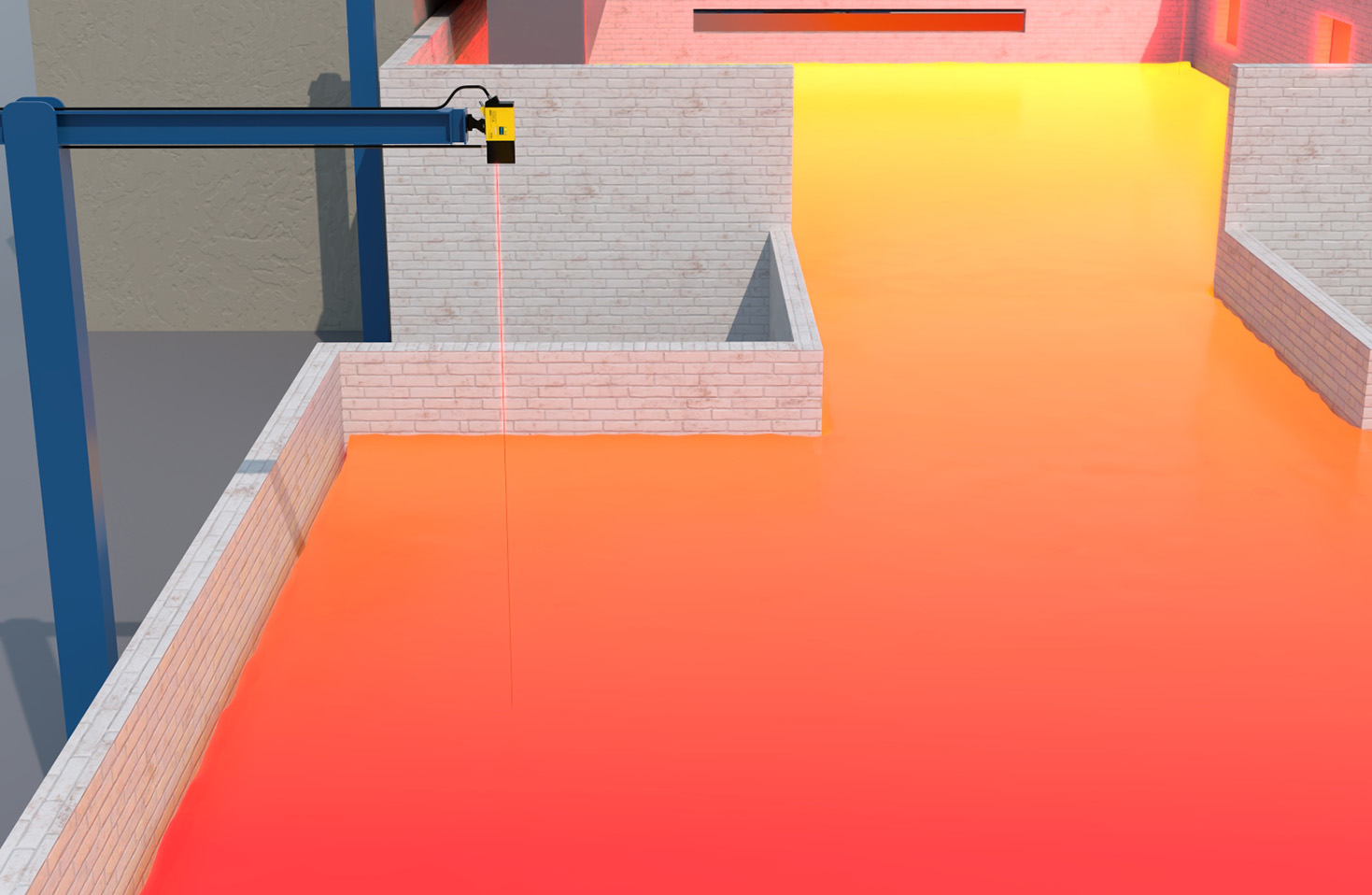
Despite their robustness, ToF sensors have limitations. Absolute accuracy at very short ranges (sub-centimeter) may be outperformed by triangulation or confocal sensors. Extremely high-precision applications requiring micron-level resolution might still rely on interferometric techniques. The laser spot size also increases with distance, which can affect measurement on very small features. However, ongoing advancements in VCSEL (Vertical-Cavity Surface-Emitting Laser) technology, SPAD (Single-Photon Avalanche Diode) detectors, and sophisticated signal processing algorithms are continuously pushing the boundaries. These improvements are leading to sensors with higher accuracy, faster measurement rates, smaller form factors, and lower power consumption.
Integration of ToF sensors into the Industrial Internet of Things (IIoT) framework is a growing trend. Smart sensors with built-in processing can perform edge computing, such as data filtering, basic analytics, or even making simple control decisions locally. This reduces the load on central PLCs and enables more distributed, intelligent systems. With standardized communication protocols, data from multiple ToF sensors can be aggregated to create detailed 3D maps or point clouds for advanced robotic vision and quality inspection systems.

In conclusion, Time-of-Flight laser displacement sensors are a powerful and flexible solution for modern industrial metrology and automation. Their principle of operation grants them unique advantages in terms of range, surface independence, and mechanical simplicity. By carefully evaluating specifications against application requirements, engineers can leverage ToF technology to enhance efficiency, quality control, and automation capabilities in diverse fields, from manufacturing and robotics to logistics and beyond. As the technology matures and converges with digitalization trends, its role in enabling smarter, more adaptive factories will only become more pronounced.