In modern industrial automation, laser distance sensors have become indispensable tools for precision measurement, quality control, and process monitoring. These sensors offer high accuracy, fast response times, and non-contact operation, making them ideal for a wide range of applications from robotics to logistics. However, the true potential of a laser distance sensor is unlocked through its interface—the critical link that enables communication with controllers, data acquisition systems, and networks. This article delves into the common interface types, their characteristics, and practical considerations for integration.
The most fundamental interface for laser distance sensors is the analog output, typically voltage (0-10V) or current (4-20mA). Analog interfaces provide a continuous signal proportional to the measured distance. They are straightforward to implement with PLCs (Programmable Logic Controllers) or analog input modules. The 4-20mA current loop is particularly valued in industrial environments for its noise immunity and ability to transmit over long distances without significant signal degradation. However, analog interfaces are limited in resolution and susceptible to electromagnetic interference if not properly shielded. For applications requiring simple distance monitoring without complex data exchange, analog outputs remain a reliable choice.
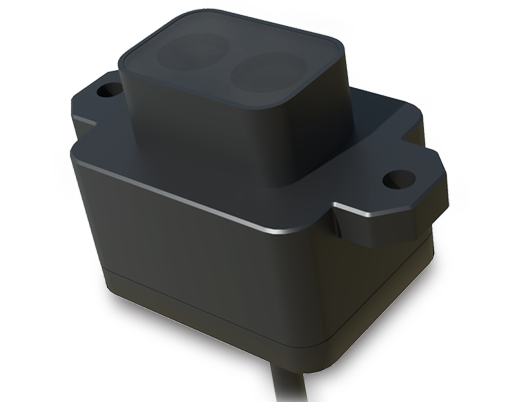
Digital interfaces have gained prominence due to their robustness, higher data throughput, and ability to transmit additional information beyond just distance values. Common digital interfaces include RS-232, RS-422, and RS-485 serial communication protocols. RS-232 is suitable for short-distance, point-to-point connections, often used for configuration and debugging. RS-422 and RS-485 support longer distances and multi-drop networks, allowing multiple sensors to communicate on a single bus—a cost-effective solution for distributed measurement systems. These serial interfaces typically use ASCII or binary protocols, requiring specific command sets for reading measurements, setting parameters, and retrieving diagnostic data. Engineers must carefully manage baud rates, parity, and termination to ensure stable communication.
Ethernet-based interfaces, such as Ethernet/IP, PROFINET, and Modbus TCP/IP, are increasingly standard in Industry 4.0 and smart factory setups. These interfaces enable seamless integration into existing LAN (Local Area Network) infrastructures, offering high-speed data transfer, remote configuration, and real-time monitoring capabilities. Sensors with Ethernet interfaces can transmit not only distance data but also status information, error codes, and even compressed waveform data for advanced analysis. The use of standard TCP/IP protocols simplifies connectivity with SCADA (Supervisory Control and Data Acquisition) systems, HMIs (Human-Machine Interfaces), and cloud platforms. However, network security, latency, and bandwidth management become critical considerations in large-scale deployments.
Fieldbus protocols like PROFIBUS DP, DeviceNet, and CANopen are dedicated to industrial automation, providing deterministic real-time communication. These interfaces are common in automotive, packaging, and assembly lines where synchronized operation is essential. They support cyclic data exchange for measurement values and acyclic communication for parameterization. Integrating a laser sensor into a fieldbus network requires configuring the device profile (e.g., using GSD files for PROFIBUS) and mapping process data to the controller's memory. While offering high reliability and synchronization, fieldbus systems can involve higher hardware costs and specialized knowledge for setup and troubleshooting.
For applications demanding ultra-high-speed data acquisition, such as dynamic profiling or vibration analysis, interfaces like USB or EtherCAT are preferred. USB provides a plug-and-play solution for PC-based measurement systems, often used in laboratory or R&D environments. EtherCAT, on the other hand, is a high-performance real-time Ethernet protocol that enables precise synchronization with sub-microsecond jitter, ideal for motion control systems integrating multiple sensors and actuators.
Selecting the appropriate interface depends on several factors: required update rate, measurement accuracy, environmental conditions (noise, temperature, humidity), distance between sensor and controller, number of sensors in the system, and existing infrastructure. Engineers should also consider future scalability and maintenance. For instance, an analog interface might suffice for a standalone machine, but a digital or network interface would be more suitable for a plant-wide monitoring system. Always consult the sensor's datasheet for detailed interface specifications, supported protocols, and wiring diagrams.
In conclusion, the interface of a laser distance sensor is not merely a connectivity option but a defining factor for system performance, flexibility, and integration depth. By understanding the strengths and limitations of each interface type, engineers can design robust, efficient, and future-proof measurement solutions that meet the evolving demands of industrial automation.