In the realm of precision measurement and industrial automation, laser displacement sensors have become indispensable tools. Among the various technologies available, sensors utilizing Complementary Metal-Oxide-Semiconductor (CMOS) image sensors represent a significant advancement, offering a blend of high speed, accuracy, and robustness. This article delves into the working principles, key advantages, typical applications, and critical selection criteria for CMOS-based laser displacement sensors.
The fundamental principle of a CMOS laser displacement sensor is based on the optical triangulation method. The sensor projects a focused laser beam onto the target surface. The diffusely reflected light from this point is then captured by a high-speed CMOS linear image sensor positioned at a specific angle relative to the laser emitter. When the target's distance changes, the position of the laser spot image shifts on the CMOS sensor array. The onboard processor calculates the displacement value by analyzing this positional shift with extreme precision. The use of a CMOS imager, as opposed to traditional CCD (Charge-Coupled Device) sensors, is a key differentiator. CMOS technology allows for faster readout speeds, lower power consumption, and the integration of processing circuitry directly on the sensor chip, leading to more compact and efficient designs.
The advantages of CMOS laser displacement sensors are numerous. First and foremost is their exceptional measurement speed, often reaching tens of thousands of samples per second. This makes them ideal for high-speed production lines, such as in electronics assembly or automotive manufacturing, where real-time inspection is crucial. Secondly, they offer high resolution and accuracy, capable of detecting minute changes in the micrometer range. Their non-contact nature eliminates the risk of damaging delicate surfaces and avoids issues like wear and tear associated with tactile probes. Furthermore, CMOS sensors generally exhibit good resistance to ambient light interference, and advanced models incorporate algorithms to filter out noise, ensuring stable measurements even in challenging industrial environments. The digital nature of the CMOS output also simplifies integration with modern control systems like PLCs and industrial PCs.
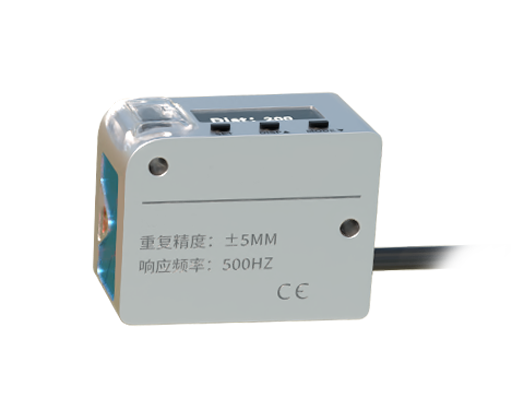
The application spectrum for these sensors is vast. Common uses include precise thickness measurement of materials like metal sheets, films, or glass; vibration analysis of rotating machinery; coplanarity inspection of electronic components such as BGA chips or connectors; profile and dimension control in continuous production processes; and gap/step height measurement in automotive body assembly. They are also deployed in robotics for guidance and positioning tasks, ensuring precise movement and manipulation.
Selecting the right CMOS laser displacement sensor requires careful consideration of several parameters. The measurement range defines the minimum and maximum distances over which the sensor can operate accurately. The spot size is critical; a smaller spot allows for measurement on edges or small features but may be more sensitive to surface roughness. Resolution and linearity indicate the sensor's precision and accuracy across its entire range. Sampling speed must match the velocity of the target process. The laser class (typically Class 2 or safe Class 1) is important for operator safety. Environmental factors like temperature stability, IP rating for dust/water resistance, and resistance to vibrations must align with the installation conditions. Finally, the output interface (analog voltage/current, digital USB, Ethernet, or fieldbus) should be compatible with the existing data acquisition system.
In conclusion, CMOS laser displacement sensors are powerful instruments that combine the reliability of laser triangulation with the speed and integration benefits of modern CMOS imaging technology. Their ability to deliver fast, accurate, and non-contact measurements makes them a cornerstone of quality control and process automation across diverse industries. By understanding their operating principles and carefully evaluating specifications against application needs, engineers can effectively leverage these sensors to enhance productivity, ensure product quality, and enable advanced automated systems.