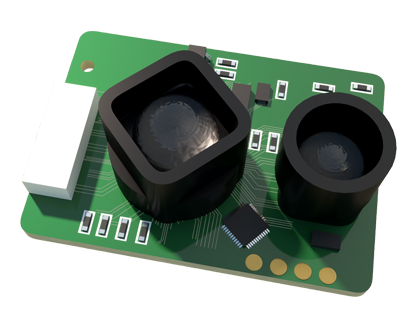
In the rapidly evolving landscape of industrial automation and precision measurement, C-Core laser sensors have emerged as a cornerstone technology. These sophisticated devices, leveraging the fundamental principles of laser triangulation, offer unparalleled accuracy, speed, and reliability for a vast array of applications. Unlike conventional sensors, the "C-Core" designation often refers to a specific, robust internal architecture or a proprietary core technology platform developed by leading manufacturers, designed to deliver exceptional performance stability in challenging environments. This article delves into the operational mechanics, key advantages, diverse application sectors, and critical selection parameters for these advanced laser displacement sensors.
At the heart of a C-Core laser sensor lies the principle of laser triangulation. The sensor projects a focused, visible red or blue laser beam onto the target surface. The diffused reflection from this point is then captured by a high-resolution CMOS or CCD receiver lens at a specific angle. The position of this light spot on the receiver shifts precisely in correlation with the distance to the target. An integrated, high-speed digital signal processor (DSP) within the "C-Core" calculates this displacement with micron-level resolution, outputting the measurement as an analog voltage/current signal or digital data via interfaces like Ethernet/IP, PROFINET, or RS-485. The core innovation often involves advanced algorithms for edge detection, surface compensation, and noise rejection, ensuring consistent readings regardless of material color, texture, or ambient light interference.
The benefits of implementing C-Core laser sensors are manifold. First and foremost is their exceptional precision, capable of resolving measurements down to sub-micron levels, which is indispensable for quality control in micro-manufacturing. They offer high-speed response, with sampling rates reaching into the tens of kilohertz, enabling real-time inspection on fast-moving production lines. Their non-contact nature eliminates mechanical wear and prevents damage to delicate surfaces. Furthermore, modern C-Core sensors are engineered with robust housings, typically rated IP67 or higher, making them resistant to dust, water jets, and vibrations commonly found in industrial settings. Their compact form factor allows for easy integration into space-constrained machinery.

The application spectrum for C-Core laser sensors is exceptionally broad. In the electronics industry, they are pivotal for measuring component coplanarity, solder paste height, and PCB warpage. Automotive manufacturers rely on them for gap and flush measurement between body panels, brake disc thickness monitoring, and robotic guidance. In precision machining, they verify part dimensions, profile contours, and surface roughness. They also play a crucial role in logistics for package dimensioning, in pharmaceuticals for tablet thickness control, and in robotics for precise object positioning and bin-picking. Their versatility extends to 3D scanning systems when configured in multi-sensor arrays.

Selecting the appropriate C-Core laser sensor requires careful consideration of several technical parameters. The measuring range and stand-off distance define the operational window. The resolution and linearity specify the accuracy and consistency across the entire range. The laser spot size is critical for measuring small features or uneven surfaces. Sampling rate must match the production line speed. The type of output signal (analog, digital, switch) should be compatible with the existing control system (PLC, PC). Environmental factors necessitate checking the housing rating (IP), temperature stability, and resistance to ambient light. Finally, user-friendly software for configuration, calibration, and data logging is a significant operational advantage.
In conclusion, C-Core laser sensors represent a mature yet continuously advancing technology that is critical for enhancing productivity, ensuring quality, and enabling automation across diverse industries. Their core strength lies in combining robust hardware design with intelligent signal processing to deliver dependable, high-precision measurements where other technologies may falter. As Industry 4.0 and smart factory concepts gain momentum, the integration of these sensors with IoT platforms for predictive maintenance and data analytics will further solidify their role as essential tools for modern industrial engineering. Understanding their principles and selection criteria is key to leveraging their full potential for optimizing automated processes and driving innovation in manufacturing and beyond.