Three-wire proximity sensors are fundamental components in industrial automation, widely used for non-contact detection of metallic objects. Understanding their internal principles is essential for engineers to optimize system performance and troubleshoot effectively. This article delves into the core mechanisms, circuit design, and operational characteristics of these ubiquitous devices.
At the heart of most three-wire proximity sensors lies an oscillator circuit, typically based on a Colpitts or Hartley configuration. This circuit generates a high-frequency electromagnetic field from a coil wound around a ferrite core located at the active face of the sensor. When a conductive target, usually metal, enters this oscillating field, eddy currents are induced on the target's surface. These eddy currents draw energy from the oscillator, causing a measurable drop in its oscillation amplitude. A subsequent detection circuit, often a Schmitt trigger or a specialized IC, monitors this amplitude change. Once the amplitude falls below a predefined threshold—corresponding to the sensor's specified sensing distance—the detection circuit triggers a change in the output state.

The "three-wire" designation refers to the power supply configuration: one wire for DC supply voltage (typically 10-30V DC), one wire for the ground (0V), and one wire for the output signal. This design separates the power and output lines, allowing for more flexible integration compared to two-wire models. Internally, the output stage is a solid-state switch, either a PNP (sourcing) or NPN (sinking) transistor. In a PNP (sourcing) sensor, the output transistor connects the load between the output wire and ground; when active, it sources current to the load. Conversely, in an NPN (sinking) sensor, the transistor connects the load between the supply voltage and the output wire; when active, it sinks current from the load to ground. The choice between PNP and NPN is critical for compatibility with programmable logic controllers (PLCs) and other control system inputs.
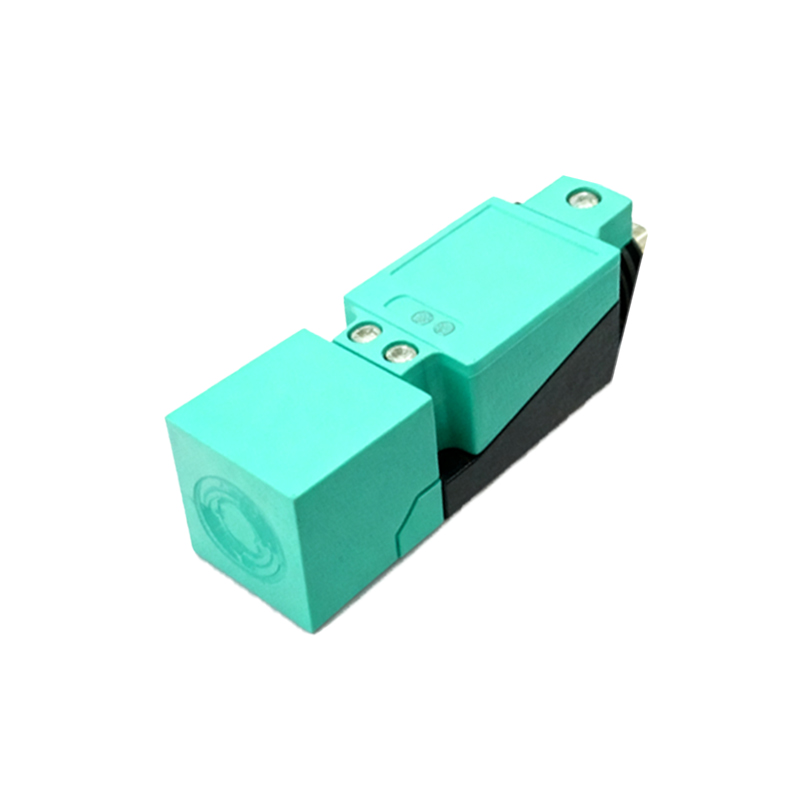
Key internal components include the oscillator coil, the ferrite core for focusing the electromagnetic field, a stable voltage regulator to ensure consistent operation despite supply fluctuations, and protection circuits. These protection circuits are vital for industrial durability, guarding against common hazards like short-circuits, reverse polarity connection, and voltage transients. Some advanced models also incorporate temperature compensation circuits to maintain a stable sensing distance across a wide operating temperature range.
The sensing principle varies with target material. Ferrous metals (like iron and steel) not only induce eddy currents but also affect the oscillator's inductance due to their high magnetic permeability, often resulting in a longer sensing range. Non-ferrous metals (like aluminum or copper) primarily interact through eddy currents, typically yielding a shorter range. This difference is quantified by a correction factor provided in sensor datasheets.
From a signal processing perspective, the internal circuit must distinguish between a genuine target and environmental noise. This is achieved through hysteresis—a built-in difference between the "switch-on" and "switch-off" points. Hysteresis prevents output chatter when a target is positioned at the very edge of the sensing range. Furthermore, the response time of the sensor, often in the range of microseconds to milliseconds, is determined by the speed of the oscillator's damping and the switching characteristics of the output transistor.
In summary, the operation of a three-wire proximity sensor is a sophisticated interplay of electromagnetic induction, analog oscillation monitoring, and digital switching. Its robust internal design, featuring regulated power, protected outputs, and material-specific detection, makes it a reliable workhorse for position sensing, object counting, and speed monitoring in demanding industrial environments. Proper selection and application require a clear understanding of these underlying principles to ensure reliable integration into automated systems.