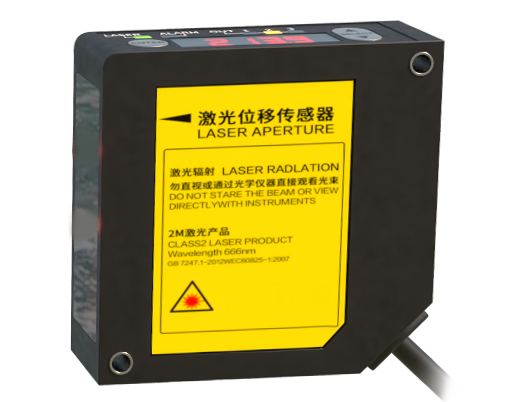
Laser displacement sensors represent a cornerstone technology in modern industrial automation and precision measurement. Their ability to perform non-contact, high-speed, and highly accurate distance measurements makes them indispensable across a vast array of sectors, from automotive manufacturing to semiconductor fabrication. At the core of their functionality is the precise determination of an object's height or position relative to a reference point. This article delves into the operational principles, key performance parameters, and practical applications of laser displacement sensors for height measurement.
The fundamental principle behind most industrial laser displacement sensors is triangulation. A laser diode projects a focused beam of light onto the target surface. The reflected light, scattered from the point of incidence, is then captured by a receiving lens and focused onto a position-sensitive detector, typically a CCD or CMOS linear array. The crucial factor is that the position of this light spot on the detector shifts linearly with changes in the target's distance. When the target height changes, the angle of the reflected light entering the receiver changes correspondingly. An integrated processor calculates the exact displacement or height value by analyzing this positional shift on the detector. This method offers exceptional resolution, often down to the sub-micron level, and high sampling rates.
Several critical specifications define a sensor's suitability for height measurement tasks. Measurement range denotes the distance over which the sensor can operate reliably, typically from a few millimeters to several hundred millimeters. Standoff distance refers to the nominal working distance from the sensor head to the target. Resolution indicates the smallest detectable change in height, while linearity defines the accuracy of the measurement across the entire range, often expressed as a percentage of full scale. Sampling speed, or response frequency, is vital for dynamic measurements on moving production lines. Furthermore, factors like target surface properties (color, material, roughness) and environmental conditions (ambient light, temperature) significantly influence performance and must be carefully considered during sensor selection.
The applications for height measurement using laser sensors are extensive and varied. In automotive assembly, they are deployed to verify the precise gap and flushness between body panels like doors and fenders, ensuring quality and aerodynamic efficiency. Within electronics manufacturing, these sensors measure the coplanarity of component leads on IC chips or the height of solder paste deposits on printed circuit boards (PCBs) before reflow soldering. In the realm of robotics, they provide essential feedback for precise guidance and object handling, enabling robots to adapt to variations in part placement. Dimensional inspection is another major domain, where sensors profile objects to confirm thickness, warpage, or step height against strict tolerances. Additionally, they monitor vibration in rotating machinery by tracking displacement over time.

Selecting the appropriate laser displacement sensor requires a thorough analysis of the application. Engineers must evaluate the required measurement range, resolution, and speed against the target's characteristics. For instance, a dark, matte surface absorbs more light, resulting in a weaker return signal compared to a bright, reflective surface. Many modern sensors offer advanced features to compensate for such challenges, including automatic exposure control, peak-hold algorithms for transparent objects, and multi-peak detection for uneven surfaces. Integration with factory networks via standard interfaces like Ethernet/IP, PROFINET, or analog outputs is also a key consideration for seamless data acquisition and process control.
In conclusion, laser displacement sensors provide a robust, accurate, and versatile solution for non-contact height measurement. Their principle of optical triangulation, combined with continuous advancements in laser and detector technology, allows them to meet the ever-increasing demands for precision in industrial environments. By understanding their operating principles, key specifications, and application nuances, engineers and technicians can effectively leverage this technology to enhance quality control, optimize processes, and drive innovation in automated manufacturing systems. As Industry 4.0 progresses, the role of precise, data-rich sensors like these will only become more central to intelligent, interconnected production ecosystems.