In the realm of industrial automation, the reliability and precision of sensing technology are paramount. Among the diverse array of sensors available, the M18 NPN flush-mount inductive proximity switch stands out as a cornerstone component for countless applications. This article delves into the technical specifications, operational principles, and practical implementation of these robust sensors, providing a detailed guide for engineers and technicians.
An inductive proximity sensor operates on the principle of electromagnetic induction. The core component is a coil housed within the sensor's face, which is energized by an oscillator circuit to generate a high-frequency electromagnetic field. When a metallic target enters this field, eddy currents are induced on the target's surface. This causes a change in the oscillation amplitude within the sensor, which is detected by a threshold circuit. This detection triggers a change in the sensor's output state. The "M18" designation refers to the standard 18mm cylindrical threaded housing, a common form factor that facilitates easy installation. The "NPN" specification indicates the type of transistor output. In an NPN (sourcing) configuration, the output transistor switches the negative (0V) line to the load. The load is connected between the positive supply voltage and the sensor's output wire. When the sensor is active (target detected), the NPN transistor turns on, connecting the output to 0V, thus completing the circuit and allowing current to flow through the load. This output type is widely used with programmable logic controllers (PLCs) with sinking input modules.
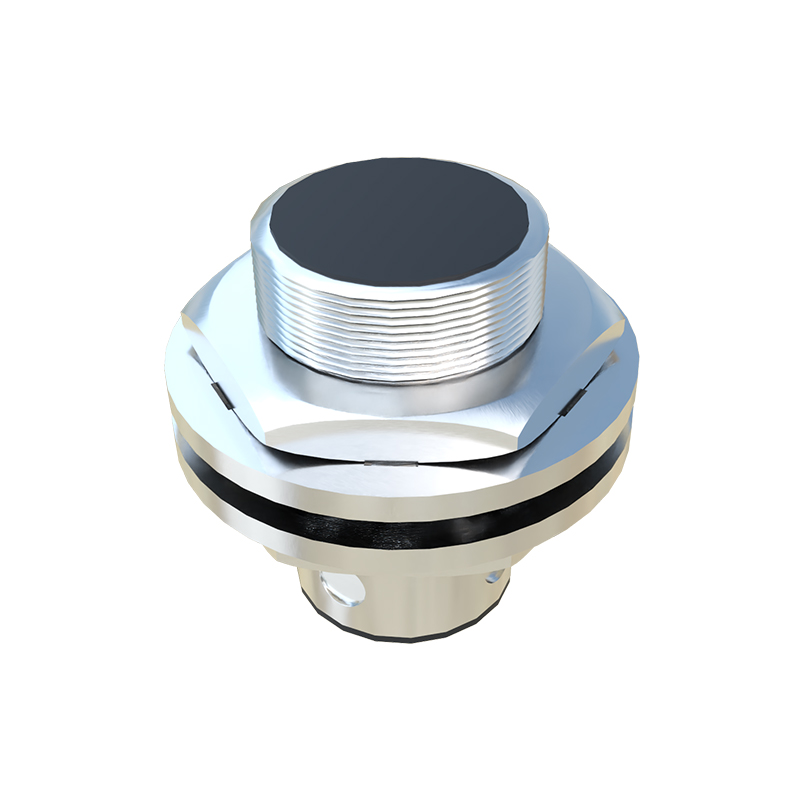
The "flush-mount" design is a critical feature. Unlike non-flush or shielded sensors, the sensing face of a flush-mount sensor is surrounded by a metal ring or is integrated flush with the housing. This design allows the sensor to be embedded directly into a metal mounting bracket without the risk of the bracket itself being detected as a target. It prevents side-lobe detection, meaning it only senses objects directly in front of it. This characteristic makes flush-mount sensors ideal for applications where the sensor must be installed flush with surrounding metal structures, such as in machine tools, pneumatic cylinders, or conveyor system frames, ensuring precise and reliable detection without false triggers from the mounting surface.
Key technical parameters define the performance of an M18 NPN flush-mount sensor. The sensing distance, typically standardized, is often 5mm or 8mm for an M18 ferrous target. It is crucial to note that this nominal sensing distance is specified for a standard mild steel target. For other metals like stainless steel, aluminum, or copper, the effective sensing range is reduced due to different material properties affecting eddy current generation; correction factors provided in datasheets must be applied. The operating voltage range is commonly between 10-30V DC, making it compatible with standard industrial control voltages. Output current rating, often up to 200mA, determines the load it can drive directly, such as a relay coil, small solenoid, or PLC input. The switching frequency, measured in Hertz (Hz), indicates how quickly the sensor can respond to targets moving past it, a vital factor for high-speed counting or positioning applications. Environmental protection is rated by the Ingress Protection (IP) code, with IP67 being standard, indicating dust-tightness and protection against temporary immersion in water, suitable for harsh industrial environments.
Wiring an M18 NPN 3-wire sensor is straightforward. The standard wire color coding is: Brown for positive supply voltage (+V), Blue for negative/0V (common), and Black for the switched output signal. For a typical NPN normally-open (NO) configuration, the load (e.g., a PLC input) is connected between the Black wire and +V. When a target is detected, the Black wire is switched to 0V (Blue), allowing current to sink into the sensor, activating the PLC input. Always consult the manufacturer's datasheet for the exact pinout and wiring diagram.
Application scenarios for these sensors are vast. They are extensively used for position detection of metal parts on assembly lines, end-of-travel sensing for pneumatic and hydraulic cylinders, rotary speed monitoring via gear teeth detection, and part presence verification in machining centers. Their rugged metal or PBT plastic housing and robust construction make them resistant to vibration, coolant, and metal chips.
When selecting an M18 NPN flush-mount sensor, engineers must consider the target material, required sensing distance, environmental conditions (temperature, chemicals), required output configuration (NPN NO/NC), and electrical load. Proper installation is also key: ensuring the correct tightening torque to avoid damage, maintaining the specified lateral and axial clearance from surrounding metal to prevent interference, and verifying the electrical connections to prevent reverse polarity.
In conclusion, the M18 NPN flush-mount inductive proximity sensor is a versatile, reliable, and essential component in modern industrial