In the realm of industrial automation and precision measurement, the laser sensor pulsed method stands as a cornerstone technology. This technique, fundamentally distinct from continuous-wave (CW) laser operation, relies on emitting short, high-intensity bursts of coherent light. The core principle involves measuring the time-of-flight (ToF) of these laser pulses. A pulse is emitted from the sensor's transmitter, travels to the target object, reflects off its surface, and returns to the sensor's receiver. An ultra-high-speed timer within the sensor precisely measures the elapsed time between emission and reception. Given that the speed of light (c) is a known constant (approximately 3×10^8 m/s), the distance (d) to the target can be calculated with exceptional accuracy using the formula: d = (c × Δt) / 2, where Δt is the measured time interval. The division by two accounts for the round-trip journey of the light pulse.
The advantages of the pulsed method are particularly pronounced in demanding industrial environments. First and foremost is its exceptional immunity to ambient light interference. Since the sensor detects only the specific, timed pulse it emitted, it effectively filters out constant or slowly varying background illumination from factory lights, sunlight, or other sources. This makes it robust for use in brightly lit or variable lighting conditions. Secondly, pulsed lasers can achieve very long measurement ranges, often exceeding hundreds of meters, because the high peak power of each pulse ensures a strong return signal even from distant or low-reflectivity targets. Furthermore, this method allows for high measurement rates, as thousands of pulses can be sent and processed per second, enabling real-time monitoring of fast-moving objects on production lines.
A critical component enabling this technology is the receiver's timing circuitry, often utilizing Time-to-Digital Converters (TDCs) or high-performance analog front-ends. The accuracy of these circuits directly dictates the sensor's resolution. For instance, a timing resolution of 10 picoseconds translates to a distance resolution of about 1.5 millimeters. Modern sensors employ sophisticated signal processing algorithms to identify the true return pulse amidst noise, further enhancing reliability. Techniques like multi-pulse averaging improve precision, while leading-edge or constant-fraction discrimination helps maintain accuracy regardless of the target's reflectivity or the pulse's shape distortion.
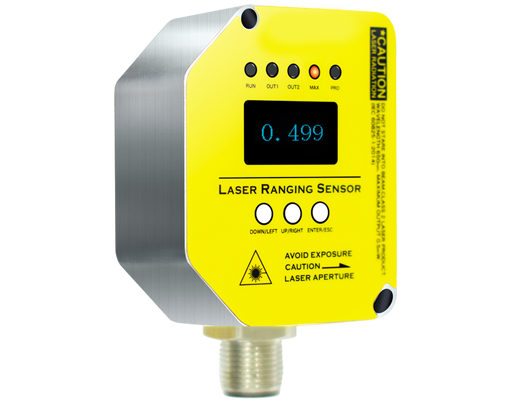
Industrial applications of pulsed laser sensors are vast and varied. In logistics and warehousing, they are integral to automated guided vehicles (AGVs) and robotic forklifts for navigation, obstacle detection, and pallet profiling. Their long range and speed are essential for mapping large spaces and ensuring safe, efficient movement. In the construction and mining sectors, these sensors are used for terrain mapping, volume calculation of stockpiles, and monitoring structural deformations over large distances. The manufacturing industry leverages them for non-contact dimensional gauging, weld seam tracking, and robotic bin-picking, where precise 3D positioning is paramount. Additionally, in the energy sector, pulsed laser sensors monitor the sag of high-voltage power lines or the fill levels of bulk material in silos, often in harsh outdoor conditions.
When selecting a pulsed laser sensor for a specific application, engineers must consider several key parameters. The measurement range and minimum measuring distance define the operational window. The repetition rate, or frequency of pulses, determines how quickly distance data is updated, which is crucial for dynamic processes. The laser's wavelength (commonly in the near-infrared range, e.g., 905nm) affects eye safety classifications and performance in different atmospheric conditions. The sensor's accuracy specification, often a combination of nonlinearity and repeatability, must align with the tolerance requirements of the task. Environmental ratings for ingress protection (IP) and resistance to vibration, shock, and temperature extremes are non-negotiable for industrial durability.

Looking ahead, the evolution of the laser sensor pulsed method is closely tied to advancements in semiconductor laser diodes, photodetectors, and processing chips. The trend is toward miniaturization, lower power consumption, higher measurement speeds, and enhanced intelligence at the edge. The integration of pulsed ToF sensors into multi-sensor fusion systems, combined with cameras or inertial measurement units (IMUs), is paving the way for more autonomous and perceptive industrial robots and systems. In conclusion, the laser sensor pulsed method, with its robust principle of time-of-flight measurement, remains an indispensable tool. It delivers the precise, reliable, and long-range distance data that forms the bedrock of modern industrial automation, driving efficiency, safety, and quality across countless applications.