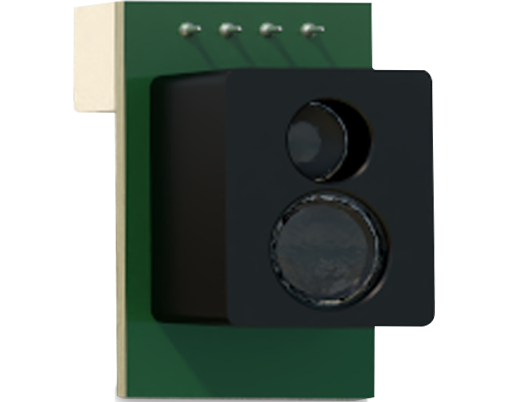
In the realm of industrial automation, robotics, and precision measurement, distance sensing technology is a cornerstone. Among the various technologies available, laser-based sensors have established themselves as leaders due to their accuracy, speed, and non-contact nature. While red laser diodes have been the traditional workhorse, green laser distance sensors are rapidly gaining prominence, offering distinct advantages in specific demanding applications. This article delves into the principles, benefits, key applications, and critical selection criteria for green laser distance sensors.
The fundamental principle of a laser distance sensor, regardless of color, is based on time-of-flight (ToF) or phase-shift measurement. In the ToF method, the sensor emits a short laser pulse towards the target. The time taken for the reflected pulse to return to the sensor's receiver is precisely measured. Since the speed of light is a known constant, the distance to the target can be calculated with high accuracy. Phase-shift methods involve modulating the intensity of a continuous laser beam and measuring the phase difference between the emitted and reflected light waves. Green laser sensors utilize a laser diode that emits light in the green spectrum, typically around 520nm wavelength.
So, why choose green over the more common red laser (typically 650nm)? The primary advantage lies in visibility and performance on certain surfaces. The human eye is most sensitive to green light in the 520-550nm range. This makes the green laser spot significantly brighter and easier to see than a red laser of the same power output, which is crucial for manual alignment, setup, and visual inspection tasks in well-lit environments. More importantly, green light interacts differently with materials. Many organic materials, certain plastics, and dark, matte surfaces that absorb red light poorly often reflect green light more effectively. This results in a stronger return signal for the sensor's photodetector, enabling more reliable and stable measurements on surfaces where red lasers might fail or produce noisy data. This characteristic is invaluable in industries like wood processing, textile manufacturing, and food production.

The applications for green laser distance sensors are diverse and growing. In the automotive industry, they are used for precise gap and flush measurement between body panels, where dark paints and complex geometries are common. In electronics assembly, they ensure accurate component placement and solder paste inspection. Logistics and warehousing benefit from their use in palletizing, dimensioning, and automated guided vehicle (AGV) navigation, especially when dealing with varied package materials. Furthermore, in outdoor or high-ambient-light applications, the brighter green spot can aid in system calibration and troubleshooting. They are also increasingly found in construction for layout and monitoring, and in agriculture for crop monitoring and guidance systems.

When selecting a green laser distance sensor for a specific application, several technical parameters must be carefully evaluated. Measuring Range: This is the minimum and maximum distance over which the sensor can operate reliably. Ensure your target falls within this range with a margin for safety. Accuracy and Resolution: Accuracy refers to the maximum deviation between the measured and true distance. Resolution is the smallest change in distance the sensor can detect. High-precision tasks demand sensors with micron-level accuracy. Laser Class: Safety is paramount. Most industrial sensors are Class 2 (safe for momentary viewing) or Class 1 (inherently safe). The brighter green dot necessitates careful consideration of laser safety protocols and labeling. Response Time/Sampling Rate: This determines how quickly the sensor can take and output measurements. High-speed applications, such as on a fast-moving production line, require a high sampling rate. Environmental Robustness: Consider the sensor's IP (Ingress Protection) rating for dust and water resistance, its operating temperature range, and its resistance to vibrations or electrical noise common in industrial settings. Output Interface: Common interfaces include analog (4-20mA, 0-10V), digital (RS-232, RS-485), and industrial Ethernet (EtherNet/IP, PROFINET). Choose one compatible with your control system.
In conclusion, green laser distance sensors represent a specialized and powerful tool within the metrology and automation landscape. Their enhanced visibility and superior performance on challenging surfaces address limitations inherent to traditional red laser sensors. By understanding their operating principles, recognizing their ideal application scenarios—particularly those involving dark, organic, or non-cooperative surfaces—and meticulously evaluating key performance specifications, engineers and system integrators can leverage this technology to achieve new levels of precision, reliability, and efficiency in their measurement and control systems. As laser technology continues to advance, we can expect green lasers to become even more compact, efficient, and integrated into smart sensor networks.