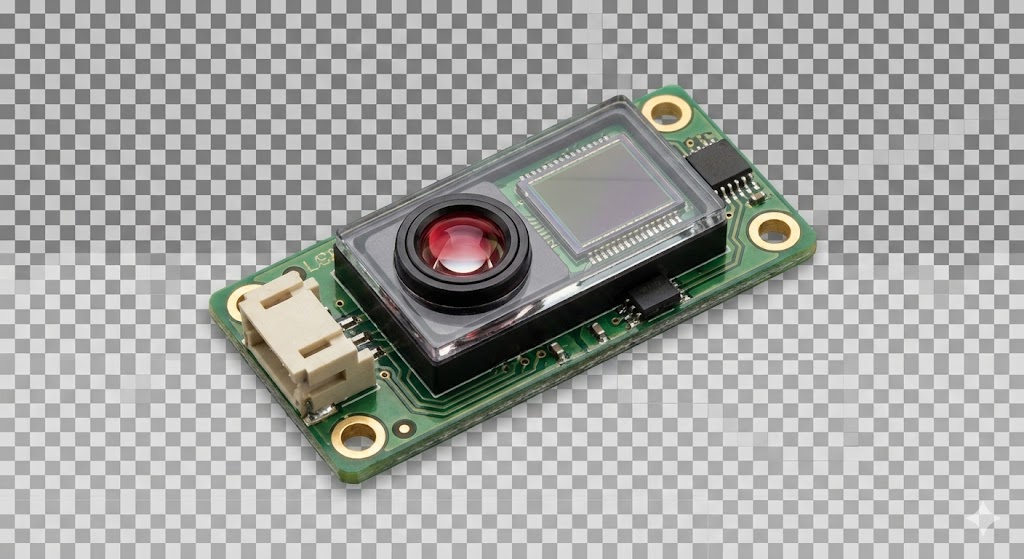
In the realm of industrial automation and precise object detection, background suppression laser sensors stand out as a critical technology. Unlike standard diffuse reflection sensors, these advanced devices can reliably detect an object within a precise, predefined sensing range while ignoring any objects or surfaces beyond that range—the "background." This capability is paramount in applications where the target object's position varies or where the background environment is cluttered or reflective.
The core principle behind background suppression (often abbreviated as BGS) laser sensors is triangulation. The sensor emits a focused beam of laser light towards the target. The light reflects off the object's surface and returns to the sensor. However, instead of a single receiver element, a BGS sensor employs a position-sensitive detector (PSD) or a specialized receiver array. The key differentiator is that the angle at which the reflected light returns changes depending on the distance of the object. Light from an object at the exact set sensing distance returns at a specific angle to hit the center of the receiver. Light from a closer object returns at a steeper angle, while light from a more distant object (the background) returns at a shallower angle. The sensor's internal electronics analyze the spot position on the receiver. It is programmed to trigger an output signal only when the light spot falls within a specific zone corresponding to the user-defined sensing window. Light from distances outside this window, typically from the background, is effectively ignored.
This technology offers several distinct advantages. First and foremost is reliable detection independent of background. Whether the background is white, black, shiny, or matte, a properly configured BGS sensor will not be falsely triggered by it. This solves a persistent challenge with standard diffuse sensors, whose performance degrades significantly with varying surface colors and reflectivity. Second, it provides high precision and repeatability. The sharp cutoff between the sensing and background zones allows for very accurate positioning and edge detection, often with sub-millimeter resolution. Third, it enables stable detection of problematic surfaces. Transparent objects like glass or plastic bottles, which are notoriously difficult for other optical sensors, can often be detected because the laser beam's reflection, though weak, still follows the triangulation principle. Similarly, detecting dark, absorbent objects on a dark conveyor belt becomes feasible.

The applications for background suppression laser sensors are vast and span numerous industries. In packaging and material handling, they are used for precise stack height control, bottle fill-level detection, and presence verification in tight spaces. In automotive assembly, they ensure components are seated correctly by verifying gaps or checking for the presence of tiny parts. In electronics manufacturing, they facilitate PCB board positioning and component counting. Logistics and warehouse automation rely on them for parcel dimensioning and sorting on conveyor systems, where the sensor must ignore the belt and distant structures. They are also indispensable in robotic guidance for pick-and-place operations, ensuring the gripper approaches the object at the correct distance.
Selecting the right background suppression laser sensor requires careful consideration of several parameters. The primary setting is the sensing distance or window. Some sensors feature a teach-in function, where a button is pressed while presenting an object at the desired detection point, making setup intuitive. Others may require potentiometer adjustment or digital configuration via software. The size and type of the laser spot is crucial; a small, precise spot is ideal for detecting edges or small objects, while a larger spot may be better for uneven surfaces. Response time and switching frequency must match the application's speed. Environmental robustness is key; look for high Ingress Protection (IP) ratings for dust and water resistance, wide operating temperature ranges, and resistance to ambient light interference. Finally, consider the output type (PNP/NPN, analog, or IO-Link) and mechanical housing design for easy integration.
In conclusion, background suppression laser sensors are a sophisticated solution for challenging detection tasks where environmental consistency cannot be guaranteed. By leveraging the triangulation principle, they deliver unmatched reliability in discriminating between target and background. For engineers and system integrators, understanding their operating principle, strengths, and configuration options is essential for implementing robust, fault-resistant automation systems that enhance productivity and quality control across diverse industrial landscapes.