In the realm of industrial automation and control systems, proximity sensors stand as fundamental components for non-contact object detection. Among the diverse range of models available, the 08NA series of inductive proximity switches has established itself as a reliable and widely adopted solution. This article delves into the technical specifications, operational principles, application scenarios, and key considerations for the 08NA proximity sensor, providing a detailed guide for electrical engineers and industry professionals.
The 08NA designation typically refers to a cylindrical, shielded (flush-mountable) inductive proximity switch with an 8mm sensing distance. These sensors operate on the principle of electromagnetic induction. Internally, the sensor contains an oscillator circuit that generates a high-frequency electromagnetic field at its active face. When a metallic object (the target) enters this field, eddy currents are induced on the surface of the target. This causes a change in the oscillation amplitude within the sensor, which is detected by a threshold circuit. This detection event triggers a change in the sensor's output state, either opening or closing a solid-state switch (typically PNP or NPN configuration) to send a signal to a programmable logic controller (PLC), relay, or other control device.
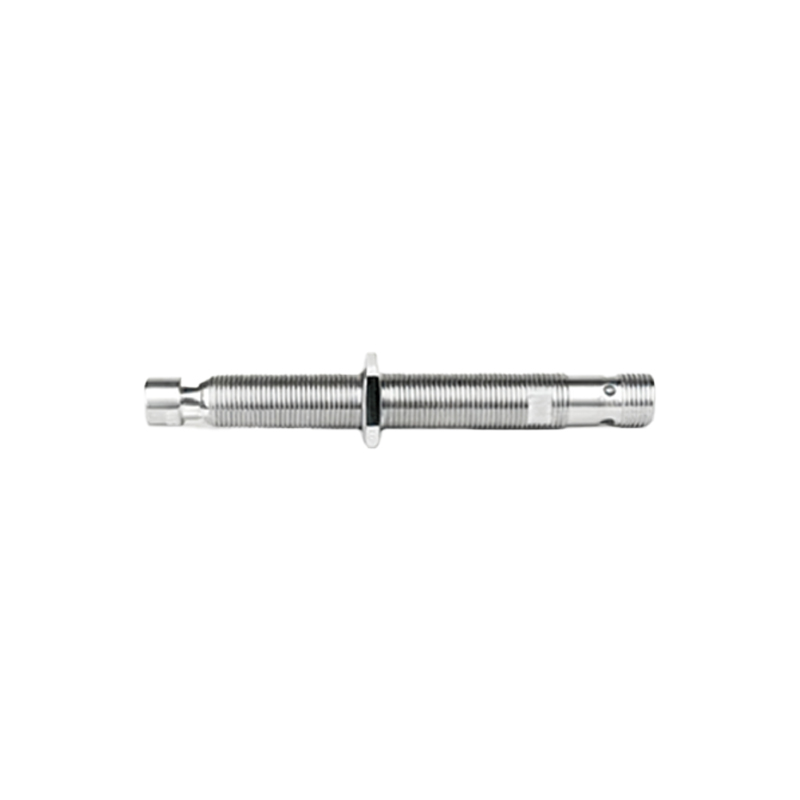
Key technical characteristics of the standard 08NA sensor include its nominal sensing distance (Sn) of 8mm. It is crucial to note that the effective operating distance can be influenced by factors such as the target material, size, and temperature. For standard mild steel, the sensing distance is as specified, but for other metals like stainless steel, aluminum, or copper, a reduction factor must be applied. These sensors are commonly available in both DC (10-30V DC) and AC variants, with two-wire, three-wire, or four-wire configurations. The three-wire DC version is particularly prevalent, offering PNP (sourcing) or NPN (sinking) outputs. The housing is usually constructed from nickel-plated brass or stainless steel, providing robustness and resistance to industrial environments, including coolants and oils. Most models feature an LED status indicator for diagnostic purposes.
The application spectrum for the 08NA sensor is vast. Its compact size and reliable performance make it ideal for position sensing in machinery, such as detecting the presence of a metal part on a conveyor, verifying the end position of a cylinder, or counting metallic objects. It is extensively used in packaging machines, assembly lines, CNC machine tools for tool positioning, and automotive manufacturing systems. The shielded design allows for flush mounting in metal, enabling installation in space-constrained areas without false triggering from surrounding metallic structures.
When selecting and installing an 08NA proximity switch, several critical factors must be considered. First, engineers must ensure the sensor's output type (PNP/NPN) is compatible with the input module of the controller. Voltage ratings and current sinking/sourcing capabilities must align with the system's electrical design. Environmental conditions are paramount; while many 08NA sensors have an IP67 rating, making them dust-tight and capable of withstanding temporary immersion, extreme temperatures, strong electromagnetic fields, or corrosive chemicals may require specialized variants. Installation requires careful attention to mounting torque to avoid damaging the housing. Furthermore, maintaining a proper safety margin—often using only 70-80% of the nominal sensing distance in the application—ensures reliable operation despite supply voltage fluctuations or target material variations.
Troubleshooting common issues often involves checking the power supply, verifying the target (material, size, and approach speed), and inspecting the wiring connections. The built-in LED is the first point of diagnosis. A steadily lit LED when a target is present typically indicates proper operation, while an unlit LED may point to a power or wiring fault. Interference from other high-frequency sources can sometimes cause erratic behavior, necessitating proper shielding and grounding practices.
In conclusion, the 08NA inductive proximity switch represents a workhorse component in electrical engineering and industrial automation. Its design balances sensing performance, physical durability, and ease of integration. A thorough understanding of its operating principles, specifications, and installation guidelines enables engineers to deploy these sensors effectively, enhancing the reliability, safety, and efficiency of automated systems. As technology evolves, newer variants with enhanced features like IO-Link communication are emerging, but the fundamental 08NA form factor and function continue to be a cornerstone of discrete sensing applications worldwide.