In the realm of industrial automation, robotics, and precision measurement, laser sensors have become indispensable tools. Their ability to provide non-contact, high-accuracy detection and measurement makes them superior to many traditional sensing technologies. This guide delves into the various models of laser sensors available, their core operating principles, and the critical factors to consider for optimal selection.
At its core, a laser sensor operates by emitting a focused beam of light—typically from a laser diode—towards a target. The sensor then analyzes the reflected light. Different models use distinct methods for this analysis, leading to varied capabilities and applications. The primary categories include Triangulation Sensors, Time-of-Flight (ToF) Sensors, and Confocal Displacement Sensors.
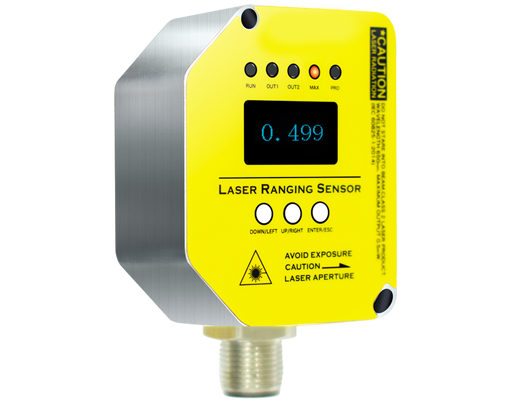
Triangulation Laser Sensors are among the most common for precise distance and displacement measurement. They work on a simple geometric principle. The laser emitter, receiver (a position-sensitive detector or PSD/CMOS), and the target form a triangle. By knowing the fixed baseline distance between the emitter and receiver and measuring the angle of the reflected light spot on the detector, the sensor's internal processor calculates the exact distance to the target with micron-level resolution. Models in this category, such as the KEYENCE IL Series or Micro-Epsilon optoNCDT, excel in tasks like thickness gauging, vibration analysis, and part dimension verification. Their performance can be affected by the target's color, reflectivity, and surface texture, though many advanced models incorporate algorithms to compensate for these variables.
Time-of-Flight (ToF) Laser Sensors measure distance by calculating the time it takes for a laser pulse to travel to the target and back. Given the constant speed of light, this time interval directly correlates to distance. ToF sensors, like the Banner Q4X or SICK DT35, are ideal for longer-range applications, typically from a few centimeters up to several hundred meters. They are less precise than triangulation sensors but offer excellent performance for presence detection, object positioning on conveyors, and bulk level monitoring. Their key advantage is that measurement is largely independent of the target's surface properties, making them robust in diverse environments.
Confocal Chromatic Sensors represent the high-precision end of the spectrum. They use a white light source, where different wavelengths are focused at different distances. By analyzing the color of the light reflected from the target, the sensor determines the distance with nanometer resolution. Models such as the Micro-Epsilon IFS2405 series are unparalleled for measuring transparent materials (like glass or film), highly reflective surfaces, or for profiling minute surface structures. Their cost is higher, but they solve challenging applications where other laser sensor models fail.

Beyond these, specialized models exist. Laser Contrast Sensors are optimized to detect marks or differences in color on surfaces. Laser Edge Detection Sensors precisely locate the edges of materials. Laser Profile Sensors (or laser line scanners) project a line instead of a dot, capturing a 2D or 3D profile of an object for inspection.
Selecting the correct laser sensor model requires a careful analysis of the application's parameters. The primary selection criteria are:
1. Measurement Range and Standoff: The required distance between the sensor and the target.
2. Resolution and Accuracy: The smallest detectable change and the trueness of the measurement.
3. Target Properties: Consider the material, color, reflectivity (shiny, matte, transparent), and surface texture.
4. Response Speed/Sampling Rate: How quickly the sensor must take measurements.
5. Environmental Conditions: Exposure to dust, moisture, temperature extremes, or ambient light.
6. Output Interface: Required communication protocol (analog voltage/current, digital I/O, Ethernet, RS-232, etc.).
7. Form Factor and Mounting: The physical size and housing (cylindrical, rectangular) suitable for the installation space.
For instance, a packaging line needing to verify the height of cardboard boxes would benefit from a robust, long-range ToF sensor. Conversely, a semiconductor manufacturing process measuring wafer warpage demands a confocal or high-end triangulation sensor.
In conclusion, the world of laser sensor models is diverse, with each type engineered to excel in specific scenarios. A thorough understanding of the operating principles of triangulation, Time-of-Flight, and confocal technologies provides a solid foundation. By methodically evaluating the application against the key selection criteria—range, accuracy, target type, and environment—engineers and system integrators can specify the ideal laser sensor model, ensuring reliability, precision, and cost-effectiveness in their automated systems. Always consult detailed datasheets and engage with technical support from manufacturers like SICK, Banner Engineering, KEYENCE, or Omron for final validation before deployment.