In modern industrial automation, the integration of sensors and actuators is fundamental to achieving precise, reliable, and efficient motion control. Among various sensor types, the three-wire proximity sensor stands out for its robustness and simplicity in detecting the presence or absence of metallic objects without physical contact. When paired with an electric cylinder—a linear actuator known for its clean operation, high precision, and programmability—this combination forms a critical subsystem in assembly lines, packaging machinery, and material handling systems. This article delves into the operational principles, wiring configurations, and implementation strategies for using a three-wire proximity sensor to control an electric cylinder.
A three-wire proximity sensor typically comprises three connections: positive voltage supply (V+), ground (GND), and a signal output line. These sensors operate on the principle of electromagnetic induction (for inductive types) or capacitive sensing. In an inductive proximity sensor, an oscillator generates a high-frequency electromagnetic field at the sensing face. When a metallic target enters this field, eddy currents are induced, causing a change in the oscillation amplitude. This change is detected by a threshold circuit, which then switches the state of the output transistor. The output can be either normally open (NO) or normally closed (NC), and it is commonly configured as a digital signal—either sourcing (PNP) or sinking (NPN) current. The three-wire design simplifies installation compared to two-wire versions by providing a dedicated output line, allowing for more stable performance and compatibility with a wider range of controllers, such as programmable logic controllers (PLCs) or dedicated motion controllers.
Electric cylinders, essentially motor-driven linear actuators, convert the rotary motion of a servo or stepper motor into linear displacement via a ball screw or lead screw mechanism. They offer advantages over pneumatic cylinders, including precise position control, speed regulation, force monitoring, and quieter operation. Control of an electric cylinder typically involves a drive or amplifier that receives command signals for position, velocity, or torque. For basic sequencing or safety interlocks, discrete input signals—like those from proximity sensors—are used to trigger actions such as stopping, starting, or changing the direction of the cylinder's stroke.
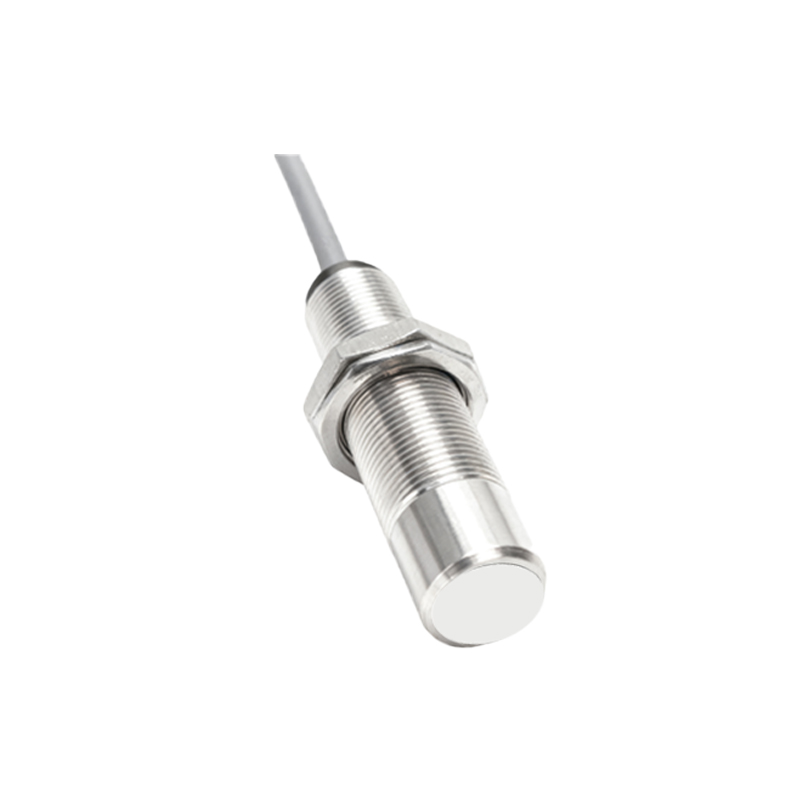
The control interface between a three-wire proximity sensor and an electric cylinder is straightforward yet requires careful attention to electrical compatibility. The sensor's output signal must be correctly matched to the input requirements of the electric cylinder's controller. For instance, a PNP (sourcing) sensor, which switches a positive voltage to the output line when activated, is suitable for controllers with a sinking input. Conversely, an NPN (sinking) sensor switches the ground connection and pairs with sourcing inputs. Incorrect matching can lead to malfunction or damage. A typical setup involves connecting the sensor's V+ and GND to a DC power supply (commonly 12-24 VDC). The output wire is then connected to a digital input channel on the electric cylinder's drive unit or an intermediate PLC. The PLC can be programmed to process the sensor signal and execute logic that commands the cylinder. For example, a sensor placed at the fully retracted position of the cylinder can provide a "home" signal, ensuring the actuator starts each cycle from a known reference point. Another sensor at the extended limit can signal the completion of a stroke, initiating retraction or the next step in a sequence.
Implementation best practices include ensuring proper sensor mounting and alignment for consistent detection, selecting sensors with appropriate sensing ranges and environmental ratings (e.g., IP67 for dust and moisture resistance), and incorporating noise suppression measures such as shielded cables, especially in electrically noisy industrial environments. Additionally, for safety-critical applications, redundant sensor configurations or using sensors with dual redundant outputs may be considered to prevent failures that could lead to machine damage or hazardous situations.
From a system integration perspective, using a three-wire proximity sensor with an electric cylinder enhances automation reliability. It enables precise end-of-travel detection, part presence verification, or positional feedback in applications where full servo feedback might be unnecessary or cost-prohibitive. This setup is common in pick-and-place operations, where a sensor confirms a part is in position before the cylinder engages, or in clamping fixtures, where sensor feedback ensures proper closure before a machining process begins. The simplicity of wiring and diagnostics—most three-wire sensors include an LED indicator for output status—also reduces maintenance downtime.
In conclusion, the synergy between a three-wire proximity sensor and an electric cylinder provides a dependable and efficient solution for automated linear motion control. By understanding the electrical characteristics, correctly interfacing the components, and adhering to installation guidelines, engineers can build robust systems that improve productivity and precision in diverse industrial settings. As automation evolves toward greater connectivity and smart manufacturing, such fundamental integrations remain the building blocks for more complex and intelligent machinery.