Linear Hall effect proximity switches represent a critical advancement in non-contact sensing technology, widely employed across automation, automotive, and industrial sectors. Unlike mechanical switches or inductive sensors, these devices leverage the Hall effect to detect the presence, absence, or position of ferromagnetic or magnetic objects without physical contact, ensuring high reliability and longevity.
The core principle hinges on the Hall effect, discovered by Edwin Hall in 1879. When a current-carrying conductor or semiconductor is exposed to a perpendicular magnetic field, a voltage difference—known as the Hall voltage—is generated across the material. This voltage is proportional to the magnetic flux density. In a linear Hall effect proximity switch, a Hall sensor IC integrates this sensing element with signal conditioning circuitry. As a magnetic target approaches, the magnetic field strength at the sensor changes, altering the Hall voltage. The integrated electronics process this signal to produce a linear output voltage that varies continuously with distance, enabling precise position detection.
Key components include the Hall element, typically made from gallium arsenide or silicon, a permanent magnet or electromagnet to establish a bias field, and amplification and temperature compensation circuits. The linear output characteristic distinguishes it from digital Hall switches, which provide only on/off signals. This analog output allows for nuanced applications such as measuring displacement, speed, or tilt.
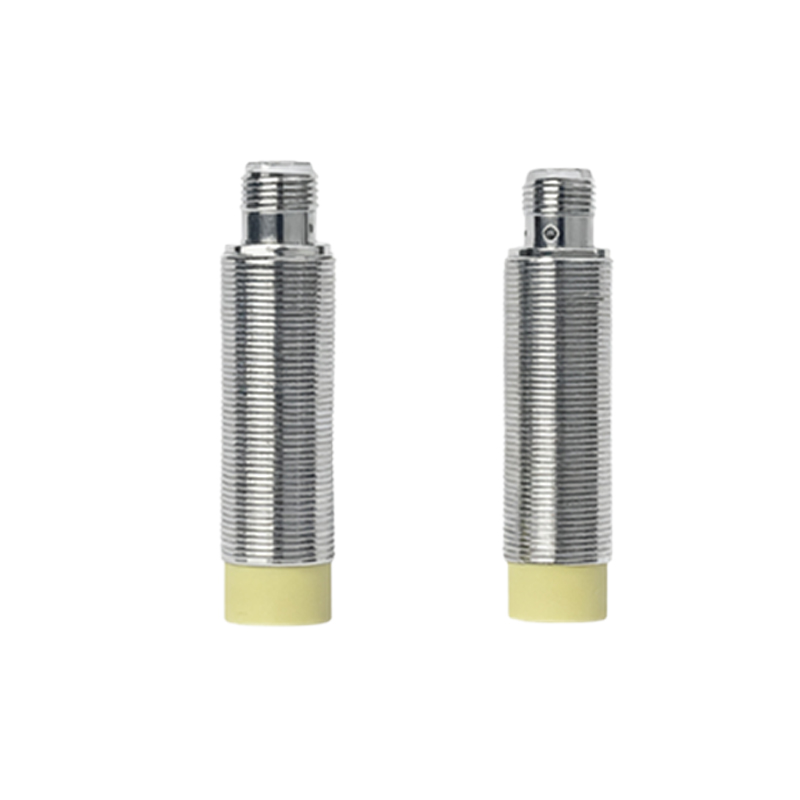
Operation begins when the sensor is powered, creating a steady current flow. In the absence of a target, the sensor outputs a baseline voltage corresponding to the ambient magnetic field. When a ferromagnetic object enters the sensing range, it distorts the magnetic field lines, increasing flux density. The Hall element detects this change, and the output voltage shifts proportionally. Advanced models incorporate differential sensing to cancel out common-mode interference, enhancing stability in electrically noisy environments.
Design considerations focus on sensitivity, linearity, and temperature drift. Sensitivity defines the output voltage change per unit of magnetic field variation, crucial for detecting small distances. Linearity ensures the output-voltage-to-distance relationship remains consistent across the sensing range. Temperature compensation circuits mitigate output drift caused by thermal variations, maintaining accuracy from -40°C to 150°C.
Applications span diverse industries. In automotive systems, linear Hall sensors monitor throttle position, pedal movement, and suspension height. Industrial automation uses them for conveyor belt positioning, robotic arm control, and liquid level sensing. They also feature in consumer electronics for joystick feedback and smart home devices. Advantages over alternatives include immunity to dust, oil, and moisture, no moving parts to wear out, and fast response times. However, limitations involve sensitivity to external magnetic fields and reduced effectiveness with non-magnetic materials.
Future trends point toward miniaturization, higher integration with microcontrollers, and improved noise immunity. Innovations like 3D Hall sensors enable multi-axis detection, expanding use in complex motion tracking. As Industry 4.0 advances, these switches will play a pivotal role in smart manufacturing and IoT connectivity.
In summary, linear Hall effect proximity switches offer a robust solution for precise, non-contact sensing. By converting magnetic field changes into linear electrical signals, they enable accurate detection in demanding environments, driving efficiency and innovation across modern engineering landscapes.