In the realm of industrial automation and process control, reliable object detection is paramount. Among the diverse array of sensing technologies available, ultrasonic proximity sensors have carved out a critical niche, offering unique advantages for challenging environments where other sensors may falter. These devices operate on a simple yet powerful principle: they emit high-frequency sound waves, typically above 20 kHz, and listen for the echo reflected from a target object. By precisely measuring the time interval between the emission and the reception of the sound wave, the sensor can calculate the distance to the object with high accuracy. This time-of-flight (ToF) measurement forms the core of ultrasonic sensing technology.
Unlike photoelectric sensors, ultrasonic sensors are largely unaffected by target color, transparency, or ambient light conditions. They can reliably detect clear glass, shiny metals, and dark objects with equal efficacy. Compared to inductive or capacitive sensors, which require specific material properties, ultrasonic sensors can detect virtually any solid or liquid material, making them exceptionally versatile. Their operation is also minimally impacted by dust, smoke, or light fog, a significant advantage in harsh industrial settings such as manufacturing plants, food processing facilities, and outdoor applications.
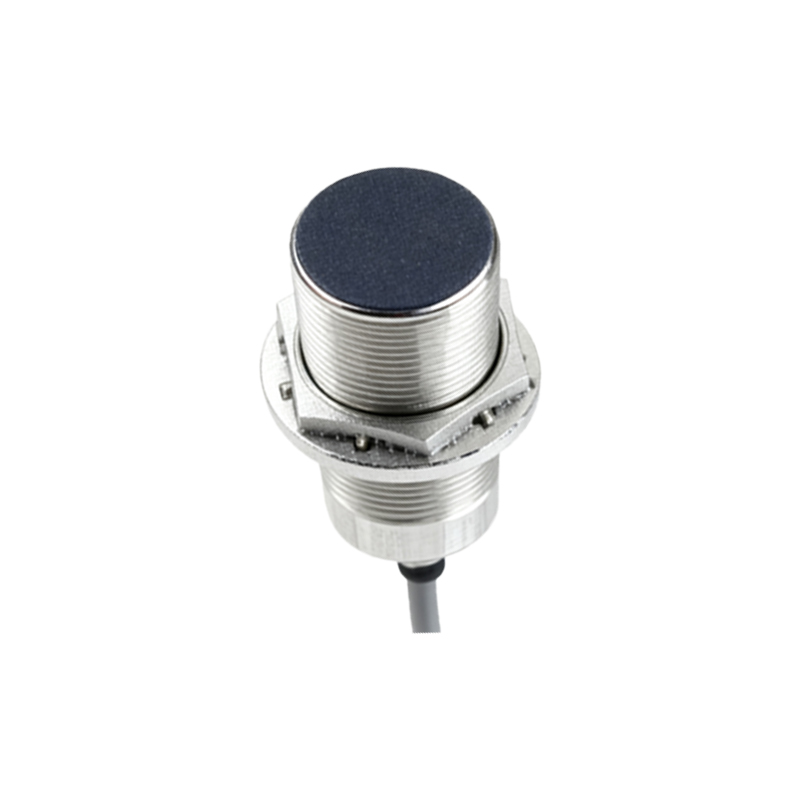
The typical construction of an ultrasonic proximity sensor includes a piezoelectric transducer that acts as both the transmitter and the receiver. Advanced models often feature temperature compensation circuitry, as the speed of sound in air varies with temperature. This compensation is crucial for maintaining measurement accuracy across varying operational environments. Modern sensors come in various form factors, including compact cylindrical housings, rectangular blocks, and remote sensor heads connected via cables. Output options are diverse, encompassing analog (4-20 mA, 0-10 V), discrete (PNP/NPN switching), and digital communication protocols like IO-Link, which enables parameterization, diagnostics, and advanced data exchange.
The application spectrum for ultrasonic proximity sensors is remarkably broad. In material handling and packaging, they are used for precise level detection in bins, silos, and tanks, controlling fill volumes for powders, granules, and liquids. On assembly lines, they provide presence detection for irregularly shaped objects or ensure proper stacking height. In the automotive industry, they facilitate robot guidance and part verification. A growing application is in parking assistance and collision avoidance systems within automated guided vehicles (AGVs) and mobile robots, where their ability to detect objects over a wider area is invaluable.
Selecting the appropriate ultrasonic sensor requires careful consideration of several key parameters. The sensing range is primary; models are available for short-range detection (a few centimeters) to long-range applications (several meters). The beam angle determines the detection cone's width—a narrow beam is ideal for precise detection, while a wide beam is better for general presence sensing. Response time, the speed at which the sensor can take consecutive measurements, is critical for high-speed applications. Environmental ratings, such as IP67 or IP69K for water and dust resistance, and operating temperature ranges must align with the installation conditions. For demanding environments, sensors with robust housings made of stainless steel or specialized plastics are recommended.
Installation and setup are straightforward but demand attention to detail. Mounting the sensor perpendicular to the intended target surface ensures optimal signal return. It is essential to avoid mounting near soft, sound-absorbing materials or in locations with excessive air turbulence, as these can attenuate the ultrasonic signal. Most sensors feature teach-in buttons or programmable settings to define the switching point or analog scaling range, allowing for quick configuration without complex tools.
Looking ahead, the integration of ultrasonic sensors into the Industrial Internet of Things (IIoT) ecosystem is a clear trend. Sensors with embedded intelligence and connectivity can provide predictive maintenance data, such as signal strength degradation indicating transducer fouling, and seamlessly integrate data into higher-level control systems. Furthermore, advancements in transducer design and signal processing algorithms continue to enhance resolution, reduce blind zones, and improve immunity to acoustic noise interference.
In conclusion, ultrasonic proximity sensors represent a robust, flexible, and reliable sensing solution. Their material-agnostic detection capability and resilience in difficult environments make them an indispensable tool for engineers designing automated systems. By understanding their operating principles, key specifications, and application best practices, automation professionals can effectively leverage this technology to solve complex detection challenges, improve process reliability, and drive operational efficiency across countless industries.