In the realm of industrial automation and control systems, proximity sensors are indispensable components. They detect the presence or absence of an object without physical contact, enabling precise, reliable, and wear-free operation in countless applications. As an electrical engineer, understanding the distinct types of proximity sensors, their operating principles, advantages, and typical use cases is fundamental to selecting the right sensor for any given task. This guide provides a detailed overview of the primary categories.
The most fundamental classification is based on the underlying sensing technology. The four main types are Inductive, Capacitive, Ultrasonic, and Photoelectric (Optical) proximity sensors.
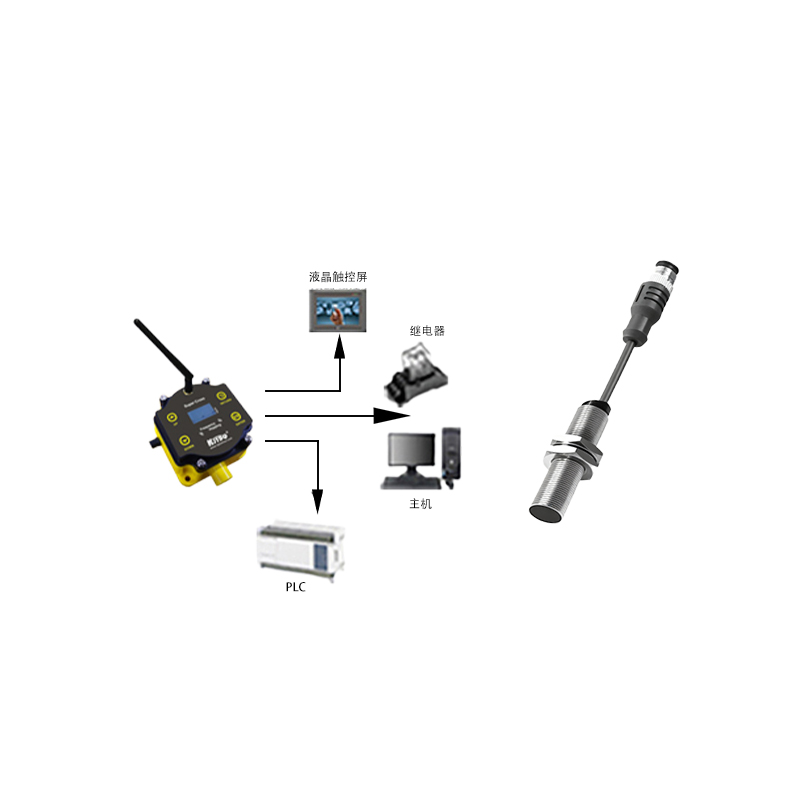
1. Inductive Proximity Sensors
Inductive sensors are the workhorses of metal detection. Their operation relies on electromagnetic induction. The sensor generates an oscillating electromagnetic field from its active face. When a metallic object (ferrous or non-ferrous) enters this field, eddy currents are induced in the object, causing a change in the oscillation amplitude. This change is detected by the sensor's circuitry, triggering a solid-state output switch.
Key Characteristics: They only detect metallic targets. Their sensing range is relatively short, typically a few millimeters to about 60 mm, and is influenced by the target metal type (standardized for mild steel). They are robust, resistant to environmental factors like dust, oil, and moisture (often rated IP67 or higher), and offer high switching frequencies.
Common Applications: Position sensing of machine parts (e.g., cylinder piston position), metal object counting, speed monitoring of gear teeth, and presence detection in metal machining and assembly lines.
2. Capacitive Proximity Sensors
Capacitive sensors can detect both metallic and non-metallic materials, including liquids, plastics, glass, wood, and granular substances. They function by measuring changes in capacitance. The sensor face acts as one plate of a capacitor, with the target object acting as the other plate. As an object approaches, the dielectric constant between the plates changes, altering the capacitance. When this change reaches a threshold, the sensor switches its output.
Key Characteristics: Versatile in target material detection. Sensing range is similar to or slightly less than inductive sensors and can be affected by the material's dielectric constant. They can sense through certain non-metallic containers (e.g., detecting liquid level inside a plastic tank). They are sensitive to environmental changes like humidity and temperature.
Common Applications: Liquid level control, bulk material level detection in silos, detection of non-metallic objects on conveyor belts, and touch-sensitive control panels.
3. Ultrasonic Proximity Sensors
These sensors use sound waves beyond the human hearing range (typically 20 kHz to 200 kHz). They operate on the time-of-flight principle: the sensor emits an ultrasonic pulse and then listens for the echo. The time delay between emission and reception is calculated to determine the distance to the target object. They are available in two main configurations: through-beam (separate emitter and receiver) and diffuse-reflective (single unit emitting and receiving).
Key Characteristics: Effective for detecting objects of virtually any material, shape, or color, as long as they adequately reflect sound. They offer the longest sensing ranges among standard proximity sensors, from centimeters to several meters. Performance can be affected by temperature (requiring compensation), air turbulence, and the object's sound-absorbing properties (like soft fabrics).
Common Applications: Distance measurement, object detection in harsh environments (dusty, foggy), palletizing, loop control in web handling, and level measurement of solids or liquids in large tanks.
4. Photoelectric (Optical) Proximity Sensors
Photoelectric sensors use a beam of light (usually infrared, visible red, or laser) to detect objects. They are categorized by their optical design:
Through-beam: Consists of separate emitter and receiver units. An object is detected when it interrupts the light beam. This type offers the longest range and highest reliability.
Retro-reflective: Uses a single unit and a reflector. The object is detected when it breaks the beam between the sensor and the reflector.
Diffuse-reflective: The most common type. The emitter and receiver are in one housing. The sensor detects light reflected directly off the target object. Range is dependent on the target's color, reflectivity, and surface texture.
Key Characteristics: Capable of detecting a wide variety of materials. Very fast response times. Sensing range varies greatly by type (diffuse models have shorter ranges). Performance can be compromised by environmental contaminants like dirt on the lens, ambient light interference, and the target's optical properties.
Common Applications: Bottle/can counting on high-speed lines, web break detection, label detection