In the realm of industrial automation and control systems, proximity sensors stand as fundamental components for non-contact detection. Among the various configurations available, the two-wire proximity sensor offers a particularly streamlined and cost-effective solution. This article delves into the operational principles, key advantages, common applications, and critical selection criteria for these ubiquitous devices.
At its core, a two-wire proximity sensor functions as a switch that detects the presence or absence of a metallic target without physical contact. It operates on the principle of electromagnetic induction. The sensor contains an oscillator circuit that generates a high-frequency electromagnetic field at its active face. When a conductive metal object enters this field, eddy currents are induced on the surface of the target. These eddy currents draw energy from the oscillator, causing a change in its amplitude. An evaluation circuit within the sensor detects this amplitude change and triggers a switching action in the output stage.
The defining characteristic of a two-wire sensor is its simple wiring scheme. Unlike three-wire or four-wire sensors that have separate power, ground, and signal lines, a two-wire sensor integrates seamlessly into the load circuit. It requires only two connection wires: one to the power supply (typically 10-30V DC or 20-250V AC) and the other to the load (such as a PLC input, relay, or indicator lamp). The sensor itself is connected in series with the load. In its normal state (target absent), a small leakage or quiescent current flows through the sensor to power its internal electronics. When a target is detected, the sensor switches to a low-resistance state, allowing the full load current to flow, thus activating the connected device. This inherent simplicity translates directly into reduced installation time, lower wiring costs, and less potential for connection errors.
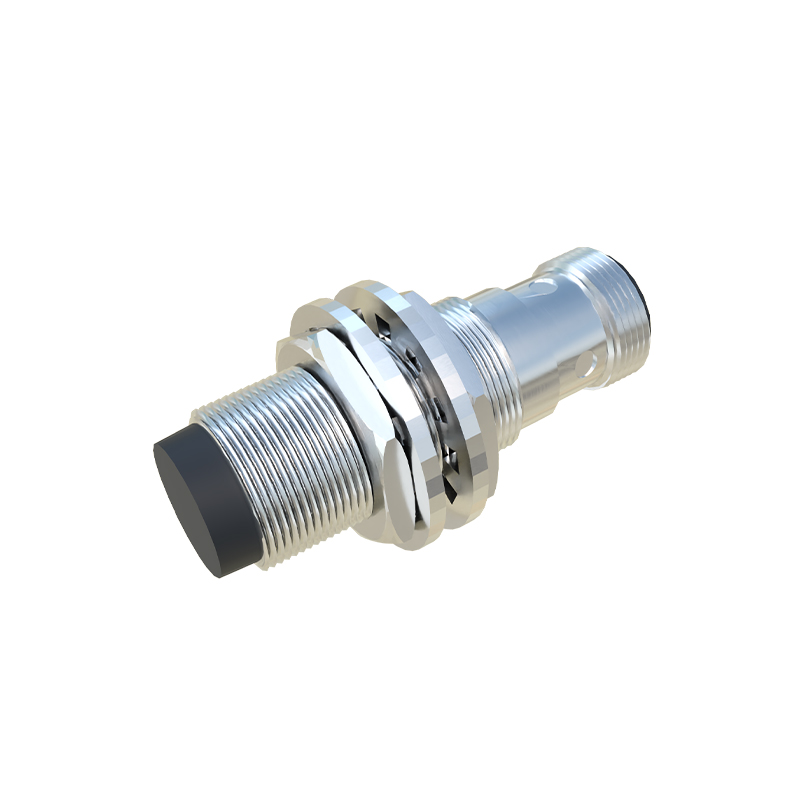
Several key advantages make two-wire sensors a preferred choice in many scenarios. Their primary benefit is the simplified installation process, which minimizes labor and material expenses. They are often more compact due to the reduced internal circuitry needed for separate power and signal lines. Furthermore, their series connection makes them inherently safe against short circuits to the power supply. For AC-powered versions, they offer the convenience of direct connection to standard line voltage without requiring a separate DC power source. However, designers must be mindful of their characteristics. Two-wire sensors have a residual voltage drop (typically 2-5V) when in the "ON" state, which must be considered to ensure the load receives sufficient voltage. They also have a small leakage current in the "OFF" state, which must be below the holding current of any connected relay to prevent unintended activation.
The applications for two-wire proximity sensors are vast and span numerous industries. They are extensively used for basic presence/absence detection in material handling, packaging machinery, and automotive assembly lines. Common tasks include counting objects on a conveyor, detecting the end position of a cylinder, verifying the closure of a safety gate, or confirming the presence of a part before a machining operation begins. Their robust construction, often featuring nickel-plated brass or stainless-steel housings with IP67 or higher ingress protection ratings, makes them suitable for harsh environments with dust, moisture, or vibration.

Selecting the appropriate two-wire proximity sensor requires careful consideration of several parameters. First, the operating voltage (DC or AC) must match the available control circuit power. The sensing distance, or nominal range, must be suitable for the application, keeping in mind that factors like target material, size, and shape can affect actual performance. The sensor's housing style (e.g., cylindrical, rectangular, or ring-shaped) and size must fit the mechanical constraints. The switching frequency defines how quickly the sensor can detect successive targets. For DC sensors, the polarity (typically PNP or NPN in a two-wire context relates to the switching logic) and the type of output (normally open or normally closed) must align with the control system's requirements. Finally, environmental conditions such as temperature extremes, potential for chemical exposure, or presence of strong electromagnetic fields must be factored into the choice of housing material and shielding.
In conclusion, the two-wire proximity sensor represents an elegant fusion of simplicity, reliability, and functionality. Its straightforward integration into existing control circuits makes it an indispensable tool for engineers seeking efficient and economical solutions for object detection. By understanding its operating principles, acknowledging its specific electrical characteristics, and carefully matching its specifications to the application needs, professionals can leverage this technology to enhance the performance and reliability of countless automated systems.