In the realm of industrial automation, where reliability and precision are paramount, inductive proximity sensors stand as a cornerstone technology. These non-contact electronic devices are engineered to detect the presence or absence of metallic objects without any physical contact, making them indispensable for countless control, counting, positioning, and safety applications. Their robust construction and consistent performance in harsh environments have solidified their role as a fundamental component in modern manufacturing, packaging, and material handling systems.
The operating principle of an inductive proximity sensor is elegantly rooted in electromagnetic induction. At its core, the sensor contains an oscillator circuit that generates a high-frequency alternating magnetic field via a coil wound around a ferrite core at the sensing face. When a metallic object (the "target") enters this oscillating field, eddy currents are induced on the surface of the target. These eddy currents draw energy from the oscillator, causing a measurable change in its amplitude. An integrated evaluation circuit detects this amplitude change and triggers a solid-state output switch, signaling the presence of the object. It is crucial to note that these sensors are primarily designed for ferrous metals like steel and iron, which cause the strongest reaction. However, they can also detect non-ferrous metals such as aluminum, brass, and copper, albeit with a reduced sensing range, often specified by a correction factor.
Key performance specifications define the selection and application of these sensors. The "nominal sensing distance" (Sn) is a standardized value under defined conditions and does not account for manufacturing tolerances or environmental factors. For practical installation, the "usable sensing distance" (Su) is typically 0.9 times Sn. To ensure reliable operation and avoid damage, the "assured operating distance" (Sa) is set at 0.81 times Sn, guaranteeing switching within this range. The "repeatability" specification indicates the sensor's precision in consistently detecting a target at the same point. Other critical parameters include switching frequency (how many on/off cycles per second), hysteresis (the difference between the switch-on and switch-off points to prevent chatter), and environmental ratings like IP (Ingress Protection) for dust/water resistance and temperature range.
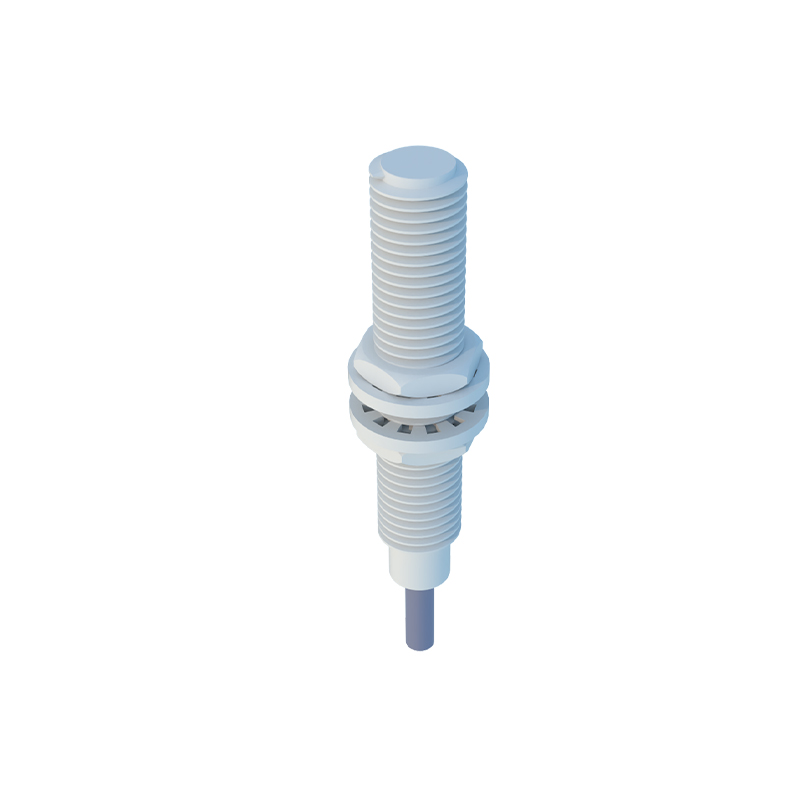
The advantages of inductive proximity sensors are numerous. Their solid-state, wear-free operation ensures a long service life, as there are no moving parts to degrade. They offer high switching speeds and frequencies, suitable for high-speed counting tasks. Their insensitivity to many environmental contaminants like dust, oil, and moisture (when properly housed) makes them ideal for dirty industrial settings. Furthermore, they are resistant to vibration and shock. Common housing materials include nickel-plated brass, stainless steel, or PBT plastic, offering varying degrees of chemical and mechanical resilience.
Applications are vast and varied. They are used for simple part detection on conveyor lines, precise positioning in machine tools (e.g., checking if a drill is in the home position), monitoring the end positions of cylinders, counting metal parts, and ensuring safety in automated systems by verifying the closure of guards or doors. Cylindrical sensors (e.g., M8, M12, M18, M30 threaded barrels) are the most common, while rectangular and ring-shaped formats serve specialized needs, such as detecting all four corners of a metal pallet or sensing the break in a metal wire.
When selecting an inductive proximity sensor, engineers must consider several factors: the target material and size (which affect the sensing range), the required sensing distance, the output type (PNP vs. NPN, NO vs. NC, compatible with the PLC or controller), the electrical connection (pre-wired cable or quick-disconnect), the housing style and size for mounting constraints, and the environmental conditions (temperature, presence of coolants, washdown requirements). Adherence to installation guidelines is essential; maintaining the proper lateral and axial spacing between sensors prevents mutual interference, and ensuring the target approaches the sensing face correctly optimizes performance.
In conclusion, inductive proximity sensors are a mature, reliable, and versatile solution for metallic object detection. Their fundamental electromagnetic principle translates into a robust performance that automation engineers rely on daily. A thorough understanding of their specifications, limitations, and correct application practices is key to designing efficient, reliable, and safe automated systems. As Industry 4.0 and smart manufacturing evolve, these sensors continue to be integral, often now featuring IO-Link connectivity for advanced diagnostics and parameterization, bridging the gap between simple binary sensing and the data-rich world of industrial IoT.