In the realm of precision measurement and industrial automation, laser displacement sensors have emerged as indispensable tools. These non-contact devices provide high-accuracy, high-speed measurements critical for quality control, process monitoring, and robotic guidance. This article delves into the operating principles, various types, and key application areas of these sophisticated sensors, offering insights for engineers and technicians integrating them into modern systems.
The fundamental principle behind a laser displacement sensor is triangulation. A laser diode projects a focused beam of light onto the target surface. The reflected light, scattered from the point of incidence, is then captured by a receiving lens and focused onto a position-sensitive detector, typically a CCD or CMOS linear array. As the target's distance changes, the position of the reflected light spot shifts on the detector. By precisely calculating this shift using trigonometric principles, the sensor's internal processor determines the exact distance to the target with remarkable resolution, often in the micron or sub-micron range. This method allows for measurements independent of the target's material, color, or surface texture, though highly reflective or transparent surfaces may require specific sensor models or surface treatment.

Several key types of laser displacement sensors cater to different measurement needs. The most common is the standard triangulation sensor, ideal for short to medium ranges with high accuracy. For applications requiring measurements over longer distances or on difficult surfaces, confocal sensors use a different optical principle, offering excellent performance on transparent or glossy materials. Another variant is the laser profile sensor, which projects a laser line instead of a single spot, capturing a 2D or 3D cross-sectional profile of an object for dimensional inspection and shape analysis. Time-of-flight (ToF) laser sensors, which measure the round-trip time of a laser pulse, are used for much longer ranges but with typically lower resolution compared to triangulation-based models.
The selection of a laser displacement sensor depends on multiple parameters. Measurement range defines the minimum and maximum distances over which the sensor can operate accurately. Resolution indicates the smallest detectable change in distance. Repeatability is the sensor's ability to produce the same result under unchanged conditions. Spot size, the diameter of the laser beam on the target, affects measurement stability on rough surfaces. Finally, sampling speed, or response frequency, determines how quickly the sensor can take measurements, a critical factor for high-speed production lines.
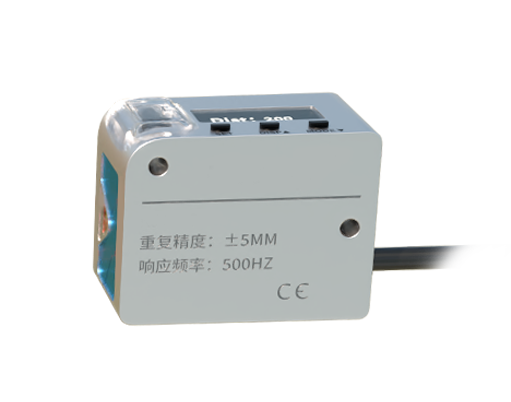
Industrial applications for laser displacement sensors are vast and varied. In automotive manufacturing, they measure body panel gaps, inspect weld seams, and control robot positioning for assembly. In electronics, they verify component coplanarity, measure solder paste height, and inspect micro-structures. The metal processing industry relies on them for thickness gauging, vibration analysis, and surface defect detection. In pharmaceutical and packaging, they ensure fill levels, check seal integrity, and verify package dimensions. Furthermore, they are pivotal in robotics for precise object detection and guidance, enabling adaptive and flexible automation.
When integrating a laser displacement sensor, environmental considerations are paramount. Ambient light, particularly strong infrared or direct sunlight, can interfere with the sensor's laser. Dust, oil mist, or steam in the environment may require sensors with higher IP ratings for protection. Vibrations can be mitigated with proper mounting. For optimal performance, careful alignment, stable mounting, and consideration of the target's surface properties are essential. Many modern sensors come with advanced features like digital interfaces (EtherCAT, EtherNet/IP, PROFINET), built-in controllers, and sophisticated software for data logging, analysis, and integration into broader control systems.

In conclusion, laser displacement sensors are a cornerstone technology for non-contact metrology. Their ability to deliver fast, precise, and reliable distance measurements makes them vital for enhancing productivity, ensuring quality, and enabling advanced automation across countless industries. As technology advances, we can expect even smaller form factors, higher speeds, smarter onboard processing, and greater robustness, further expanding their role in the factories and laboratories of the future.