In the intricate world of industrial automation and safety systems, sensor technology serves as the foundational nervous system. Among the diverse array of sensing solutions, the normally closed (NC) laser sensor represents a sophisticated and highly reliable category. This article delves into the operational principles, key applications, and distinct advantages of normally closed laser sensors, providing a comprehensive overview for engineers and system integrators.
At its core, a normally closed laser sensor operates on a fundamental electrical configuration. The term "normally closed" refers to the state of its output signal circuit under nominal, non-actuated conditions. In an NC configuration, the output circuit is closed, allowing current to flow continuously when the sensor is in its resting state—that is, when the laser beam is uninterrupted and the target is not present at the sensing point. When the laser beam is broken or the target is detected, the sensor actuates, opening the output circuit and stopping the current flow. This behavior is the inverse of a normally open (NO) sensor. This design principle is intrinsically linked to fail-safe considerations, a critical aspect in industrial environments.
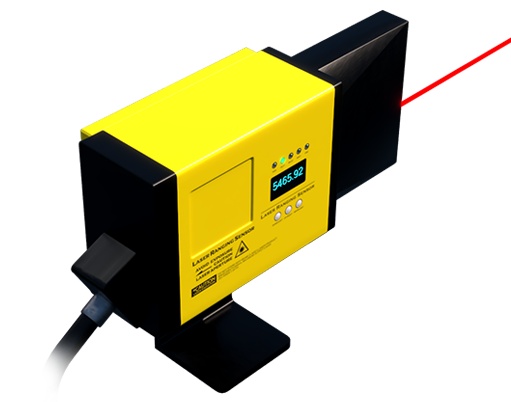
The operational mechanism combines this electrical logic with precise optical technology. A typical NC laser sensor comprises a laser emitter, a receiver, and control electronics. The emitter projects a highly focused, coherent beam of light towards the receiver. Under normal conditions, this beam is received continuously, maintaining the closed circuit. The moment an object intercepts this beam, the receiver detects the loss of signal, triggering the internal switch to change state and open the output circuit. Modern variants often incorporate modulated laser light to combat ambient light interference and ensure high stability. Advanced models feature background suppression technology, allowing them to ignore reflections from distant surfaces and only react to objects within a precise, predefined range.
The applications for normally closed laser sensors are vast and critical, particularly where safety and reliable detection are paramount. One of the most significant uses is in safety light curtains and perimeter guarding systems for hazardous machinery. In these setups, an array of NC laser beams creates an invisible protective screen. As long as all beams are unbroken (circuit closed), the machine operates. If a person or object breaks any beam (circuit opens), an immediate stop signal is sent to the machine's controller, ensuring operator safety. This fail-safe design ensures that a wire break or power loss to the sensor also results in an open circuit, triggering a safe shutdown.

Beyond safety, NC laser sensors are indispensable in material handling and packaging. They are used for precise object detection on high-speed conveyor lines, jam detection in automated assembly processes, and verifying the presence of components. In cleanroom environments or applications involving small, delicate parts, the non-contact nature of laser sensing prevents contamination or damage. They are also deployed in registration control, ensuring labels or products are correctly positioned before a subsequent operation like printing or sealing.
The advantages of opting for a normally closed laser sensor are compelling. The foremost benefit is enhanced fail-safe operation. In critical safety applications, it is often safer to design a system where a fault condition (like a broken wire, sensor failure, or loss of power) causes the output to go to the "off" or "alarm" state. The NC configuration naturally provides this, as any disruption in the sensor's normal operation typically opens the circuit. This aligns with safety standards that mandate fail-safe design for protective devices.
Secondly, these sensors offer exceptional precision and range. Laser beams can be focused to a very small spot, enabling the detection of minute objects or precise edge positioning over longer distances compared to standard photoelectric or ultrasonic sensors. This allows for flexible mounting and reliable performance in complex layouts. Furthermore, their response time is extremely fast, making them suitable for high-speed production lines where milliseconds count.

When integrating normally closed laser sensors, several best practices must be observed. Correct alignment between the emitter and receiver is crucial for reliable operation; even slight misalignment can cause intermittent failures. The sensing environment must be evaluated for potential optical obstructions, dust, fog, or highly reflective surfaces that could affect performance. Selecting the appropriate sensing range, output type (e.g., PNP/NPN), and housing rating (IP67 for washdown environments) is essential. Finally, the NC output must be correctly interpreted by the programmable logic controller (PLC) or safety relay. The logic programming must account for the fact that an active detection event corresponds to an open circuit (loss of signal), which is a fundamental difference from NO sensor wiring.
In conclusion, normally closed laser sensors are a pivotal technology bridging high-precision detection with inherent safety-oriented design. Their principle of operation—where a broken beam opens a circuit—makes them the default choice for protective systems and reliable automation tasks where failure must lead to a safe state. As automation evolves towards greater intelligence and safety integration, understanding and effectively implementing normally closed laser sensors remains a critical competency for engineers designing the robust and efficient industrial systems of today and tomorrow.