In the realm of industrial automation and control systems, the 12V proximity sensor stands as a fundamental and versatile component. Its primary function is to detect the presence or absence of an object within its sensing range without any physical contact. Operating on a 12-volt DC power supply—a standard in many automotive, packaging, material handling, and assembly line applications—these sensors offer a reliable and efficient solution for position sensing, counting, and object detection tasks.
The core principle behind an inductive proximity sensor, the most common type for metallic object detection, is electromagnetic induction. The sensor generates a high-frequency oscillating electromagnetic field from its active face. When a conductive metal target enters this field, eddy currents are induced on the target's surface. This causes a change in the oscillation amplitude within the sensor's internal LC tank circuit. This change is detected by the sensor's circuitry, which then triggers a solid-state output switch. For detecting non-metallic objects, such as plastics, wood, or liquids, capacitive proximity sensors are used, which operate on a similar principle but respond to changes in capacitance.
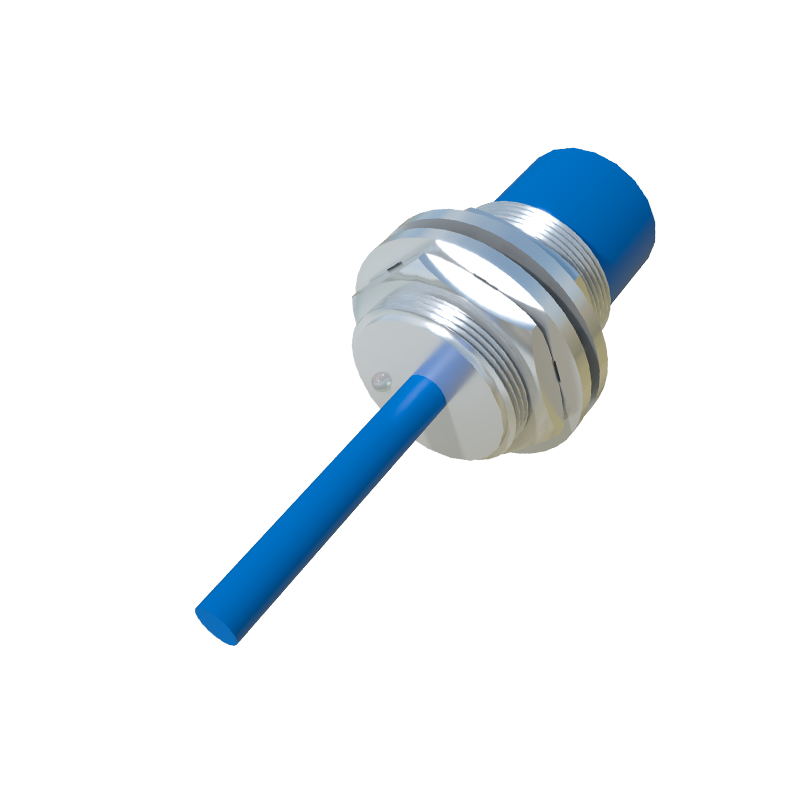
A 12V DC proximity sensor typically features three wires: brown for the positive supply (12V DC), blue for the common negative or ground (0V), and black for the switched output. The output can be either NPN (sinking) or PNP (sourcing). An NPN sensor switches the negative (ground) line to the load, common in Asian and some European designs, while a PNP sensor switches the positive voltage line to the load, prevalent in North America and Europe. Understanding this distinction is critical for proper integration with Programmable Logic Controllers (PLCs) and other control devices to avoid incorrect wiring and potential damage.
The advantages of using a 12V DC power specification are numerous. It aligns perfectly with standard industrial control voltages, allowing for easy integration into existing 12V/24V DC control panels. It is considered a safe low voltage, reducing risks associated with electrical shock during installation and maintenance. Furthermore, 12V DC systems are less susceptible to electrical noise compared to higher voltage AC systems, leading to more stable and reliable sensor operation in electrically noisy industrial environments.
When selecting a 12V proximity sensor for a specific application, several key parameters must be considered. The sensing range, typically specified in millimeters, indicates the maximum distance at which the sensor can reliably detect a standard target. The housing material, such as nickel-plated brass, stainless steel, or PBT plastic, must be chosen based on the environmental conditions, including exposure to chemicals, washdowns, or physical impact. The output configuration (NPN/PNP, normally open/closed) must match the input requirements of the controller. Additionally, factors like switching frequency (response speed), temperature range, and protection ratings (e.g., IP67 for dust and temporary immersion protection) are vital for ensuring long-term reliability.
Common applications for 12V proximity sensors are extensive. They are used for end-of-travel detection on pneumatic cylinders, part presence verification on conveyor belts, rotary speed monitoring via gear tooth sensing, and precise positioning in machine tools. In automotive manufacturing, they ensure components are correctly positioned for robotic welding or assembly. Their non-contact nature ensures no wear and tear on the sensor or the target, leading to a virtually maintenance-free operation with a long operational lifespan.
Installation and wiring require attention to detail. Sensors should be mounted securely to prevent vibration from affecting performance. It is crucial to maintain the recommended lateral and axial distances between multiple sensors to prevent mutual interference, a phenomenon known as "crosstalk." Always refer to the manufacturer's datasheet for specific mounting clearances. The load (e.g., a PLC input) should be connected in series with the sensor's output. For an NPN sensor, the load is connected between the output (black wire) and the positive supply; for a PNP sensor, the load is connected between the output and ground.
Troubleshooting typically involves checking the power supply with a multimeter to ensure a steady 12V DC, verifying the wiring against the sensor's diagram, and confirming that the target object is within the specified sensing range and is of the correct material. An LED indicator, present on most modern sensors, provides immediate visual feedback on power status and output switching.
In conclusion, the 12V DC proximity sensor is an indispensable workhorse in industrial automation. Its robustness, reliability, and compatibility with standard control voltages make it a preferred choice for engineers and technicians worldwide. By understanding its operating principles, specifications, and correct application practices, one can effectively leverage this technology to enhance the efficiency, safety, and precision of automated systems.